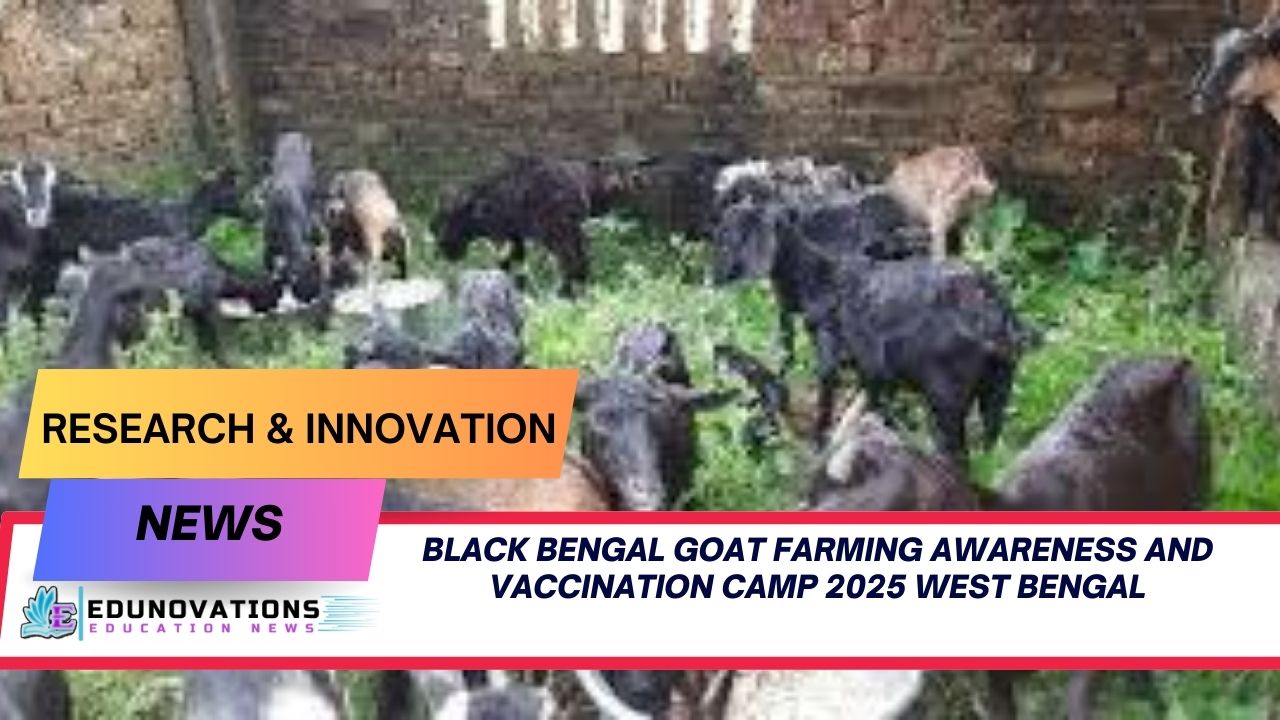
Black Bengal goat farming awareness and vaccination camp 2025 West Bengal strengthens tribal livelihoods through scientific livestock support, training, and animal health initiatives.
Sustainable livestock practices are increasingly becoming a cornerstone of rural development in India, especially in regions where agriculture alone cannot ensure stable incomes. In this context, the Black Bengal goat farming awareness and vaccination camp 2025 West Bengal has emerged as a significant intervention aimed at empowering tribal and marginal farming communities through scientific animal husbandry practices.
Organised with a focus on integrated livestock development, the initiative highlights how targeted veterinary support, farmer training, and awareness programmes can enhance income security, food availability, and resilience among rural households. The programme aligns closely with national goals of doubling farmers’ income, promoting women-led enterprises, and ensuring sustainable livestock productivity in tribal belts.
Strengthening Tribal Livelihoods Through Livestock Development
Livestock rearing has long been an integral part of rural economies in eastern India. In districts such as South 24 Parganas, where landholdings are small and climatic vulnerabilities are high, small ruminants and poultry often act as a financial safety net for families.
The Black Bengal goat, in particular, is valued for its adaptability, high meat quality, and low maintenance requirements. Similarly, ducks such as the Chara Chambeli breed are well-suited to wetland ecosystems, making them ideal for coastal and semi-coastal regions of West Bengal.
The Black Bengal goat farming awareness and vaccination camp 2025 West Bengal focuses on harnessing these local strengths by combining traditional knowledge with modern veterinary science.
Integrated Approach to Goat and Duck Farming
One of the distinguishing features of the initiative is its emphasis on integrated farming systems. Rather than promoting a single livestock species, the programme encourages farmers to adopt a mixed model that includes goats and ducks.
This approach offers several advantages:
- Diversified income sources reduce economic risk
- Efficient use of natural resources such as grazing land and water bodies
- Improved household nutrition through meat and eggs
- Better resilience against disease outbreaks affecting a single species
Through structured demonstrations and field interactions, participants were introduced to goat–duck integrated farming training for tribal farmers in South 24 Parganas, a model that has shown promising results in similar agro-ecological zones.
Focus on Animal Health and Preventive Care
Disease remains one of the biggest threats to small livestock farmers. Unchecked infections can wipe out entire herds, pushing families into debt. Recognising this challenge, the Black Bengal goat farming awareness and vaccination camp 2025 West Bengal placed strong emphasis on preventive healthcare.
Veterinary experts conducted:
- Systematic vaccination of goats against common diseases
- Health check-ups and deworming sessions
- Awareness talks on early disease symptoms
- Guidance on hygiene and housing management
These scientific livestock farming workshops and animal health camps in rural Bengal aim to shift farmers from reactive treatment to preventive care, significantly reducing mortality rates and improving productivity.
Training and Capacity Building for Farmers
Beyond vaccinations, the programme invested heavily in knowledge dissemination. Many smallholders lack access to formal training, relying instead on inherited practices that may no longer be effective in changing climatic and economic conditions.
Training modules covered:
- Scientific feeding practices for goats and ducks
- Importance of balanced nutrition and mineral supplementation
- Breeding management and selection of healthy stock
- Cost-effective housing designs using local materials
- Market linkages and value addition opportunities
Such capacity-building efforts ensure that the impact of the Black Bengal goat farming awareness and vaccination camp 2025 West Bengal extends well beyond a single event.
Empowering Women Through Livestock Enterprises
Women play a central role in livestock management in tribal and rural households. Recognising this, the initiative actively encouraged women’s participation, particularly through targeted support measures.
Special emphasis was placed on Chara Chambeli duckling distribution and goat feed support for women farmers, enabling them to start or expand small livestock units with minimal upfront investment.
Experts noted that women-led livestock enterprises often result in:
- Better animal care and hygiene
- Improved household nutrition
- Greater reinvestment of income into education and health
- Enhanced decision-making power for women
The programme thus contributes directly to gender empowerment alongside economic development.
Livelihood Security for Tribal Communities
For tribal families facing irregular income and limited employment opportunities, livestock rearing offers year-round economic activity. The livelihood support programs for tribal women through goat and duck rearing showcased during the initiative demonstrate how small interventions can create sustainable income streams.
By combining training, input support, and veterinary services, the Black Bengal goat farming awareness and vaccination camp 2025 West Bengal addresses multiple constraints simultaneously. This integrated approach is critical for long-term success in tribal development initiatives.
Expert Insights on Sustainable Livestock Practices
Veterinary scientists and rural development experts involved in the programme highlighted the importance of region-specific livestock strategies. According to experts, indigenous breeds like the Black Bengal goat are naturally resilient but require scientific management to reach their full potential.
They emphasised that:
- Preventive healthcare can reduce livestock losses by up to 30–40%
- Balanced feeding improves growth rates and reproductive efficiency
- Integrated farming enhances overall farm sustainability
Such expert perspectives reinforce the value of awareness and vaccination camps as scalable models for rural development.
Alignment with National Livestock Development Goals
The initiative aligns closely with broader national priorities, including sustainable agriculture, nutritional security, and inclusive growth. Programmes promoting scientific livestock practices support India’s efforts to strengthen the rural economy while ensuring environmental sustainability.
The Black Bengal goat farming awareness and vaccination camp 2025 West Bengal also complements ongoing efforts to modernise animal husbandry through technology adoption, farmer education, and institutional support.
Role of Awareness in Long-Term Impact
Awareness programmes are often underestimated, yet they play a critical role in behavioural change. By educating farmers about disease prevention, nutrition, and market dynamics, such initiatives create informed stakeholders capable of making better decisions.
The success of the Black Bengal goat farming awareness and vaccination camp 2025 West Bengal underscores the need for continuous engagement rather than one-time interventions.
Digital Learning and Exam-Oriented Resources
Students preparing for competitive examinations can benefit from understanding such real-world development initiatives. For concept clarity and exam preparation, learners can explore:
- NCERT Courses: https://courses.edunovations.com/
- Current Affairs: https://edunovations.com/currentaffairs/
- Notes: https://edunovations.com/notes/
- MCQs: https://edunovations.com/mcq/
- Videos: https://edunovations.com/videos/
- Syllabus: https://edunovations.com/syllabus/
- Free NCERT PDFs and Mind Maps: https://courses.edunovations.com/shop-2/
These resources help students connect policy initiatives with syllabus-based learning.
Technology and Outreach Support
Effective dissemination of such programmes also depends on digital infrastructure and outreach platforms. Educational institutions and rural organisations seeking professional web solutions can explore services from Mart Ind Infotech, a technology partner supporting institutional visibility and communication.
Future Outlook for Livestock-Based Livelihoods
As climate uncertainties increase, diversified farming systems will become even more important. Programmes like the Black Bengal goat farming awareness and vaccination camp 2025 West Bengal offer a replicable model for other regions with similar socio-economic conditions.
With sustained policy support, expert guidance, and community participation, livestock-based livelihoods can significantly contribute to rural prosperity.
Toppers Use Mind Maps to score more than 95%
NCERT Class 11th Commerce Mind Maps
Add to cartOriginal price was: ₹999.00.₹199.00Current price is: ₹199.00.NCERT Class 12th Chemistry Mind Maps
Add to cartOriginal price was: ₹199.00.₹75.00Current price is: ₹75.00.NCERT Class 12th Commerce Mind Maps
Add to cartOriginal price was: ₹999.00.₹199.00Current price is: ₹199.00.NCERT Class 12th Science Mind Maps
Add to cartOriginal price was: ₹999.00.₹199.00Current price is: ₹199.00.NCERT Mind Maps For Class 10th
Add to cartOriginal price was: ₹999.00.₹199.00Current price is: ₹199.00.





Purchase Today
Frequently Asked Questions (FAQs)
1. What is the Black Bengal goat farming awareness and vaccination camp 2025 West Bengal?
It is a livestock development initiative focusing on vaccination, training, and awareness to improve goat and duck farming practices among tribal communities.
2. Why is Black Bengal goat farming important for rural livelihoods?
Black Bengal goats are hardy, low-maintenance, and highly valued for meat quality, making them ideal for small and marginal farmers.
3. How does goat–duck integrated farming benefit tribal farmers in South 24 Parganas?
It diversifies income, improves resource utilisation, and enhances nutritional security through multiple livestock products.
4. What role do animal health camps play in livestock sustainability?
They reduce disease outbreaks, lower mortality rates, and improve overall productivity through preventive care.
5. How does Chara Chambeli duckling distribution support women farmers?
It provides women with an affordable entry into poultry farming, strengthening household income and empowerment.
6. What training is provided under scientific livestock farming workshops in rural Bengal?
Farmers receive guidance on feeding, breeding, housing, disease prevention, and market access.
7. How do livelihood support programs for tribal women through goat and duck rearing work?
They combine input support, training, and veterinary services to create sustainable income opportunities.
8. Are such livestock awareness camps aligned with national development goals?
Yes, they support sustainable agriculture, women empowerment, and rural economic growth.
9. Can students use this topic for competitive exam preparation?
Absolutely, as it relates to agriculture, rural development, animal husbandry, and current affairs.
10. Can similar livestock models be replicated in other regions?
Yes, with local adaptation, integrated goat and duck farming models can be scaled across suitable regions.