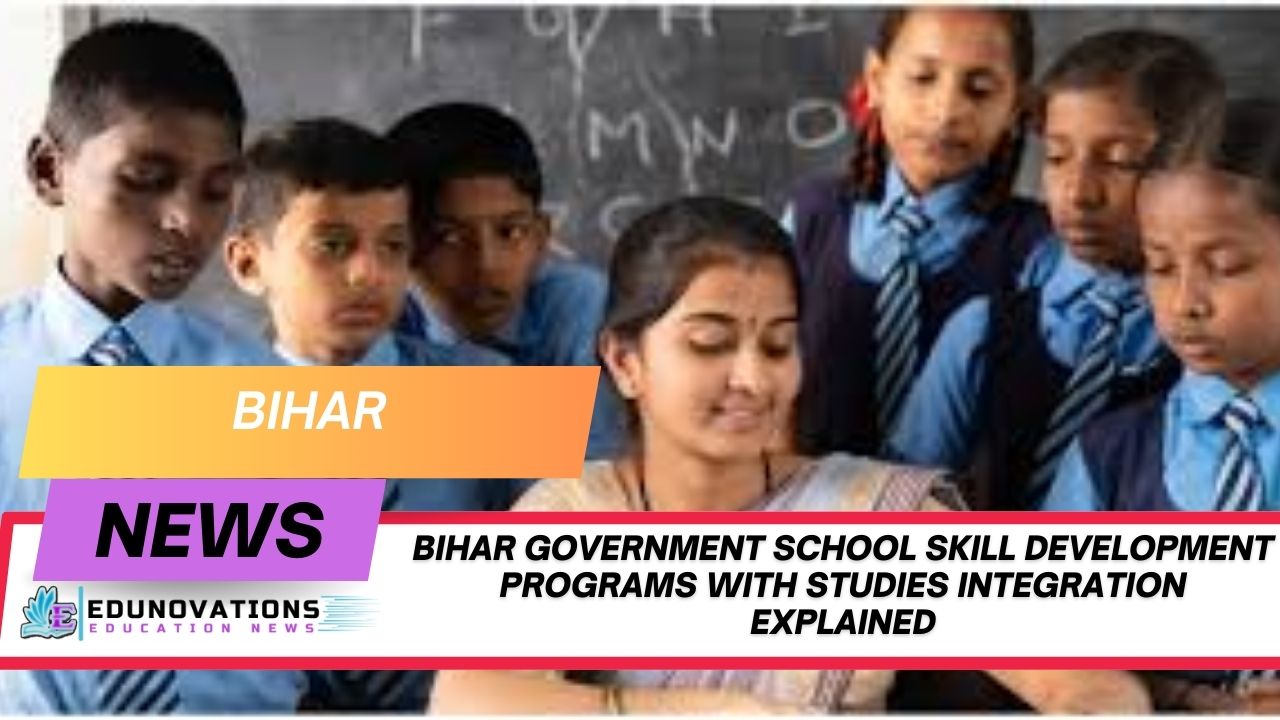
Bihar government school skill development programs with studies integration aim to equip students with vocational skills alongside academics under NEP 2020.
The Bihar government school skill development programs with studies integration mark a significant shift in the state’s approach to secondary education. In a move aligned with the National Education Policy (NEP) 2020, the Bihar government has initiated a structured plan to introduce vocational and employability skills alongside regular academic curricula in government schools. The initiative is expected to bridge the long-standing gap between classroom education and real-world job readiness for students studying in Classes 9 to 12.
Education experts believe that the Bihar government school skill development programs with studies integration could play a transformative role in reducing dropout rates, improving employability, and supporting self-employment among students from economically weaker backgrounds. The policy signals a shift from rote learning to outcome-based education that prepares students for both higher education and the workforce.
Transforming Secondary Education in Bihar
For decades, government schools in Bihar have largely focused on textbook-centric learning. While academic performance has improved in recent years, employability outcomes remained a concern. The Bihar government school skill development programs with studies integration aim to address this challenge by introducing structured vocational modules without compromising core academic subjects.
Under this initiative, students will receive exposure to practical skills during school hours, ensuring that vocational education becomes a part of mainstream schooling rather than an optional add-on. The integration ensures students do not feel overburdened while gaining industry-relevant competencies.
Alignment With National Education Policy 2020
The Bihar government school skill development programs with studies integration directly reflect the vision laid out in NEP 2020, which emphasizes experiential learning, multidisciplinary education, and early exposure to vocational skills.
NEP 2020 recommends that at least 50 percent of learners should have exposure to vocational education by 2025. Bihar’s initiative positions the state among early adopters of this national vision. Education analysts note that embedding vocational training at the school level will create smoother transitions into higher education, skill universities, and employment pathways.
Former Union Education Minister Ramesh Pokhriyal ‘Nishank’, while discussing NEP implementation earlier, highlighted that “skill-based learning integrated with academics is essential to make India’s youth globally competitive.” His remarks underline the relevance of Bihar’s education reforms.
Pilot Implementation Across Select Districts
The initial rollout of the Bihar government school skill development programs with studies integration is being conducted as a pilot across select districts. These districts were chosen based on infrastructure readiness, availability of trained instructors, and student enrollment capacity.
The pilot phase focuses on evaluating:
- Student adaptability to vocational learning
- Teacher readiness and training effectiveness
- Infrastructure sufficiency
- Industry relevance of skill modules
Once feedback is collected and analyzed, the program is expected to be expanded statewide in phases.
Vocational Modules Introduced for Students
One of the key highlights of the Bihar government school skill development programs with studies integration is the range of vocational modules introduced for secondary school students. These modules are designed to offer practical exposure while remaining age-appropriate and academically aligned.
Key vocational areas include:
- Electrical and electronics fundamentals
- Plumbing and basic construction skills
- Information technology and digital literacy
- Retail and service sector skills
- Basic entrepreneurship and financial literacy
Education planners have ensured that these modules complement academic subjects like science, mathematics, and social studies rather than replacing them.
Focus on Classes 9 to 12
The Bihar government school skill development programs with studies integration primarily target students from Classes 9 to 12, a crucial stage where students begin making career-defining decisions. This age group benefits most from early exposure to practical skills, helping them identify interests beyond conventional academic streams.
Students completing secondary education will now possess:
- Foundational vocational skills
- Awareness of career pathways
- Confidence for self-employment or skill-based jobs
- Readiness for higher education and professional courses
Experts believe that this dual-learning approach will reduce dependency on private coaching institutes and post-school skill centers.
Teacher Training and Capacity Building
Successful implementation of the Bihar government school skill development programs with studies integration depends heavily on teacher preparedness. The state government has emphasized structured teacher training programs to equip educators with the necessary skills to deliver vocational content effectively.
Teacher capacity-building initiatives include:
- Orientation programs on vocational pedagogy
- Industry exposure visits
- Digital training modules
- Continuous professional development workshops
According to education specialists, teacher involvement is critical in ensuring that vocational learning is not treated as secondary to academics.
Industry Linkages and Skill Relevance
To maintain relevance, the Bihar government school skill development programs with studies integration emphasize industry-aligned curriculum design. Skill modules are being mapped to current market requirements, ensuring students gain competencies that are in demand.
Policy advisors note that linking school education with industry needs is essential for:
- Reducing youth unemployment
- Supporting local economic development
- Encouraging entrepreneurship in rural areas
Such alignment also opens doors for apprenticeships, internships, and certification pathways in the future.
Career Guidance and Self-Employment Focus
A major objective of the Bihar government school skill development programs with studies integration is to provide structured career guidance to students. Career counseling sessions are planned to help students understand how academic learning connects with vocational skills.
This focus on career planning encourages:
- Informed subject selection
- Awareness of vocational career options
- Motivation toward self-employment and startups
- Reduced pressure to pursue limited conventional career paths
Education reformers argue that career guidance at the school level is essential to reduce post-school confusion among students.
Addressing Dropout Rates and Employability
One of the anticipated outcomes of the Bihar government school skill development programs with studies integration is a reduction in school dropout rates. When students perceive education as directly linked to employment opportunities, engagement levels increase significantly.
Data from national education surveys indicate that skill-linked education improves:
- Student retention
- Learning outcomes
- Economic participation after schooling
Bihar’s initiative is expected to particularly benefit students from rural and economically disadvantaged communities.
Expert Insights on Skill-Integrated Education
Education economist Dr. Jandhyala B. G. Tilak, known for his work on education policy, has previously emphasized that “vocational education integrated into mainstream schooling is key to inclusive growth.” His observations resonate strongly with the goals of the Bihar government school skill development programs with studies integration.
Similarly, former NITI Aayog CEO Amitabh Kant has highlighted the need for India’s education system to focus on skills that align with emerging industries. These expert perspectives reinforce the importance of Bihar’s education reforms.
Digital Support and Learning Resources
To strengthen learning outcomes, digital platforms and supplementary resources are being leveraged alongside the Bihar government school skill development programs with studies integration. Students and teachers can access academic and vocational learning materials through trusted educational platforms.
Relevant internal learning resources include:
- NCERT Courses for curriculum alignment
- Current Affairs sections for exam relevance
- Subject-wise notes and MCQs for assessment
- Video lectures for conceptual clarity
- Syllabus and free NCERT PDF downloads for structured learning
These resources ensure that students receive holistic support throughout their academic and vocational journey.
Infrastructure and School Readiness
Infrastructure development plays a crucial role in the success of the Bihar government school skill development programs with studies integration. Schools participating in the pilot have been assessed for classroom space, electrical facilities, digital equipment, and safety standards.
Authorities have indicated that infrastructure gaps identified during the pilot phase will be addressed before statewide expansion. This phased approach ensures sustainability and quality control.
Long-Term Impact on Bihar’s Education Ecosystem
The Bihar government school skill development programs with studies integration are expected to have long-term implications beyond immediate academic outcomes. Over time, the initiative could reshape Bihar’s workforce, strengthen local economies, and improve human capital development.
Anticipated long-term benefits include:
- Increased employability among school graduates
- Growth of local entrepreneurship
- Reduced migration for low-skill jobs
- Enhanced perception of government schools
Policy analysts view this initiative as a model that other states could replicate.
Challenges and Way Forward
Despite its promise, the Bihar government school skill development programs with studies integration face challenges such as:
- Ensuring uniform quality across districts
- Sustaining teacher motivation
- Regular curriculum updates
- Monitoring learning outcomes
Education officials have acknowledged these challenges and emphasized continuous evaluation, stakeholder feedback, and policy refinement.
Conclusion
The Bihar government school skill development programs with studies integration represent a bold and necessary step toward modernizing school education in the state. By embedding vocational skills within the academic framework, Bihar is empowering students with practical competencies, career awareness, and economic resilience.
As the program expands beyond the pilot phase, its success will depend on effective implementation, teacher engagement, and industry alignment. If executed well, this initiative could redefine the future of government school education in Bihar and serve as a national benchmark for skill-integrated learning.
Toppers Use Mind Maps to score more than 95%
NCERT Class 11th Commerce Mind Maps
Add to cartOriginal price was: ₹999.00.₹199.00Current price is: ₹199.00.NCERT Class 12th Chemistry Mind Maps
Add to cartOriginal price was: ₹199.00.₹75.00Current price is: ₹75.00.NCERT Class 12th Commerce Mind Maps
Add to cartOriginal price was: ₹999.00.₹199.00Current price is: ₹199.00.NCERT Class 12th Science Mind Maps
Add to cartOriginal price was: ₹999.00.₹199.00Current price is: ₹199.00.NCERT Mind Maps For Class 10th
Add to cartOriginal price was: ₹999.00.₹199.00Current price is: ₹199.00.




Purchase Today
FAQs
1. What are Bihar government school skill development programs with studies integration?
They are initiatives to combine vocational skill training with regular academic education in Bihar government schools.
2. Which classes are covered under Bihar government school skill development programs with studies integration?
The program mainly targets students from Classes 9 to 12.
3. How does this initiative align with NEP 2020?
It follows NEP 2020’s recommendation to integrate vocational education into mainstream schooling.
4. What skills are taught under this program?
Students learn technical, digital, entrepreneurial, and service-sector skills.
5. Will academics be affected by skill training?
No, the Bihar government school skill development programs with studies integration are designed to complement academics.
6. Is the program implemented statewide?
Currently, it is being piloted in selected districts before statewide expansion.
7. How will students benefit from this program?
Students gain employability skills, career awareness, and self-employment opportunities.
8. Are teachers trained for vocational education?
Yes, specialized training programs are being conducted for teachers.
9. Does the program support self-employment?
Yes, it emphasizes entrepreneurship and practical career readiness.
10. Why is this initiative important for Bihar?
It addresses unemployment, dropout rates, and skill gaps among government school students.