Discover how IIT Madras professor’s appointment to United Nations AI panel underscores global AI governance and responsible technology leadership.
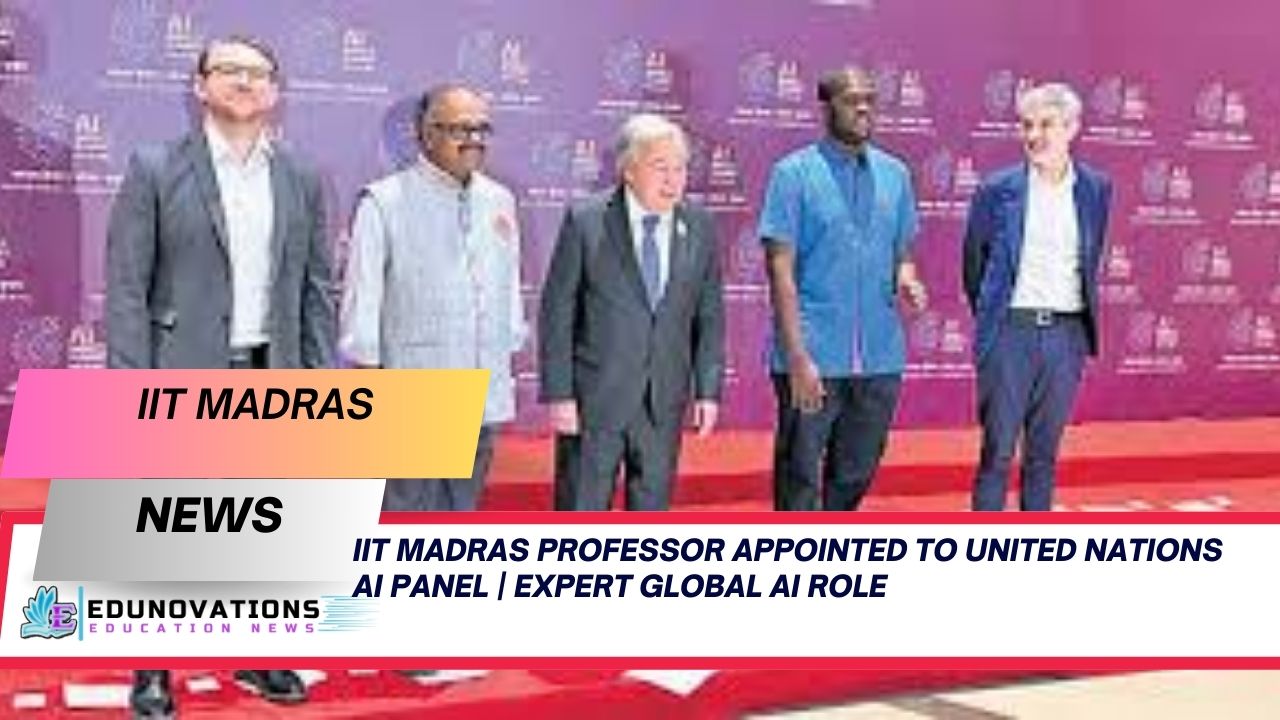
In a landmark move for Indian academia and international scientific cooperation, IIT Madras professor appointed to United Nations AI panel — marking a significant step in shaping global discourse on Artificial Intelligence (AI). This appointment not only reflects the growing stature of Indian research on the world stage, but also highlights the urgent need for responsible AI assessment and governance in an era where AI impacts every aspect of everyday life.
A Historic Appointment to the UN’s Scientific Panel
Professor B. Ravindran, a distinguished academician from the Indian Institute of Technology Madras (IIT Madras), has been selected as a member of the Independent International Scientific Panel on AI, created by the United Nations (UN) to provide evidence‑based scientific insights on how AI continues to transform societies worldwide.
Established through UN General Assembly Resolution A/RES/79/325 in August 2025, this panel serves as the first global scientific body solely dedicated to AI research and assessment. Its mandate is to generate independent, multidisciplinary knowledge that can inform policy, ethics, and international governance of AI systems.
With a membership of 40 leading experts from around the world, the panel represents diverse academic and disciplinary expertise, and Professor Ravindran’s appointment places India’s responsible AI research firmly on the global map.
Professor B. Ravindran: A Voice of Responsible AI
Professor Ravindran leads the Wadhwani School of Data Science and AI and is the Founding Head of the Centre for Responsible AI (CeRAI) at IIT Madras. He brings more than three decades of real‑world experience in advanced AI research, particularly in areas such as responsible AI, deep reinforcement learning, and socio‑economic implications of intelligent systems.
In his remarks upon the appointment, Prof. Ravindran emphasized how AI has permeated daily life — often without public awareness — and underscored his pride in representing India and the Global South on this critical international platform.
This historic recognition is a testament to IIT Madras’ unwavering commitment to ethical and impactful research in emerging technologies. It also continues the institute’s tradition of producing thought leaders whose work resonates within and beyond academic corridors.
UN Secretary‑General Highlights AI Governance
At the India AI Impact Summit 2026 held in New Delhi, UN Secretary‑General António Guterres articulated the importance of this scientific panel in shaping a shared global AI future. He stressed that in a rapidly evolving digital landscape, AI must be inclusive, ethical, and evidence‑driven.
According to Guterres:
“AI must belong to everyone. Replace hype and fear with shared evidence and close knowledge gaps. This panel will provide what’s been missing — rigorous, independent scientific insight.”
His comments highlighted the panel’s dual goals: strengthening global scientific cooperation and informing AI governance frameworks that prioritize human rights, safety, and shared progress across nations.
Why This Panel Matters in 2026 and Beyond
Artificial Intelligence is no longer technical jargon reserved for labs or research circles. From education and healthcare to national security and economic planning, AI affects decisions that shape the future of billions. Understanding this technology requires diverse scientific perspectives grounded in evidence — something that global policymakers now urgently need.
Here’s why the formation of this panel is pivotal:
- Global Leadership: It establishes an independent, scientific voice capable of guiding international policy dialogues on AI.
- Evidence‑Based Insights: It offers a structured way to assess societal impacts, risks, and opportunities presented by AI.
- Inclusive Representation: By including experts from various regions and disciplines, it ensures the Global South has a voice in shaping AI’s future.
- Bridging Tech and Society: The panel’s work will help policymakers, civil society, and private sectors make decisions grounded in rigorous research.
These goals match broader commitments outlined in the Global Digital Compact, adopted at the 2024 Summit of the Future, which envisioned an open, safe, and inclusive digital landscape driven by scientific cooperation.
Expert Context: AI Governance and Public Trust
Experts around the world have increasingly called for global cooperation in AI governance. A recent global AI safety report highlights the need for independent scientific bodies to assess potential risks and benefits across economies and communities. This reflects the same global ethos driving the UN’s scientific panel.
According to AI governance scholars, structures like the Independent International Scientific Panel on AI can serve as a model for international collaboration, providing transparent and trustworthy insights that shape regulation, ethical guidelines, and cross‑border cooperation. While AI promises economic and societal gains, independent assessment is critical in preventing misuse and addressing unintended consequences.
What This Means for India and Global Research
India’s representation through Professor Ravindran — enriched by research from institutions like IIT Madras — reinforces the country’s position as a technology and innovation hub. It reflects a broader trend where emerging economies contribute meaningfully to global research priorities, including AI ethics, risk analysis, and policy frameworks.
For students and professionals navigating AI careers, this underscores the importance of interdisciplinary learning — a blend of technology, ethics, data science, and policy understanding. If you’re seeking related NCERT educational resources, check out our foundational content on current affairs, AI basics, and responsible technology concepts:
- Current Affairs
- Syllabus
- MCQ’s
- Notes
- Videos
- NCERT Courses
And don’t forget to explore downloadable free NCERT PDFs and NCERT mind maps to strengthen your learning base.
External Resources and Further Reading
For institutions and schools interested in AI education partnerships, you may find relevant support through authoritative development platforms such as Mart Ind Infotech which assists educational entities with digital and technical solutions.
Toppers Use Mind Maps to score more than 95%
NCERT Class 11th Commerce Mind Maps
Add to cartOriginal price was: ₹999.00.₹199.00Current price is: ₹199.00.NCERT Class 12th Chemistry Mind Maps
Add to cartOriginal price was: ₹199.00.₹75.00Current price is: ₹75.00.NCERT Class 12th Commerce Mind Maps
Add to cartOriginal price was: ₹999.00.₹199.00Current price is: ₹199.00.NCERT Class 12th Science Mind Maps
Add to cartOriginal price was: ₹999.00.₹199.00Current price is: ₹199.00.NCERT Mind Maps For Class 10th
Add to cartOriginal price was: ₹999.00.₹199.00Current price is: ₹199.00.



Purchase Today
Frequently Asked Questions (FAQs)
- What does it mean that IIT Madras professor appointed to United Nations AI panel in 2026?
It means Professor B. Ravindran will serve on a global scientific body that provides independent AI assessments for international policy and governance. - Who is Professor B. Ravindran and why is his appointment significant?
He is a leading AI expert from IIT Madras focused on responsible AI, and his role brings India’s research perspective to global AI discourse. - What is the Independent International Scientific Panel on AI?
It is an expert group established by the UN to assess the societal impact of AI and guide ethical governance worldwide. - How will the panel influence global AI governance?
By providing rigorous scientific evidence that supports policy decisions and international AI norms. - Why is India’s inclusion important in this UN AI panel?
It ensures perspectives from the Global South and emerging economies are included in global AI research and policy planning. - What are key goals of the UN’s AI scientific panel?
To strengthen cooperation, provide evidence‑based insights, and support ethical deployment of AI technologies globally. - How does this panel relate to the Global Digital Compact?
The panel was formed as a key commitment of the Compact to promote inclusive, open digital futures. - What expertise does Professor Ravindran bring to the panel?
Decades of work in responsible AI, data science, and AI ethics research. - Is this panel part of global AI safety efforts?
Yes — it aligns with global discussions on AI governance and safety frameworks. - How can students and schools benefit from this development?
This highlights the importance of multidisciplinary AI education, which you can reinforce through NCERT resources in current affairs, AI basics, and technology literacy.