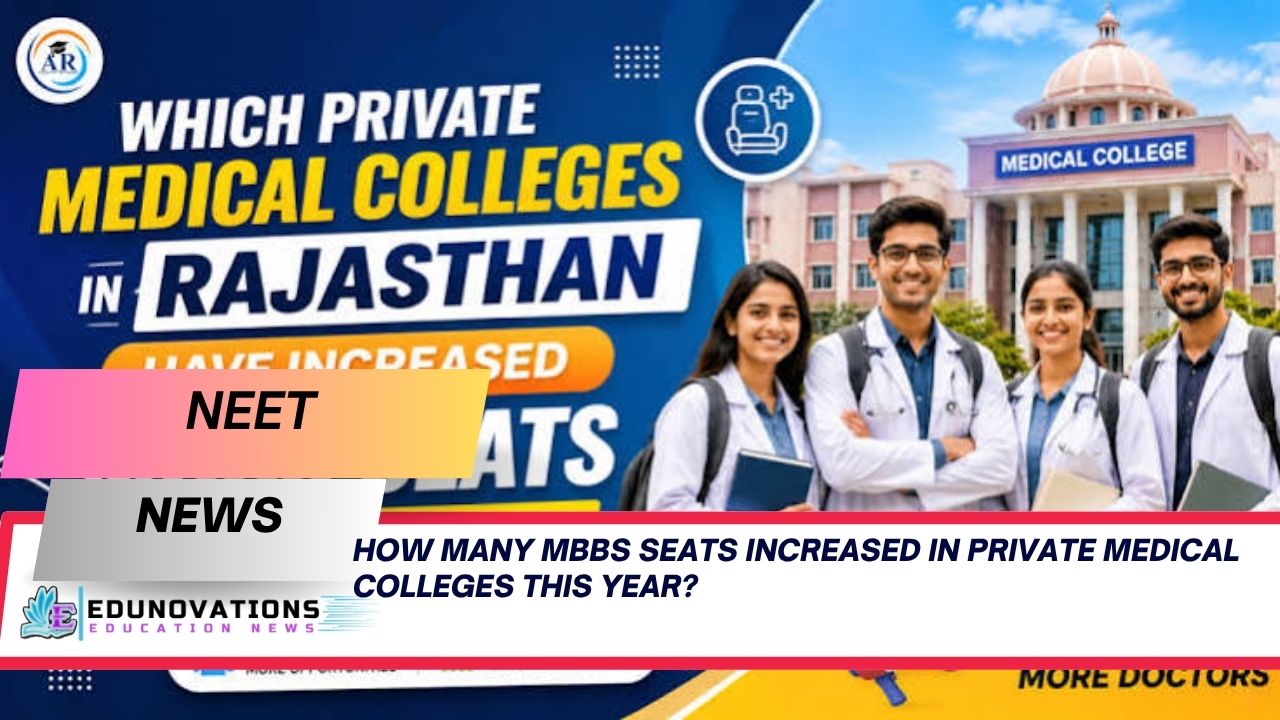
Discover how many MBBS seats increased in private medical colleges this year as NMC expands the total medical seat matrix across India for the upcoming academic session.
Massive Seats Up For Grabs: How Many MBBS Seats Increased in Private Medical Colleges This Year?
In a monumental development for medical education in India, the National Medical Commission (NMC) has officially sanctioned a historic expansion in the national undergraduate medical seat matrix. For the upcoming academic session, thousands of medical aspirants nationwide will benefit from the addition of 9,911 undergraduate medical seats. This significant expansion elevates the total country-wide capacity to a record-breaking 1,36,939 seats. As the nation prepares for the high-stakes counseling process, millions of families are asking one critical question: exactly how many MBBS seats increased in private medical colleges this year?
Data released by the Medical Assessment and Rating Board (MARB) reveals that private institutions have overwhelmingly driven this massive seat surge. Out of the 9,911 freshly approved slots, private colleges account for a striking 79 percent of the expansion. This dynamic structural shift is bound to alter the dynamics of choices for candidates who appeared for the highly competitive National Eligibility cum Entrance Test (NEET-UG).
To navigate these changes seamlessly, competitive aspirants must leverage top-tier educational assets. Students can enhance their fundamental readiness through targeted NCERT Courses, access highly critical Current Affairs documentation, or brush up on fundamental medical screening standards via comprehensive Syllabus breakdowns.
Decoding the Anatomy of the New NMC Seat Matrix
The massive influx of 9,911 seats has completely reshaped the landscape of Indian medical counseling. To fully comprehend the impact of these changes, it is essential to look closely at the data released by the regulator. The comprehensive matrix covers 823 functional medical colleges across various states, excluding Institutes of National Importance like AIIMS and JIPMER.
Private vs. Government Seat Breakdowns
The newly approved seats are distributed between entirely new campuses and expansions within existing facilities:
- Newly Established Institutions: A total of 25 new medical colleges have received green signals to begin operations. This includes 7 new government institutions and 18 private campuses, opening up 2,400 fresh openings right away.
- Enhanced Capacity inside Existing Campuses: The remaining 7,511 slots come from expanding infrastructure within already functional campuses.
The dominance of private players in this expansion highlights why so many families are tracking how many MBBS seats increased in private medical colleges this year. Private institutions contribute nearly four-fifths of the additions, providing an alternative path for students who miss out on high-demand government merit positions. Meanwhile, students aiming for the remaining seats can access free resources like Downloads of Free NCERT PDFs to strengthen their foundational knowledge.
The Policy Driving the Change: Explaining the Regulatory Shifts
The rapid acceleration in medical seat availability did not happen by chance. It is the direct result of deliberate regulatory evolution designed to dismantle old bureaucratic bottlenecks. According to Dr. M.K. Ramesh, President of the Medical Assessment and Rating Board (MARB), the sudden surge was catalyzed by modern provisions within the historic Graduate Medical Education Regulations, 2023.
Historically, older regulations restricted existing medical institutes from expanding their student intake capacity until their very first batch of students finished their entire four-and-a-half to five-year clinical curriculum. This left valuable hospital resources underutilized for years. The implementation of the 2023 guidelines completely transformed this timeline.
Now, medical colleges can legally request an intake increase as early as their second year of operations, provided they fulfill the strict infrastructure, faculty, and clinical load criteria set by the NMC. This policy shift has enabled modern private and public entities to scale up their capacity quickly. This explains why knowing how many MBBS seats increased in private medical colleges this year has become vital for charting a successful admissions strategy.
Expert Insights and Implications for Healthcare Infrastructure
Public health experts look at these numbers with cautious optimism. India’s doctor-to-population ratio currently stands at roughly 1:811, surpassing the World Health Organization’s standard benchmark of 1 doctor per 1,000 citizens. However, significant geographical imbalances persist between urban centers and rural areas.
Dr. R.V. Asokan, National President of the Indian Medical Association (IMA), has frequently highlighted these structural challenges. Commenting on the scale of medical education expansion in the country, Dr. Asokan noted:
“While expanding the seat count helps address the demand from millions of students, our focus must remain on maintaining the highest standards of medical training. Adding seats requires a parallel increase in fully functional hospital beds, experienced teaching faculty, and diverse clinical exposure. Growth should not compromise the quality of care our future doctors will provide.”
This highlights why understanding the impact of graduate medical education regulations 2023 on MBBS seats is so critical. The regulations must balance rapid infrastructure scaling with rigorous, high-quality assessments to ensure new doctors are fully prepared for the field.
Preparing a Strategic Approach for Upcoming Counseling Sessions
With the updated seat numbers locked in, candidates must recalibrate their counseling preferences. Because over 22 lakh aspirants compete in the NEET-UG ecosystem annually, securing a seat requires a clear understanding of the final seat availability metrics.
Students mapping out their options should carefully evaluate both cost and location. While knowing how many MBBS seats increased in private medical colleges this year helps clarify options, looking at the state wise distribution of new MBBS seats approved by NMC is equally essential. Different states have distinct regional quotas and open-seat counseling rules that can significantly impact your chances of admission.
+-------------------------------------------------------------+
|               NATIONAL MBBS CAPACITY AT A GLANCE            |
+-------------------------------------------------------------+
|  Total National Capacity        : 1,36,939 Seats            |
|  Total Freshly Approved Seats   : 9,911 Seats               |
|  Contribution from Private Sector: ~79% of New Seats        |
|  Total Evaluated Colleges       : 823 Institutions          |
+-------------------------------------------------------------+
To build a reliable competitive advantage, students can sharpen their preparation by reviewing comprehensive educational Notes, testing their knowledge with interactive MCQ’s, and visualizing complex scientific concepts with high-quality Videos. Schools looking to upgrade their digital outreach during this high-demand academic season can also consult professionals via Mart Ind Infotech to build advanced online resources.
Toppers Use Mind Maps to score more than 95%
NCERT Class 11th Commerce Mind Maps
Add to cartOriginal price was: ₹999.00.₹199.00Current price is: ₹199.00.NCERT Class 12th Chemistry Mind Maps
Add to cartOriginal price was: ₹199.00.₹75.00Current price is: ₹75.00.NCERT Class 12th Commerce Mind Maps
Add to cartOriginal price was: ₹999.00.₹199.00Current price is: ₹199.00.NCERT Class 12th Science Mind Maps
Add to cartOriginal price was: ₹999.00.₹199.00Current price is: ₹199.00.NCERT Mind Maps For Class 10th
Add to cartOriginal price was: ₹999.00.₹199.00Current price is: ₹199.00.





Purchase Today
Frequently Asked Questions (FAQs)
Q1: Exactly how many MBBS seats increased in private medical colleges this year?
Out of the 9,911 additional slots approved by the NMC, private institutions accounted for approximately 79% of the growth. This substantial share makes understanding this specific increase critical for students evaluating private medical education pathways.
Q2: What is the significance of the state wise distribution of new MBBS seats approved by NMC?
The state-wise distribution determines the local seat matrix for 85% state quota counseling. Because seat increases vary by region, checking these state-specific lists helps candidates assess local cutoff variations.
Q3: What is the direct impact of graduate medical education regulations 2023 on MBBS seats?
The 2023 regulations removed the rule requiring colleges to wait 5 years before expanding their capacity. Institutions can now apply to increase their student intake from their second year of operations, accelerating seat availability across the country.
Q4: What is the estimated total number of govt medical college MBBS seats in India 2026?
While the total national capacity has scaled to 1,36,939 seats across 823 colleges (including 441 government and 382 private institutions), government seats make up nearly half the total matrix, offering subsidized education to top merit rankers.
Q5: Where can I check the official list of new medical colleges approved for MBBS counseling this year?
The official list is available on the NMC website under the MARB seat matrix updates. It includes 25 entirely new medical colleges (7 government and 18 private) approved for the current academic session.
Q6: Are premium institutes like AIIMS and JIPMER included in this 1,36,939 seat matrix?
No, the 823 colleges evaluated in this specific matrix exclude Institutes of National Importance (INIs) like AIIMS and JIPMER, which conduct their admissions through separate counseling parameters.
Q7: Can the NMC modify this seat matrix before the final rounds of counseling?
Yes, the NMC has indicated that the matrix may be updated based on pending decisions from the official Appeal Committee or other competent authorities.
Q8: What happens if a medical college admits more students than its approved matrix?
The NMC has issued a strict warning that any institution admitting students beyond its sanctioned intake will face immediate regulatory and penal action under the NMC Act, 2019.
Q9: How can I access foundational materials to prepare for medical entry concepts?
Students can download comprehensive resources, including NCERT Mind Maps, to streamline their revision and master complex topics efficiently.
Q10: Why did private colleges contribute the majority of the seat increases this year?
Private institutions adapted rapidly to the new 2023 regulatory changes, utilizing their existing healthcare infrastructure to quickly meet the necessary NMC compliance standards for intake expansion.