
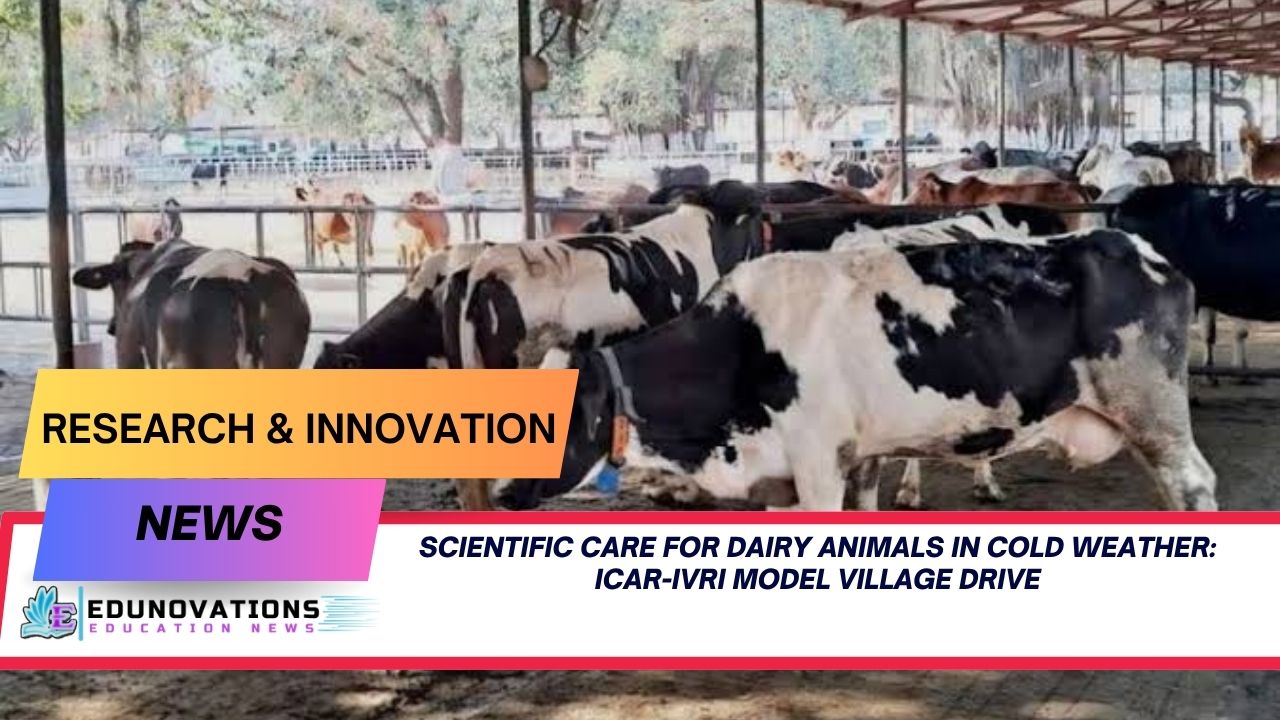
ICAR-IVRI Mukteswar launches a model village initiative focused on scientific care for dairy animals in cold weather, fruit sapling distribution, and sustainable farming.
The Indian Council of Agricultural Research – Indian Veterinary Research Institute (ICAR-IVRI), Mukteswar campus, has marked a milestone in rural agricultural extension. Under the leadership of institutional directors and extension scientists, ICAR-IVRI organized a seminar-cum-distribution drive in Sunkiya village, Nainital district, Uttarakhand.
The initiative delivered high-yielding saplings of guava and orange to local farmers alongside scientific guidance on livestock protection, orchard management, and organic farming techniques. The program reinforces the government’s vision of building self-sustaining model villages by integrating animal husbandry with horticultural production.
Transforming Rural Livelihoods: ICAR-IVRI Extension Program in Sunkiya
On October 7, 2026, the Extension Education Section of ICAR-IVRI Mukteswar convened a field-level workshop in Sunkiya village. Situated in the temperate Kumaon hills, Sunkiya was selected for transformation into a model agricultural village. The initiative combined technical training, input distribution, and expert advice to help hill farmers diversify away from mono-cropping toward integrated farming systems.
The program was directed by Dr. Sher Singh, Acting Joint Director of the ICAR-IVRI Mukteswar Campus, and coordinated by extension specialist Dr. Manish Tomar. Livestock management advice was led by veterinary scientist Dr. Nitesh Kharayat. The event had the support of Dr. Raghavendra Bhatta, Deputy Director General (Animal Science) and Director (Additional Charge) at ICAR-IVRI, who praised the team’s field execution and called for continuous technical assistance to mountain farmers.
+-----------------------------------------------------------------------------------+
|                        ICAR-IVRI EXTENSION MODEL AT SUNKIYA                       |
+-----------------------------------------------------------------------------------+
|                                                                                   |
|    +-------------------------+                       +-----------------------+    |
|    |  Horticultural Care     |                       |  Livestock Security   |    |
|    +-------------------------+                       +-----------------------+    |
|    | - Guava & Orange Saplings                       | - Winter Housing Care |    |
|    | - Organic Soil Health   |                       | - Balanced Nutrition  |    |
|    | - Scientific Pruning    |                       | - Seasonal Vaccines   |    |
|    +------------+------------+                       +-----------+-----------+    |
|                 |                                                |                |
|                 +-----------------------+------------------------+                |
|                                         |                                         |
|                                         v                                         |
|                       +-----------------------------------+                       |
|                       |   Sustainable Model Agriculture   |                       |
|                       |    - Diversified Income Streams   |                       |
|                       |    - Reduced Chemical Dependency  |                       |
|                       |    - Enhanced Climate Resilience  |                       |
|                       +-----------------------------------+                       |
+-----------------------------------------------------------------------------------+
Extension activities that directly connect scientists with smallholders play a critical role in mountain agriculture, where terrain and unpredictable weather create unique operational challenges.
To access structured academic materials and comprehensive study tools for agricultural competitive examinations, explore curated NCERT Courses and review updated Syllabus resources.
Climate Adaptation and Winter Care for Hill Livestock
Livestock keeping in high-altitude regions like Mukteswar requires specific seasonal management protocols. Dropping temperatures, frost, and unseasonal rainfall directly impact milk yields, feed efficiency, and animal health.
+----------------------------------------------------------------------------------+
|                  SEASONAL LIVESTOCK MANAGEMENT PRIORITIES                        |
+----------------------------------------------------------------------------------+
|                                                                                  |
|    [Thermal Housing] ------------> Prevents Cold Stress & Respiratory Illness     |
|                                                                                  |
|    [Energy-Dense Feed] ----------> Maintains Core Temp & Daily Milk Yields       |
|                                                                                  |
|    [Dry Bedding Hygiene] --------> Blocks Environmental Mastitis Vectors         |
|                                                                                  |
|    [Prophylactic Vaccines] -------> Prevents Seasonal Viral Outbreaks             |
|                                                                                  |
+----------------------------------------------------------------------------------+
During the workshop, Dr. Nitesh Kharayat provided practical protocols for maintaining dairy herds during cold and rainy periods. He emphasized four core management practices:
1. Thermal Insulation and Barn Ventilation
High-altitude winter winds can lower the effective temperature inside livestock sheds, causing cold stress.
- Farmers were advised to cover shed openings with gunny bags or heavy canvas drapes during nighttime while keeping upper vents open for air circulation.
- Controlling humidity inside cattle sheds prevents respiratory pathogens like Pasteurella multocida (the causal agent of Hemorrhagic Septicemia) from multiplying.
2. Energy-Dense Feeding and Mineral Supplementation
Cattle use more metabolic energy to maintain body warmth during cold spells, leaving less energy for milk production.
- Rations should be fortified with high-energy feed additives, including crushed maize, mustard cake, and mineral mixtures.
- Adding 30 to 50 grams of specialized mineral mixture daily improves metabolic efficiency, immunity, and reproductive health.
3. Moisture Control and Mastitis Prevention
Cold, damp floors create breeding grounds for bacterial mastitis.
- Keeping shed floors dry with clean straw, pine needles, or wood shavings reduces bacterial contact with teat canal openings.
- Regular teat dipping before and after milking protects herd health during winter.
4. Scheduled Deworming and Seasonal Vaccination
- Broad-spectrum dewormers administered before winter onset ensure animals efficiently convert fodder into thermal energy and milk rather than losing nutrition to internal parasites.
- Keeping routine vaccination schedules up to date protects dairy cows from Foot-and-Mouth Disease (FMD) and Black Quarter (BQ).
For updated academic notes on livestock physiology, agricultural sciences, and veterinary extensions, visit Notes or practice subject modules with targeted MCQs.
Scientific Fruit Cultivation and Organic Soil Management
A central feature of the Sunkiya program was the distribution of high-yielding, disease-resistant guava (Psidium guajava) and orange (Citrus sinensis) saplings to participating households.
Coordinating the distribution, Dr. Manish Tomar explained how scientific orchard establishment helps small farmers transition from traditional subsistence farming to income-generating horticulture.
+---------------------------------------------------------------------------------+
|                    SCIENTIFIC ORCHARD ADOPTION TIMELINE                         |
+---------------------------------------------------------------------------------+
|                                                                                 |
|  Year 1: Sapling Distribution, Pit Preparation & Organic Basal Manuring         |
|  ─────────────────────────────────────────────────────────────────────────────  |
|  Year 2: Canopy Training, Mulching & Micro-Nutrient Application                 |
|  ─────────────────────────────────────────────────────────────────────────────  |
|  Year 3: Integrated Pest Management & Initial Flowering Management              |
|  ─────────────────────────────────────────────────────────────────────────────  |
|  Year 4+: Full Fruit Production, Commercial Harvesting & Village Processing     |
|                                                                                 |
+---------------------------------------------------------------------------------+
Scientific Pit Preparation and Planting Protocol
Dr. Tomar detailed proper planting preparation to maximize sapling survival:
- Pit Dimensions: Dig pits measuring 60 cm x 60 cm x 60 cm at least two weeks before planting to allow soil aeration and solarization.
- Soil Mixture: Mix topsoil with 10–15 kg of well-decomposed Farmyard Manure (FYM), 250 grams of single superphosphate, and 50 grams of neem cake to deter root grubs and termites.
- Water Management: Water saplings immediately after planting, ensuring drainage channels prevent waterlogging around root zones during winter rains.
Phasing Out Chemical Inputs in Mountain Agro-Ecosystems
The scientists encouraged farmers to adopt bio-pesticides, neem-based sprays, and vermicompost while reducing synthetic fertilizers. Excess reliance on synthetic inputs damages native soil biota, reduces earthworm populations, and accelerates soil erosion on hill slopes. Organic soil management improves water retention, enhances fruit quality, and builds long-term climate resilience.
To stay current on agricultural policies, rural development schemes, and national research updates, browse Current Affairs and review recent video lessons on Videos. Educational institutions looking for modern web platforms can explore services provided by Mart Ind Infotech.
Expert Perspectives on the Model Village Framework
Scientific leadership emphasized that short-term extension activities must form part of a sustained, multi-year strategy to yield lasting economic results.
“Transforming a village into a sustainable agricultural model requires moving beyond one-off input distribution drives. We must provide continuous technical handholding across both crop cultivation and livestock management. By combining scientific fruit production with modern animal care, smallholder families build resilient income streams that can withstand market fluctuations and climate shifts.”
— Dr. Sher Singh, Acting Joint Director, ICAR-IVRI Mukteswar Campus
Commenting on institutional coordination, ICAR-IVRI leadership underscored the importance of grassroots scientific extension:
“The primary mission of agricultural research institutes is to translate laboratory breakthroughs into field-level practices. Establishing model villages like Sunkiya demonstrates how integrated farming—combining animal health, horticulture, and soil management—can elevate mountain agriculture and support rural livelihoods.”
— Dr. Raghavendra Bhatta, DDG (Animal Science) & Director (Additional Charge), ICAR-IVRI
Comparative Analysis: Integrated Hill Farming vs. Traditional Monoculture
Transitioning from traditional cereal-based monoculture to an integrated system that combines dairy farming with fruit orchards offers clearer economic and environmental advantages for small hill farms:
| Feature | Traditional Hill Monoculture | Integrated Horticulture & Livestock Model |
| Primary Income Sources | Seasonal grain crops (e.g., finger millet, paddy) | Daily milk sales, seasonal fruit crops, compost |
| Climate Resilience | Low; vulnerable to drought and unseasonal rain | High; diversified enterprise buffers crop failures |
| Soil Health Profile | Nutrient depletion from continuous cropping | Enhanced organic carbon via manure and cover crops |
| Resource Efficiency | Requires purchasing off-farm inputs | On-farm recycling of crop residues and animal manure |
| Cash Flow Pattern | Irregular harvest-linked payouts | Regular daily/weekly income from dairy product sales |
Action Plan for Mountain Farmers: Implementing Scientific Techniques
To mirror the Sunkiya model village approach, hill farmers can adopt a simple, structured strategy:
+-----------------------------------------------------------------------------------+
|                        4-STEP IMPLEMENTATION CHECKLIST                            |
+-----------------------------------------------------------------------------------+
|                                                                                   |
|  [Step 1] Audit Available Land & Barn Infrastructure                              |
|           Assess unused homestead space for fruit trees and evaluate shed drapes. |
|                                                                                   |
|  [Step 2] Adopt Dual-Purpose Feeding Strategies                                   |
|           Combine local green fodder with oil cakes and 30–50g mineral mixture.   |
|                                                                                   |
|  [Step 3] Plant Disease-Resistant Saplings                                        |
|           Prepare 60cm cubed pits with organic manure and neem cake before planting. |
|                                                                                   |
|  [Step 4] Maintain Clean, Dry Livestock Sheds                                     |
|           Use dry bedding straw to prevent cold-stress and udder infections.      |
|                                                                                   |
+-----------------------------------------------------------------------------------+
- Conduct an Integrated Resource Audit: Map available homestead land, evaluate existing cattle shed insulation, and assess fodder availability.
- Upgrade Winter Barn Management: Drape gunny bags over open windows, raise calf sleeping areas off damp ground, and maintain a dry floor using dry straw or pine litter.
- Implement Balanced Rations: Supplement daily feeds with locally sourced energy inputs, mineral mixtures, and clean, warm drinking water during winter months.
- Establish High-Value Fruit Trees: Plant certified fruit saplings during optimal seasons using solarized pits, organic manure, and proper spacing.
- Establish Feedback Loops with Extension Centers: Maintain close contact with regional Krishi Vigyan Kendras (KVKs) and veterinary centers for timely vaccinations, disease diagnosis, and pruning advice.
For additional study materials, downloadable visual aids, and learning resources, access the Free NCERT PDFs library and download specialized NCERT Mind Maps.
Key Takeaways
- Integrated Agricultural Model: Combining livestock care with fruit horticulture provides a balanced, climate-resilient economic foundation for mountain farm families.
- Proactive Winter Care: Protecting cattle from cold stress through proper barn insulation, energy-rich feed, and clean bedding preserves daily milk yield and prevents respiratory illnesses.
- Scientific Orchard Establishment: Proper pit preparation, organic soil enrichment, and routine canopy management are critical for establishing long-term fruit yields.
- Institutional Support for Model Villages: Field-level interventions by research centers like ICAR-IVRI Mukteswar accelerate technology adoption across mountain communities.
Toppers Use Mind Maps to score more than 95%
-
NCERT Class 11th Commerce Mind Maps
Add to cartOriginal price was: ₹999.00.₹199.00Current price is: ₹199.00. -
NCERT Class 12th Chemistry Mind Maps
Add to cartOriginal price was: ₹199.00.₹75.00Current price is: ₹75.00. -
NCERT Class 12th Commerce Mind Maps
Add to cartOriginal price was: ₹999.00.₹199.00Current price is: ₹199.00. -
NCERT Class 12th Science Mind Maps
Add to cartOriginal price was: ₹999.00.₹199.00Current price is: ₹199.00. -
NCERT Mind Maps For Class 10th
Add to cartOriginal price was: ₹999.00.₹199.00Current price is: ₹199.00.





Purchase Today
Frequently Asked Questions (FAQs)
1. What is the primary purpose of scientific care for dairy animals in cold weather?
Scientific care protects livestock from cold stress, maintains metabolic heat balance, prevents respiratory infections like Hemorrhagic Septicemia, and helps cows sustain daily milk yields during winter drops in temperature.
2. How should farmers prepare pits according to an organic guava and orange plantation guide?
Pits should be dug to dimensions of 60 cm x 60 cm x 60 cm at least two weeks before planting. The removed soil should be solarized and mixed with 10–15 kg of well-decomposed FYM, single superphosphate, and neem cake to deter root pests.
3. What steps explain how to protect milch cows during rainy season?
Protecting cows during the monsoon requires keeping shed floors dry with clean bedding straw, maintaining clean milking conditions to prevent mastitis, providing clean drinking water, and administering preventative vaccines for Foot-and-Mouth Disease (FMD) and Black Quarter (BQ).
4. What are the best integrated farming ideas for small farmers in hilly regions?
Effective integrated farming combines small-scale dairy cattle management, fruit orchards (such as guava, orange, and apple), vermicomposting, and poultry or beekeeping. This structure recycles farm waste, diversifies daily income, and improves soil health.
5. What key features belong in a dairy cattle housing layout for cold climate regions?
A cold-climate dairy shed layout requires heavy, movable window covers (like canvas or gunny bags) for night insulation, upper ventilation gaps to prevent moisture buildup, elevated slatted flooring for calves, and well-drained, dry bedding areas.
6. Why did ICAR-IVRI Mukteswar select Sunkiya village for input distribution?
ICAR-IVRI selected Sunkiya to develop it into a model agricultural village, demonstrating how scientific advice, organic soil management, and high-yielding fruit distribution can raise living standards in mountain farming communities.
7. How does cold stress affect daily milk production in dairy cattle?
Cold stress forces an animal to divert food energy toward maintaining core body heat rather than producing milk. Without high-energy feed supplements, daily milk output drops sharply during cold spells.
8. What role does neem cake play during fruit sapling plantation?
Neem cake serves as a natural pest deterrent against soil-borne insects, root grubs, and termites while adding organic matter to the root zone of newly planted saplings.
9. Why is organic soil management better for hill orchards than chemical fertilizers?
Organic management improves soil structure, increases water retention, preserves native micro-organisms, and reduces soil erosion on sloped mountain land without leaving chemical residues.
10. How can small farmers access scientific veterinary and agricultural extension services?
Farmers can contact local Krishi Vigyan Kendras (KVKs), state veterinary dispensaries, or regional research campuses like ICAR-IVRI for technical guidance, diagnostic support, and high-quality farming inputs.


