As digital governance expands across India, protecting critical public platforms has transformed from a back-office priority into a primary pillar of national security.
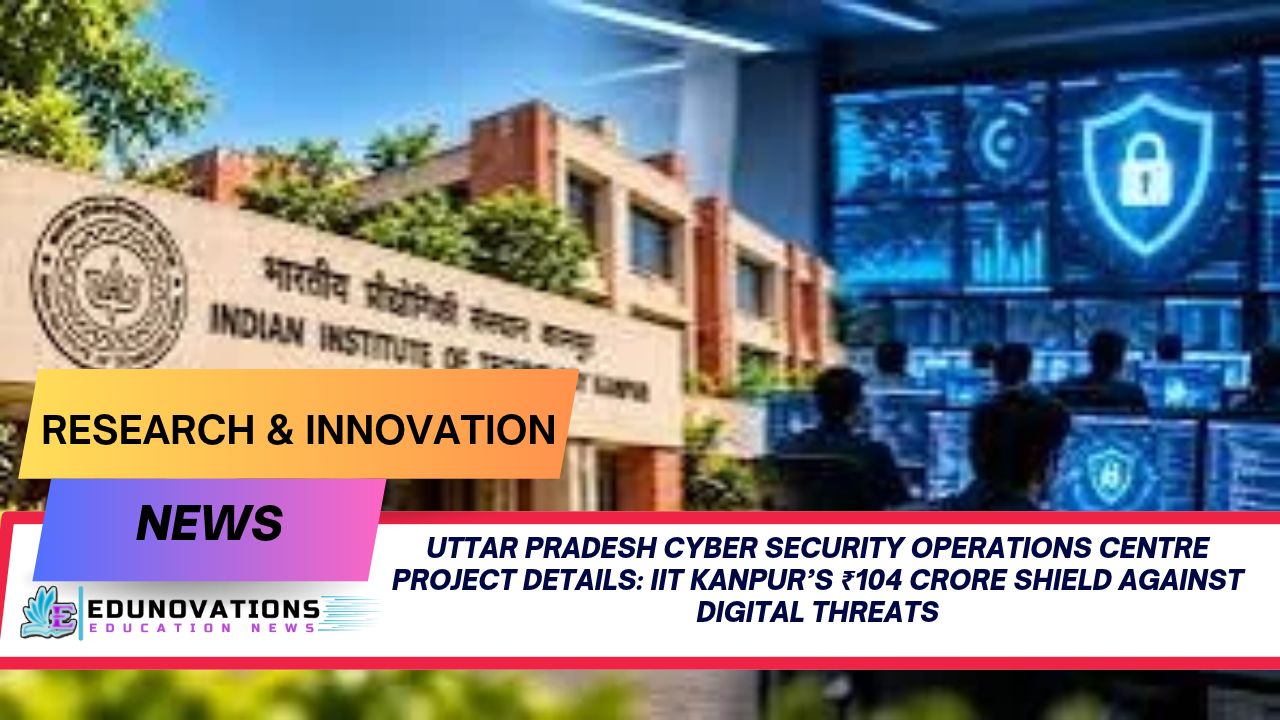
As digital governance expands across India, protecting critical public platforms has transformed from a back-office priority into a primary pillar of national security. In a landmark move to fortify public networks against sophisticated cyber threats, the Uttar Pradesh Cabinet, under the leadership of Chief Minister Yogi Adityanath, has greenlit a transformative ₹104.28-crore initiative. This monumental project brings forth the establishment of the Uttar Pradesh Cyber Security Operations Centre project details, a state-of-the-art facility designed to safeguard government digital infrastructure.
Entrusted to C3iHub—the specialized Cybersecurity Technology Innovation Hub at the Indian Institute of Technology Kanpur (IIT Kanpur)—this three-year operational and maintenance undertaking represents a vital fusion of academic excellence and governmental strategy. For citizens, administrators, and policy researchers tracking digital transformations through platforms like Current Affairs, this development marks a historic paradigm shift in how regional public networks defend themselves against modern cyber warfare.
The Strategic Imperative Behind the UP-CSOC Initiative
In recent years, the state of Uttar Pradesh has dramatically accelerated its digital footprint. From land registry records and utility distributions to public welfare schemes and e-governance portals, millions of citizens interact daily with state-run digital frameworks. However, this rapid digitization has inevitably caught the attention of malicious actors seeking to exploit vulnerabilities in public sector networks.
Recognizing these compounding risks, the state administration determined that conventional, fragmented security measures were no longer adequate. A centralized command structure capable of round-the-clock observation was desperately required. This led directly to the conceptualization of the Uttar Pradesh Cyber Security Operations Centre (UP-CSOC).
The project is structured to provide an impregnable defense layer. By pooling state resources and channeling the elite technical competence of IIT Kanpur, the administration aims to create a bulletproof framework that not only detects intrusions but neutralizes them before damage can occur. Students and aspirants preparing for competitive examinations can explore detailed Syllabus modules and reference Notes to understand how digital governance policies intersect with state security frameworks.
C3iHub IIT Kanpur Cyber Center Role and Operational Scope
At the heart of this massive ₹104-crore undertaking is the C3iHub IIT Kanpur cyber center role. Known widely for its pioneering research and development in critical infrastructure protection, C3iHub is uniquely positioned to handle the gargantuan task of running the UP-CSOC for an initial period of three years.
Prof. Manindra Agrawal, Director of IIT Kanpur, emphasized the gravity of the mission during the announcement, stating:
“The establishment of the UP Cyber Security Operations Centre is an important step towards protecting the state’s digital infrastructure from evolving cyber threats. C3iHub at IIT Kanpur, with its specialized expertise and technical competence, is well-positioned to lead this initiative.”
Prof. Agrawal also highlighted C3iHub’s stellar track record, noting that the hub has previously successfully deployed and managed Security Operations Centre (SOC) capabilities for premier national bodies, including the Steel Authority of India Limited (SAIL) Bhilai Steel Plant, the National Highways Authority of India (NHAI), and the Indian Ports Association (IPA).
To support institutional learning and professional development in this sector, educators and tech enthusiasts can utilize specialized tools like MCQ’s and interactive Videos to dive deeper into networking concepts. Furthermore, educational institutions aiming to upgrade their digital and administrative infrastructure can [Need Website for Schools Contact https://www.martindiainfotech.com/ “Mart Ind Infotech”] for professional development solutions.
Integrating IT and OT Security Monitoring Systems India
Modern state infrastructure is no longer limited to computer terminals and cloud-based databases; it heavily incorporates physical operational systems. One of the standout features of the UP-CSOC project is its comprehensive oversight covering both Information Technology (IT) and IT and OT security monitoring systems India wide.
Operational Technology (OT)—encompassing industrial control systems, smart water grids, power distribution networks, and automated transit systems—requires an entirely different defense paradigm compared to standard IT environments. A breach in an OT network can result in physical disruptions to public services. By bridging this gap, the newly approved center ensures that municipal services, smart city projects, and backend database architectures receive unified protection.
To break down complex technical architectures for students and researchers, free visual learning aids and downloadable reference sheets can be accessed via Downloads of Free NCERT PDFs and For NCERT Mind Maps. For structured academic paths, learners can browse through comprehensive NCERT Courses.
Fortifying Government Digital Infrastructure Threat Detection
As public portals process sensitive citizen data—ranging from Aadhaar identifiers to financial records—ensuring robust data privacy is paramount. The UP-CSOC acts as an active shield focusing heavily on government digital infrastructure threat detection.
Operating 24 hours a day, 7 days a week, the center utilizes an array of next-generation defense mechanisms:
- Artificial Intelligence (AI) and Machine Learning (ML): To automatically flag anomalies, study behavioral patterns, and predict impending attack vectors before execution.
- Security Information and Event Management (SIEM): To aggregate logs and security alerts across multiple departmental servers in real time.
- Security Orchestration, Automation, and Response (SOAR): To streamline incident handling and automate repetitive mitigation protocols.
- Network Detection and Response (NDR): To continuously inspect deep network traffic for hidden malware or lateral movement by intruders.
Through these advanced layers, the center ensures that threat severity is systematically analyzed and prioritized. Departmental Chief Information Security Officers (CISOs) and designated nodal officers will work in close coordination with C3iHub to execute periodic security audits, vulnerability assessments, and simulated cyber drills.
Shaping the Uttar Pradesh State Cyber Security Framework
The launch of this operational hub solidifies the Uttar Pradesh state cyber security framework as one of the most progressive in the country. By institutionalizing a proactive defense posture rather than reacting reactively to breaches, the state government is setting a national benchmark for digital safety.
Chief Minister Yogi Adityanath’s administration has consistently emphasized that technological advancement must go hand-in-hand with data sovereignty and citizen protection. The ₹104.28-crore allocation reflects a calculated, long-term investment in economic stability, ensuring that business investors, citizens, and administrative branches operate within a secure, tamper-proof digital ecosystem.
Toppers Use Mind Maps to score more than 95%
-
NCERT Class 11th Commerce Mind Maps
Add to cartOriginal price was: ₹999.00.₹199.00Current price is: ₹199.00. -
NCERT Class 12th Chemistry Mind Maps
Add to cartOriginal price was: ₹199.00.₹75.00Current price is: ₹75.00. -
NCERT Class 12th Commerce Mind Maps
Add to cartOriginal price was: ₹999.00.₹199.00Current price is: ₹199.00. -
NCERT Class 12th Science Mind Maps
Add to cartOriginal price was: ₹999.00.₹199.00Current price is: ₹199.00. -
NCERT Mind Maps For Class 10th
Add to cartOriginal price was: ₹999.00.₹199.00Current price is: ₹199.00.





Purchase Today
Frequently Asked Questions
1. What is the total budget approved for the Uttar Pradesh Cyber Security Operations Centre?
The Uttar Pradesh Cabinet approved an estimated budget of ₹104.28 crore for the establishment, operation, and maintenance of the UP-CSOC.
2. Which institution is leading the establishment of the UP-CSOC?
C3iHub, the Cybersecurity Technology Innovation Hub at the Indian Institute of Technology Kanpur (IIT Kanpur), is leading the initiative.
3. How long will C3iHub manage the operations of the centre?
C3iHub will undertake the operation and maintenance of the UP-CSOC for an initial period of three years.
4. What are the primary objectives of the UP-CSOC project?
The centre aims to provide 24/7 security monitoring, threat detection, vulnerability management, and coordinated incident response across the state’s government digital infrastructure.
5. Does the centre cover both IT and OT environments?
Yes, the UP-CSOC is designed to monitor and protect both Information Technology (IT) and Operational Technology (OT) environments across government departments.
6. What advanced technologies will be deployed at the operations centre?
The facility will leverage Artificial Intelligence (AI), Machine Learning (ML), Security Information and Event Management (SIEM), Security Orchestration, Automation and Response (SOAR), and Network Detection and Response (NDR).
7. Who chaired the cabinet meeting that approved this cybersecurity project?
The project received approval at a cabinet meeting chaired by Uttar Pradesh Chief Minister Yogi Adityanath.
8. What previous projects has C3iHub managed in a similar capacity?
C3iHub has previously deployed Security Operations Centre (SOC) capabilities for organizations such as the SAIL Bhilai Steel Plant, the National Highways Authority of India (NHAI), and the Indian Ports Association (IPA).
9. How will individual government departments collaborate with the centre?
Departmental Chief Information Security Officers (CISOs) and designated nodal officers will coordinate directly with the centre for cybersecurity training, drills, and independent audits.
10. Why is this initiative crucial for low domain authority websites and researchers?
It provides clear institutional benchmarks, project metrics, and technical blueprints that researchers and independent digital platforms can analyze, summarize, and report on to capture niche search traffic.