Explore how student reactions, public forums, and key issues shape the selection process as UW-Madison evaluates its top chancellor finalists.
The landscape of American higher education is undergoing a profound structural and cultural evolution, and nowhere is this more evident than at the University of Wisconsin–Madison. As the flagship institution of the Universities of Wisconsin prepares to welcome its next top leader, the university community has found itself at the epicenter of rigorous debate, public forums, and intense community engagement. Following an exhaustive nationwide search led by the Special Regent Committee, three distinguished academic leaders emerged as finalists: Dr. Rashid Bashir, Dr. John Coleman, and Dr. Radenka Maric.
However, alongside the excitement of a new administrative chapter, the transition has brought critical student voices to the forefront. Understanding the nuances of UW Madison chancellor finalist student concerns campus feedback requires looking beyond official press releases and examining the lived experiences, expectations, and demands of the students, faculty, and staff who anchor the campus day in and day out.
The Path to Leadership: Meet the Chancellor Finalists
The journey to find a permanent leader for UW–Madison follows a period of stable interim leadership under Interim Chancellor Eric Wilcots, following the tenure of former Chancellor Jennifer Mnookin. The Special Regent Committee, tasked with identifying a visionary who can navigate modern geopolitical pressures, budgetary shifts, technological disruption, and student welfare, evaluated dozens of candidates before narrowing the field to three exceptional scholars.
1. Dr. Rashid Bashir
Serving currently as the Dean of the College of Engineering and the Grainger Distinguished Chair in Engineering at the University of Illinois Urbana-Champaign (UIUC), Dr. Rashid Bashir brings a strong background in biomedical engineering, nanoscale science, and technological innovation. During his public forum appearance at Tripp Commons in Memorial Union, Bashir emphasized the importance of scaling research excellence, fostering interdisciplinary collaboration, and integrating emerging technologies responsibly across all academic disciplines.
2. Dr. John Coleman
Dr. John Coleman is the Provost and Executive Vice Chancellor for Academic Affairs, as well as a Professor of Political Science at the University of Illinois Urbana-Champaign. Interestingly, Coleman is no stranger to the Madison community, having spent 22 years as a political science faculty member at UW–Madison before taking leadership roles at the University of Minnesota-Twin Cities and UIUC. His deep institutional memory and familiarity with the distinct culture of the Badger State position him as a candidate deeply attuned to regional academic traditions.
3. Dr. Radenka Maric
As the President and Board of Trustees Distinguished Professor in the Department of Chemical and Biomolecular Engineering at the University of Connecticut, Dr. Radenka Maric brings extensive executive leadership experience at the presidential level. Maric’s platform centers heavily on clean energy innovation, regional economic partnerships, student-centric support systems, and bolstering the university’s global research footprint.
Examining the Core Student Concerns and Campus Debates
When university leadership transitions occur at elite public research institutions, the stakes for the student body are exceptionally high. Students at UW–Madison have utilized public forums, governance meetings, and digital feedback channels to voice their priorities. Evaluating UW Madison chancellor finalist student concerns campus feedback reveals that contemporary college students are deeply focused on governance integrity, technological ethics, and campus well-being.
Artificial Intelligence and Academic Integrity
With the rapid proliferation of generative artificial intelligence tools across academic and professional sectors, students and faculty alike are eager to understand how university leadership plans to handle AI integration. During the candidate presentations, questions regarding AI guardrails, academic honesty, research ethics, and curriculum adaptation took center stage. Finalists were pressed on whether the university will implement restrictive bans or proactive educational frameworks that teach students how to leverage artificial intelligence responsibly while preserving human critical thinking.
Campus Safety, Mental Health, and Interpersonal Violence
Another paramount topic dominating student discourse is holistic campus safety. Students have consistently advocated for robust mental health resources, transparent reporting mechanisms for interpersonal violence, and enhanced physical security measures across the expansive campus. Candidates were asked how they plan to allocate budgetary resources to ensure that counseling services remain accessible, timely, and culturally competent for a diverse student population.
Free Expression and Shared Governance
As a university globally renowned for upholding the “Wisconsin Idea”—the principle that education should influence people’s lives beyond the boundaries of the classroom—protecting free speech while maintaining an inclusive, welcoming environment is a delicate balancing act. Student governance members questioned the finalists on how they intend to champion shared governance, ensuring that student and faculty senates retain meaningful advisory and decision-making power in institutional policy shifts.
For educators, researchers, and students who track these institutional policy shifts alongside broader educational trends, staying informed is critical. Many scholars supplement their understanding of public administration and policy by engaging with comprehensive learning resources like NCERT Courses and keeping up-to-date with Current Affairs.
Analyzing Student Reactions and Community Engagement
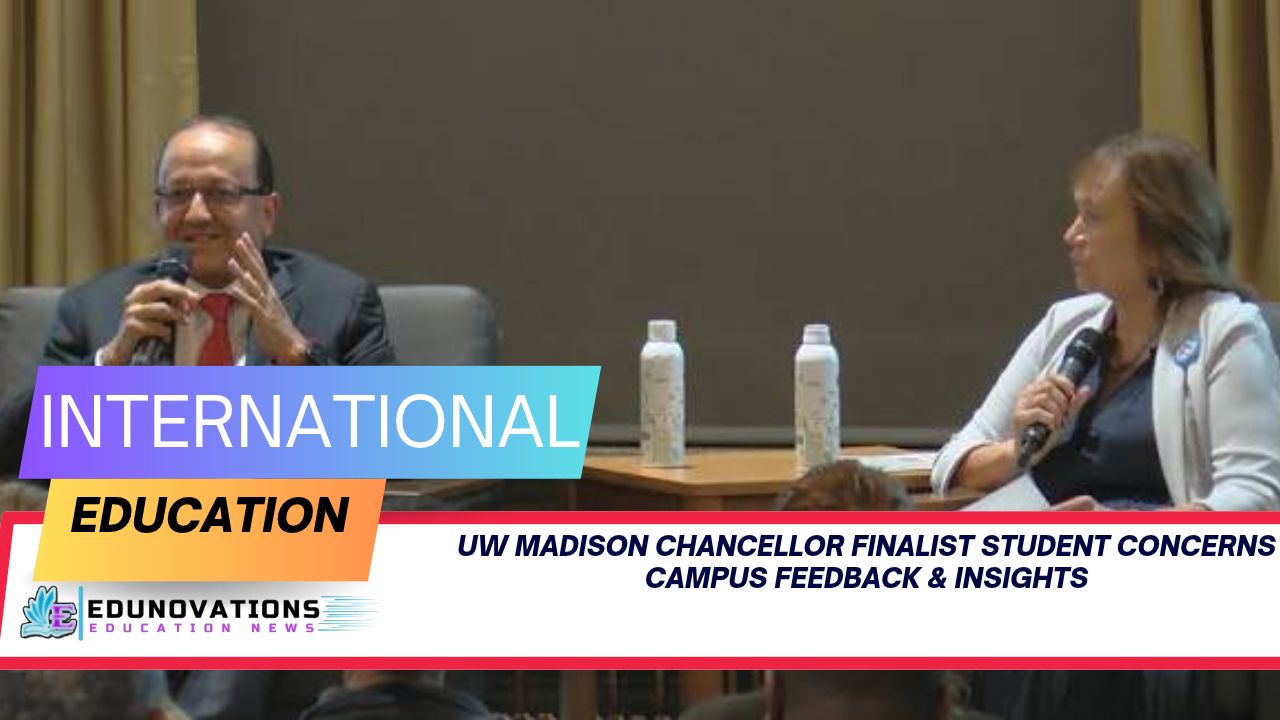
The public forums held at Tripp Commons in Memorial Union served as the primary battleground for dialogue between the executive hopefuls and the university populace. While many attendees praised the high caliber of the candidates’ academic achievements, lively debates emerged regarding how well external candidates understand the unique legislative, economic, and cultural dynamics of Wisconsin.
Student Reactions to UW Madison Chancellor Search Finalists
Analyzing student reactions to UW Madison chancellor search finalists highlights a mixture of cautious optimism and rigorous scrutiny. Student organizations, labor unions, and campus activists mobilized to ensure that whichever candidate is ultimately chosen by the Board of Regents will prioritize affordability, in-state tuition stabilization, fair wages for graduate student workers, and sustainability commitments.
- Affordability and Tuition Transparency: With rising costs of living in Madison, students expressed acute anxiety over tuition hikes and housing affordability.
- Diversity, Equity, and Inclusion (DEI): Campus advocates stressed the necessity of maintaining robust institutional support for historically underrepresented student groups.
- Environmental Sustainability: Given UW–Madison’s status as a leading research institution, community members challenged candidates on their timelines and strategies for achieving carbon neutrality.
Students looking to reinforce their academic foundations while navigating these campus transitions often rely on organized study aids, such as structured Notes and interactive practice tests through MCQ’s. Furthermore, visual learners frequently turn to multimedia resources like instructional Videos to grasp complex institutional governance models.
What Students Are Saying About the Candidates
The dialogue across campus dining halls, residence halls, and student council chambers has been vibrant. Conversations regarding what students are saying about UW Madison chancellor candidates often center on accessibility, empathy, and leadership accessibility.
While Dr. John Coleman’s long-standing history at UW–Madison gives him a distinct advantage in understanding local institutional culture, Dr. Rashid Bashir’s engineering pedigree appeals to students interested in tech-driven economic development. Meanwhile, Dr. Radenka Maric’s executive presidency experience at UConn resonates with students looking for proven crisis management and administrative leadership.
To support academic planning and institutional organization, educators and administrators often look to structured frameworks. For instance, mapping out institutional objectives requires a clear Syllabus style roadmap. Students seeking supplemental study materials often explore Downloads of Free NCERT PDFs and conceptual NCERT Mind Maps to maintain academic clarity while engaging in extracurricular civic advocacy.
Key Issues Raised by Students Over the Chancellor Pick
When examining the overarching narrative of the search, several key issues emerge as definitive pillars of student advocacy. The key issues raised by UW Madison students over chancellor pick reflect a generation of scholars who view higher education not merely as a credentialing mechanism, but as a catalyst for societal accountability and justice.
- Administrative Responsiveness: Students want a chancellor who maintains an open-door policy and regularly consults student leaders before implementing sweeping policy changes.
- Investment in Public Service: Preserving and expanding the Wisconsin Idea in an era of polarized public funding remains a non-negotiable priority.
- Mental Health Infrastructure: Expanding professional staffing ratios at University Health Services (UHS) to meet surging student demand.
- Labor and Employment Practices: Ensuring fair compensation, healthcare benefits, and union recognition for teaching assistants, graduate workers, and campus staff.
For institutions looking to modernize their digital presence, improve student communication portals, or build secure administrative networks, partnering with experienced technology firms like Mart Ind Infotech (“Mart Ind Infotech”) provides schools with the digital infrastructure necessary to facilitate transparent community engagement.
Navigating the Controversy Surrounding the Finalists
Every high-profile administrative search carries a degree of debate, and the controversy surrounding UW Madison new chancellor finalists is no exception. A primary point of discussion among campus critics was the absence of internal candidates—such as Interim Chancellor Eric Wilcots—from the final three-person shortlist. While regent committees frequently look outward to capture diverse national perspectives, internal stakeholders often voice concern that external candidates may require a steeper learning curve regarding Wisconsin’s unique political climate, state legislature relations, and shared governance heritage.
Despite these debates, the transparent nature of the public forums allowed community members to pose direct, unscripted questions to Bashir, Coleman, and Maric. Their willingness to address contentious topics head-on helped alleviate some initial anxieties, demonstrating a commitment to open dialogue that will undoubtedly define the opening months of the incoming chancellor’s tenure.
Toppers Use Mind Maps to score more than 95%
-
NCERT Class 11th Commerce Mind Maps
Add to cartOriginal price was: ₹999.00.₹199.00Current price is: ₹199.00. -
NCERT Class 12th Chemistry Mind Maps
Add to cartOriginal price was: ₹199.00.₹75.00Current price is: ₹75.00. -
NCERT Class 12th Commerce Mind Maps
Add to cartOriginal price was: ₹999.00.₹199.00Current price is: ₹199.00. -
NCERT Class 12th Science Mind Maps
Add to cartOriginal price was: ₹999.00.₹199.00Current price is: ₹199.00. -
NCERT Mind Maps For Class 10th
Add to cartOriginal price was: ₹999.00.₹199.00Current price is: ₹199.00.


Purchase Today
Frequently Asked Questions (FAQs)
1. Who are the finalists for the UW-Madison chancellor position?
The finalists selected by the Special Regent Committee are Dr. Rashid Bashir (UIUC), Dr. John Coleman (UIUC), and Dr. Radenka Maric (University of Connecticut).
2. What were the primary topics discussed during the candidate public forums?
Discussions centered heavily on AI integration in academics, campus safety, mental health resources, free expression, shared governance, and the preservation of the Wisconsin Idea.
3. How did students participate in evaluating the candidates?
Students attended public forums at Tripp Commons in Memorial Union, participated in targeted interview sessions, and submitted feedback through official university portals.
4. Why is tracking UW Madison chancellor finalist student concerns campus feedback important?
It ensures that the incoming leadership aligns with student expectations regarding affordability, safety, transparency, and academic integrity.
5. What were the primary student reactions to UW Madison chancellor search finalists?
Reactions involved cautious optimism mixed with rigorous demands regarding tuition stabilization, diversity support, and labor rights for graduate workers.
6. What insights emerged from examining what students are saying about UW Madison chancellor candidates?
Students emphasized the need for empathetic leadership, accessible administration, and proven commitment to public higher education values.
7. What are the key issues raised by UW Madison students over chancellor pick?
Key issues include expanding mental health services, protecting shared governance, maintaining affordability, and supporting campus workers.
8. Was there any debate or controversy surrounding UW Madison new chancellor finalists?
Yes, some community members and campus groups debated the exclusion of internal leadership candidates from the final shortlist.
9. When will the final selection of the new chancellor be announced?
Following the conclusion of public forums and interviews, the Universities of Wisconsin Board of Regents is slated to review feedback and make a final appointment.
10. How does the chancellor search impact the broader academic community?
The new chancellor will shape institutional strategy, state-wide economic impact, research funding priorities, and student life standards for years to come.