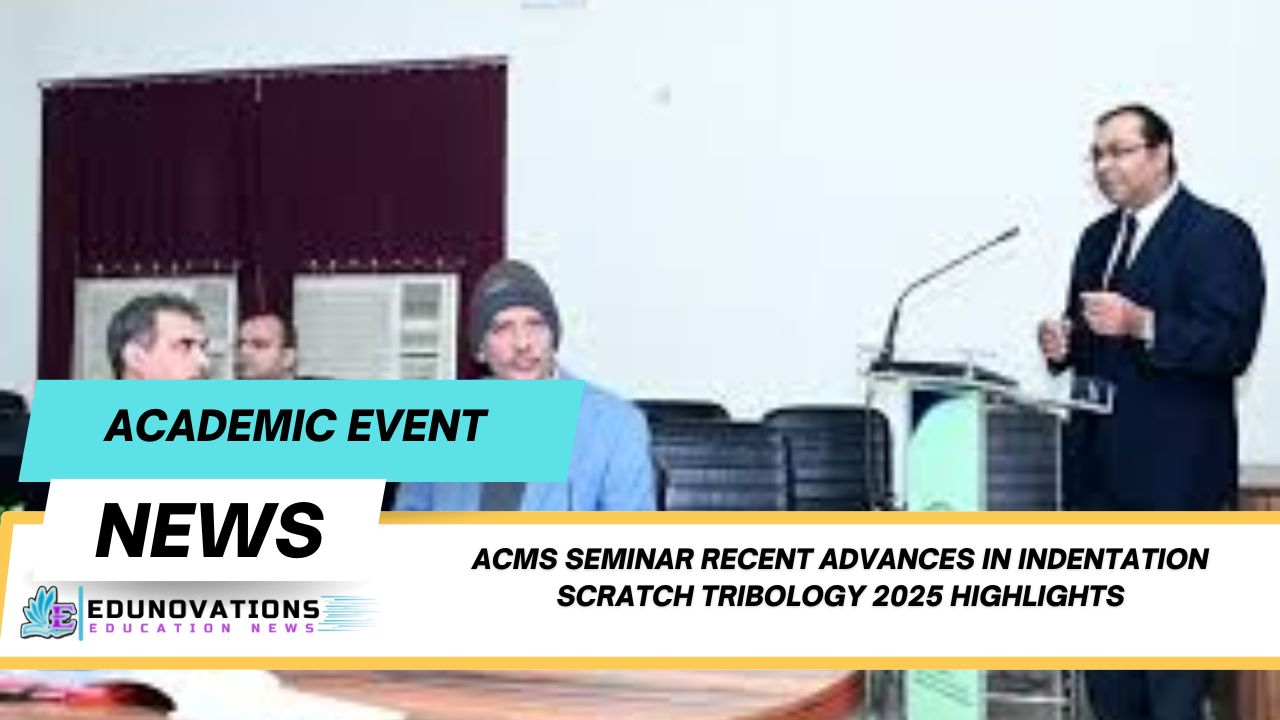
Explore detailed insights from the ACMS Seminar Recent Advances in Indentation Scratch Tribology 2025 at IIT Kanpur, covering nanoindentation, tribology, and materials science breakthroughs.
Introduction
The ACMS Seminar 2025 at the prestigious Indian Institute of Technology Kanpur marked a significant milestone in materials science research. Focusing on recent advances in indentation scratch tribology, the seminar attracted leading scholars, researchers, and industry experts from across India. Organized by the Advanced Centre for Material Science (ACMS), the event provided a platform for sharing cutting-edge research, innovative methodologies, and practical applications in nanoindentation and tribology.
As emerging technologies increasingly rely on material durability and surface characterization, seminars like ACMS 2025 are vital for bridging academic research and industrial application. Attendees gained exposure to advanced materials testing, characterization techniques, and analytical tools that shape the future of engineering materials.
Key Highlights of the Seminar
The one-day event featured a series of technical presentations, workshops, and panel discussions. Here’s a detailed overview of the seminar:
1. Nanoindentation and Tribology Sessions
Experts delved deep into nanoindentation techniques for evaluating material hardness, elastic modulus, and fracture behavior. These sessions highlighted:
- Latest methodologies in scratch testing and tribological analysis.
- Case studies demonstrating material performance under mechanical stress.
- Hands-on demonstrations for graduate students and early-career researchers.
These insights are crucial for materials science students seeking to understand the interaction between surface properties and material longevity.
2. Advanced Materials Characterization Techniques
Another major focus was on characterization techniques used to study materials at micro and nano scales. Topics included:
- Atomic force microscopy for surface analysis.
- Electron microscopy for high-resolution imaging.
- Surface wear analysis using scratch tribology.
These sessions enabled participants to comprehend the practical applications of materials testing in sectors like aerospace, automotive, and electronics manufacturing.
3. Panel Discussions and Expert Insights
The seminar included panels featuring renowned professors and industry leaders. Discussions centered on:
- Emerging trends in tribology research.
- Industrial adoption of nanoindentation methods.
- Collaborative research opportunities between IIT Kanpur and other institutions.
Dr. Rajeev Sharma, a leading expert in materials engineering, emphasized the importance of bridging theoretical research and practical industrial solutions, stating, “Understanding the mechanical behavior of materials at micro and nano scales is critical for designing next-generation durable products.”
4. Student and Researcher Engagement
The ACMS Seminar 2025 also prioritized student participation:
- Young researchers presented their ongoing studies on surface wear and scratch resistance.
- Interactive Q&A sessions facilitated knowledge transfer.
- Networking opportunities encouraged collaborations across institutions.
This focus on engagement ensures that the next generation of materials scientists are well-equipped to advance the field.
Importance of the Seminar in Materials Science
The ACMS seminar on recent advances in indentation scratch tribology underscores the critical role of academic gatherings in promoting scientific excellence. With industries increasingly demanding materials that withstand harsh conditions, seminars like this provide actionable insights into:
- Designing wear-resistant and durable materials.
- Enhancing product reliability through surface engineering.
- Accelerating the translation of laboratory research to industrial applications.
Moreover, by sharing the latest techniques in nanoindentation and scratch tribology, IIT Kanpur continues to solidify its position as a hub for materials science innovation.
Practical Applications of Learnings
The seminar’s findings have immediate relevance for various industrial sectors:
- Automotive Industry: Improving engine components and reducing wear in high-friction areas.
- Aerospace Engineering: Enhancing the durability of turbine blades and structural materials.
- Electronics: Ensuring reliability of microelectronic devices through surface hardness analysis.
- Biomedical Devices: Optimizing material performance in implants and prosthetics.
These applications demonstrate the tangible benefits of attending seminars and staying updated on materials characterization techniques.
Linkages and Resources
For students and researchers seeking further learning:
- Explore NCERT Courses for foundational knowledge on materials: NCERT Courses
- Stay updated with Current Affairs in education and science: Current Affairs
- Access detailed study notes on materials science topics: Notes
- Practice MCQs relevant to engineering and materials testing: MCQs
- Watch tutorials and lectures for hands-on insights: Videos
- Check syllabus for upcoming materials science courses: Syllabus
- Download free NCERT PDFs for study reference: Free PDFs
- Explore NCERT Mind Maps for better conceptual clarity: Mind Maps
- Contact authoritative sources for institutional collaborations: Mart India Infotech
Expert Opinions on Material Surface Research
Prof. Anjali Menon, a prominent tribology researcher, remarked, “Seminars like ACMS 2025 are invaluable for young researchers. Exposure to advanced characterization tools fosters innovation and enhances industry readiness.”
Additionally, industrial consultant Mr. Vikram Desai highlighted the seminar’s relevance: “Understanding scratch and wear mechanisms directly impacts product longevity and cost-efficiency. This knowledge is critical for sectors like automotive and electronics.”
Key Takeaways from ACMS Seminar 2025
- Emphasis on nanoindentation and tribology research for next-generation materials.
- Hands-on demonstrations bridging theoretical knowledge and practical applications.
- Student engagement and networking opportunities fostering collaborations.
- Industrial insights highlighting real-world applications.
- Cross-disciplinary discussions promoting research integration.
The seminar successfully combined academic rigor with practical relevance, ensuring attendees leave with actionable insights into indentation scratch tribology.
Conclusion
The ACMS Seminar 2025 on recent advances in indentation scratch tribology at IIT Kanpur was more than a gathering—it was a catalyst for innovation in materials science. By focusing on nanoindentation techniques, scratch analysis, and surface characterization, the seminar empowered students, researchers, and industry experts alike to advance the field.
For those keen to stay ahead in materials research and tribology, attending such seminars and accessing related resources is vital. Leveraging internal resources like NCERT Courses and Notes, alongside expert insights, ensures a well-rounded understanding of these cutting-edge developments.
Toppers Use Mind Maps to score more than 95%
NCERT Class 11th Commerce Mind Maps
Add to cartOriginal price was: ₹999.00.₹199.00Current price is: ₹199.00.NCERT Class 12th Chemistry Mind Maps
Add to cartOriginal price was: ₹199.00.₹75.00Current price is: ₹75.00.NCERT Class 12th Commerce Mind Maps
Add to cartOriginal price was: ₹999.00.₹199.00Current price is: ₹199.00.NCERT Class 12th Science Mind Maps
Add to cartOriginal price was: ₹999.00.₹199.00Current price is: ₹199.00.NCERT Mind Maps For Class 10th
Add to cartOriginal price was: ₹999.00.₹199.00Current price is: ₹199.00.
Purchase Today
FAQs: ACMS Seminar 2025
- What is the main focus of the ACMS Seminar 2025?
The seminar focuses on recent advances in indentation scratch tribology, nanoindentation, and materials characterization techniques. - Who organized the ACMS Seminar 2025?
It was organized by the Advanced Centre for Material Science (ACMS) at IIT Kanpur. - Which techniques were highlighted at the seminar?
Nanoindentation, scratch testing, tribology analysis, and surface characterization techniques. - How can students benefit from this seminar?
Students gain exposure to advanced materials research, hands-on demonstrations, and networking opportunities with experts. - What industries can apply the learnings from ACMS 2025?
Automotive, aerospace, electronics, biomedical devices, and other engineering sectors. - Were there expert panels in the seminar?
Yes, leading professors and industry experts discussed emerging trends and research collaborations. - Is there a way to access resources related to this seminar?
Yes, through NCERT Courses, Notes, Videos, and current affairs updates on educational portals. - Who provided industry insights during the seminar?
Consultants like Mr. Vikram Desai shared practical applications of indentation scratch tribology. - How does nanoindentation help in material analysis?
It measures hardness, elastic modulus, and surface deformation, crucial for designing durable materials. - Can students network with researchers at such seminars?
Yes, the seminar included interactive sessions and opportunities for collaboration across institutions.