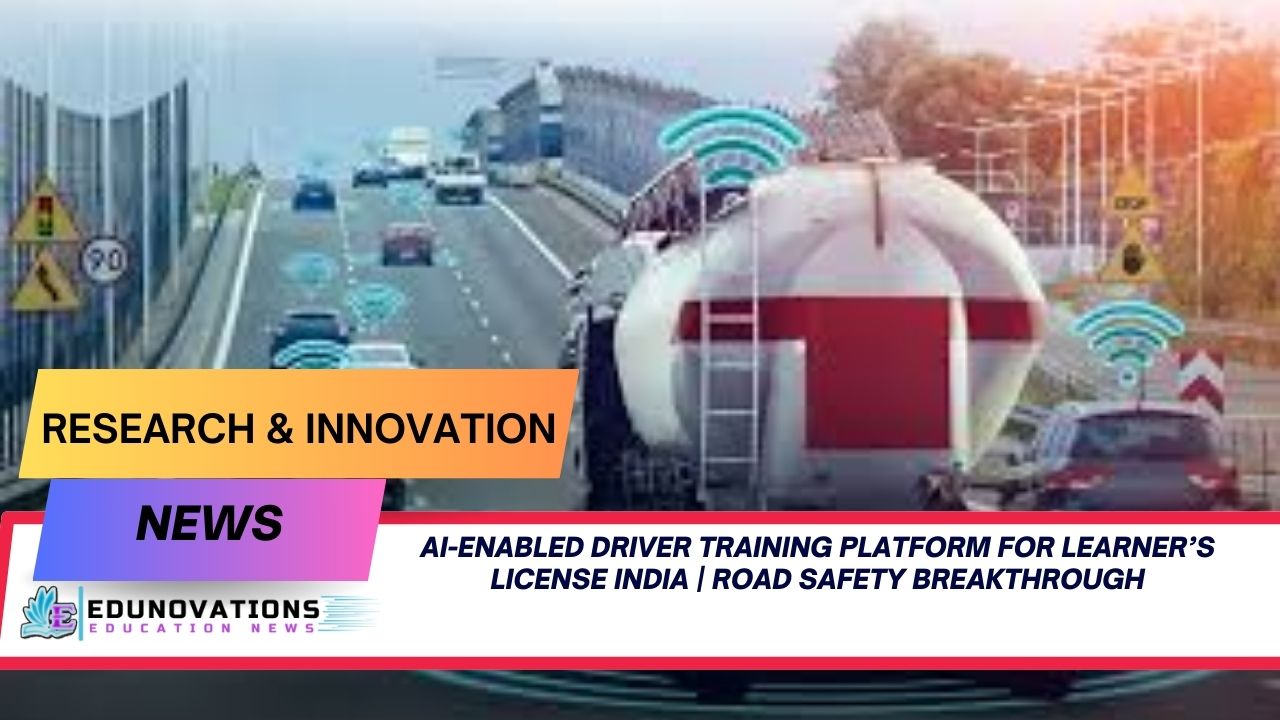
Discover how the AI-enabled driver training platform for learner’s license India is transforming road safety with personalised learning, expert insights, and future-ready driver readiness skills to reduce fatalities.
AI-Enabled Driver Training Platform for Learner’s License India: Revolutionising Pre-Licensing Education and Road Safety
New Delhi, India — In a landmark initiative aimed at reshaping driver education and reducing traffic fatalities, the AI-enabled driver training platform for learner’s license India has been officially launched by the Centre of Excellence for Road Safety (CoERS) at the Indian Institute of Technology Madras (IIT Madras). Unveiled during the AI for Road Safety session at the India AI Impact Summit 2026 held in New Delhi, this innovative platform—named ThinnAI—is an adaptive, personalised solution built with artificial intelligence to prepare aspiring drivers long before they approach licensing authorities.
According to Ministry of Road Transport and Highways (MoRTH) data, India suffers from about 1.7 lakh road fatalities each year, a statistic that strongly underscores the need for more effective driver education and safety interventions. ThinnAI directly targets this challenge by strengthening pre-licensing readiness, moving beyond rote memorisation and passive learning to deliver practical, behavioural skill development and risk-based assessments.
Understanding ThinnAI: A Personalized AI-Driven Pre-Licensing Trainer
ThinnAI is designed to bridge a critical gap in conventional driver licensing systems by offering a personalised AI enabled driver training platform for first time drivers India that goes far beyond textbook learning. It uses interactive, video game-like adaptive assessments to evaluate and bolster a candidate’s:
- Knowledge of traffic signs and road rules
- Understanding of motor vehicle dynamics
- Cognitive skills (risk perception, situational awareness, judgment)
- Physical readiness for driving
Unlike traditional classroom approaches, this AI-based traffic rules and cognitive driving assessment tool responds dynamically to the user’s performance, tailoring content to improve behavioural responses—making learning more effective and retention stronger.
Key Point: The platform is engineered to function without human intervention, allowing learners to access personalised modules anytime, anywhere.
Why India Needs AI-Powered Driver Education
India’s road safety crisis is deeply rooted in both systemic licensing issues and real-world behavioural deficits. Traditional licensing tests often focus on memorisation rather than critical thinking or on-road decision-making. This leads to large numbers of drivers passing exams without building essential safe driving instincts.
Experts estimate that human error accounts for a substantial proportion of accidents nationwide. As the number of vehicles increases, challenges intensify—reinforcing the need for modern, effective training aligned with real traffic conditions.
Dr. Venkatesh Balasubramanian, Head of CoERS and a Faculty member in the Department of Engineering Design at IIT Madras, stated that the emphasis on behavioural science and adaptive learning is what makes ThinnAI revolutionary. He explained that developing responsible road users—not just licensed drivers—is the ultimate purpose of the platform.
How ThinnAI Works: Features and Training Approach
ThinnAI’s design combines AI technology with evidence-based learning frameworks, including behavioural science principles. Key components include:
🔹 Adaptive Learning Modules
Learner’s progress through increasingly complex traffic scenarios adjusted in real-time based on their responses.
🔹 Cognitive and Situational Awareness Testing
This evaluates how well a user responds under simulated risk, prioritising judgment and reflex skills—essential traits for road safety.
🔹 Interactive Scenarios
ThinnAI uses multimedia and interactive visuals to create engaging simulations rather than static quizzes.
🔹 Custom Feedback Reports
After completing each assessment level, learners receive actionable insights to improve areas of weakness.
By addressing both knowledge and behaviour, the platform enhances readiness for official examination and real-life driving challenges.
Expert Perspectives: Empowering Road Users Through Technology
During the summit, experts from academia, policymaking, and industry echoed strong support for AI-centred approaches to improve road safety culture.
Shri Pankaj Agarwal, Chief Engineer, MoRTH, underscored that safe driving should be treated as a life skill integrated into educational curricula at school and college levels. He added that initiatives like ThinnAI are crucial for building responsible young drivers equipped with awareness and safety foresight.
Public policy experts also pointed out that combining AI with traditional training methods helps reduce the cognitive load on human instructors, while simultaneously standardising the learning process for every aspirant.
Research in traffic psychology suggests that of all major factors associated with crash involvement, behavioural response remains the most modifiable through structured training, further validating the importance of platforms like ThinnAI.
Supporting Initiatives: A Holistic Road Safety Framework
ThinnAI isn’t the only innovation showcased at the summit. CoERS also introduced key solutions designed to bolster road safety governance and community involvement:
🌐 RATH: AI-powered Data Governance Tool
RATH is an AI-enabled platform aimed at consolidating road safety data from stakeholders, enabling authorities to make data-driven decisions.
📍 Data-Driven Hyperlocal Interventions (DDHI)
This initiative supports community-level analysis and targeted safety measures to reduce crash hotspots across high-risk districts.
🚀 Road Safety Hackathon 2026
CoERS and MoRTH launched a nationwide hackathon to encourage young innovators to build hyperlocal AI tools that can strengthen enforcement, data analytics, and education interventions.
Together, these technologies create a multi-pronged roadmap to improve safety outcomes, enhance governance, and support behavioural transformation across all road users.
Benefits for First-Time Drivers and India’s Licensing Ecosystem
The road safety education platform to reduce India driver fatalities brings several tangible benefits:
- Reduced Learning Barriers: Learners can prepare effectively before official test dates.
- Cost-Efficient: Accessible digital resources reduce dependency on expensive training centres.
- Higher Safety Awareness: Focused cognitive training encourages risk perception and safer decision-making.
- Policy Alignment: Enhances synergy between technology, governance, and licensing systems.
Additionally, by providing personalised learning paths, ThinnAI aligns with global best practices in adaptive training—an approach that many high-income countries use to improve driver competency.
Looking Ahead: Scaling AI in Road Safety Education
With India’s roads experiencing continuous growth in vehicle numbers and increased urban mobility challenges, scalable solutions are key. AI-enabled driver education tools like ThinnAI promise:
- Integration into national learner licensing programs
- Partnership opportunities with educational institutions
- Expansion into continuous driver education and refresher modules
Experts believe that embedding such systems into policy frameworks—and promoting collaboration between government, academia, and industry—can dramatically improve safety outcomes over the next decade.
Toppers Use Mind Maps to score more than 95%
NCERT Class 11th Commerce Mind Maps
Add to cartOriginal price was: ₹999.00.₹199.00Current price is: ₹199.00.NCERT Class 12th Chemistry Mind Maps
Add to cartOriginal price was: ₹199.00.₹75.00Current price is: ₹75.00.NCERT Class 12th Commerce Mind Maps
Add to cartOriginal price was: ₹999.00.₹199.00Current price is: ₹199.00.NCERT Class 12th Science Mind Maps
Add to cartOriginal price was: ₹999.00.₹199.00Current price is: ₹199.00.NCERT Mind Maps For Class 10th
Add to cartOriginal price was: ₹999.00.₹199.00Current price is: ₹199.00.



Purchase Today
10 FAQs on AI-Enabled Driver Training and ThinnAI
- What is the AI-enabled driver training platform for learner’s license India?
It’s an AI-driven platform called ThinnAI designed to prepare aspiring drivers with personalised training and assessments before they obtain a learner’s licence. - How does ThinnAI improve driver readiness?
ThinnAI uses adaptive learning modules and cognitive scenarios to build risk perception, situational awareness, and responsible decision-making. - Can ThinnAI replace traditional driving schools?
It complements traditional schools by providing personalised training before real-world instruction and licensing tests. - Is ThinnAI effective for first-time drivers?
Yes, because it tailors learning to individual strengths and weaknesses, enhancing preparedness for real-life driving conditions. - What makes ThinnAI different from other AI programmes?
Its focus on behavioural outcomes, interactive assessments, and zero-human intervention training sets it apart. - Does ThinnAI include traffic rules and road signs education?
Yes—traffic rules, signs, and motor vehicle knowledge are core components of training. - Who can benefit from the platform?
Aspiring drivers, policymakers, road safety educators, and licensing authorities can benefit. - Is ThinnAI available nationwide?
It is currently being tested and showcased; wide rollout depends on policy adoption. - How does this platform reduce road fatalities?
By improving driver behaviour and readiness before licensing, thereby reducing errors that lead to crashes. - Can other organisations collaborate on ThinnAI development?
Potentially, as CoERS encourages partnerships with educators, technologists, and safety advocates.