
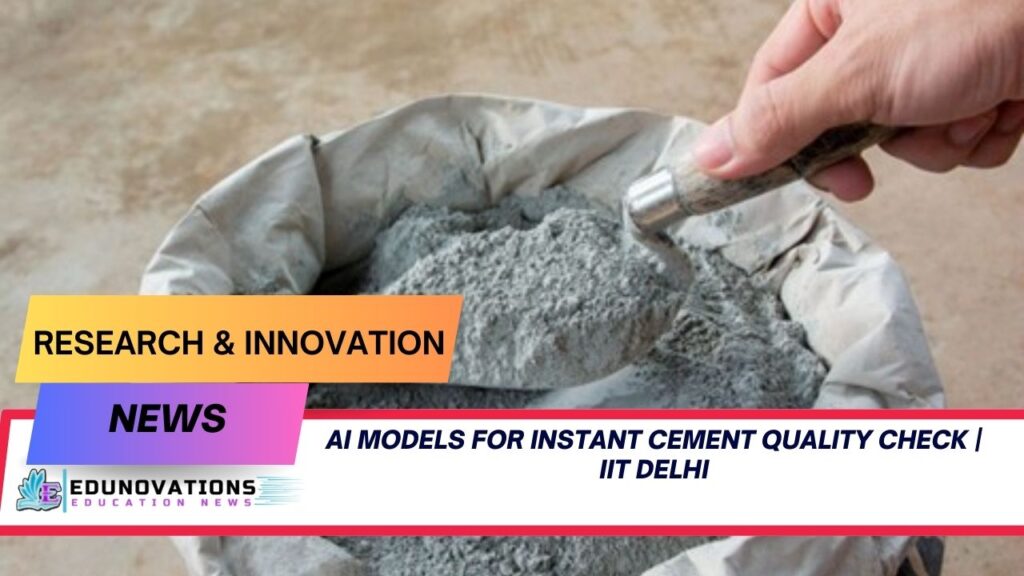
Discover how IIT Delhi’s AI models revolutionize cement quality assessment, enabling real-time predictions and enhancing industry sustainability.
Introduction
In a significant advancement for the construction industry, researchers at the Indian Institute of Technology (IIT) Delhi have developed artificial intelligence (AI) models capable of instantly predicting the quality of cement clinker. This breakthrough promises to drastically reduce delays and minimize waste across the cement industry, marking a pivotal step towards more efficient and sustainable construction practices.
Toppers Use Mind Maps to score more than 95%
-
NCERT Class 11th Commerce Mind Maps
Add to cartOriginal price was: ₹999.00.₹199.00Current price is: ₹199.00. -
NCERT Class 12th Chemistry Mind Maps
Add to cartOriginal price was: ₹199.00.₹75.00Current price is: ₹75.00. -
NCERT Class 12th Commerce Mind Maps
Add to cartOriginal price was: ₹999.00.₹199.00Current price is: ₹199.00. -
NCERT Class 12th Science Mind Maps
Add to cartOriginal price was: ₹999.00.₹199.00Current price is: ₹199.00. -
NCERT Mind Maps For Class 10th
Add to cartOriginal price was: ₹999.00.₹199.00Current price is: ₹199.00.





Purchase Today
The Traditional Cement Quality Assessment Process
Traditionally, cement quality is assessed by passing high-energy X-rays through clinker, the partially processed form of cement. This process can take up to four hours, often resulting in reprocessing if problems are detected. Such delays not only waste time but also lead to significant material and energy losses, underscoring the need for more efficient quality control methods.Facebook+6Indian Institute of Technology Delhi+6TimelineDaily+6The New Indian Express+3The Tribune+3The Tribune+3
The Role of AI in Revolutionizing Cement Quality Checks
Addressing these challenges, the team at IIT Delhi, led by PhD scholar Sheikh Junaid Fayaz under the supervision of Professor N.M. Anoop Krishnan, has developed AI models that can perform the same quality assessment in mere fractions of a second. These models deliver predictions in just 1/100 of a second, making quality control a million times faster than traditional methods. This rapid assessment allows engineers to adjust plant parameters in real-time, ensuring target quality is achieved before production, rather than relying on delayed post-production checks.
Impact on the Cement Industry
The implications of this innovation are profound. Cement production is one of the world’s most carbon-intensive processes, contributing nearly 8% to global carbon emissions. With over 4.1 billion tonnes produced annually, improving the efficiency and sustainability of cement manufacturing has become an urgent priority. By enabling real-time quality assessments, IIT Delhi’s AI models help reduce energy consumption and material waste, contributing to more sustainable production practices.
Broader Applications of AI in Industrial Practices
The significance of this work extends beyond cement manufacturing. It showcases how AI can modernize traditional industrial practices and support sustainability targets. Given the strong performance of these models, several cement plants globally have already shown interest in adopting this technology. This development encourages wider AI integration across various sectors, paving the way for more intelligent and sustainable industrial practices.
Future Prospects and Industry Adoption
The research team envisions a future where AI-driven quality assessments become standard practice in the cement industry. By reducing reliance on energy-intensive X-ray analyses and enabling real-time adjustments, these AI models not only enhance efficiency but also promote environmental sustainability. The growing interest from global cement plants indicates a promising trajectory for the widespread adoption of this technology.
Conclusion
IIT Delhi’s development of AI models for instantaneous cement quality checks marks a significant milestone in the quest for more efficient and sustainable construction practices. By leveraging advanced AI techniques, the team has addressed long-standing challenges in the cement industry, offering solutions that reduce delays, minimize waste, and support environmental sustainability. As the industry moves towards greater adoption of AI technologies, this innovation stands as a testament to the transformative potential of artificial intelligence in industrial applications.
Frequently Asked Questions (FAQs)
- What is the focus of IIT Delhi’s recent research?
- The research focuses on developing AI models for instantaneous quality assessment of cement clinker.
- How do these AI models compare to traditional methods?
- Traditional methods can take up to four hours, while the AI models provide predictions in just 1/100 of a second.
- What are the environmental implications of this innovation?
- The AI models help reduce energy consumption and material waste, contributing to more sustainable cement production.
- Who led the research at IIT Delhi?
- The research was led by PhD scholar Sheikh Junaid Fayaz under the supervision of Professor N.M. Anoop Krishnan.
- Where was the research published?
- The study was published in the journal Communications Engineering.
- How does AI improve cement quality assessment?
- AI models enable real-time predictions, allowing for immediate adjustments in plant parameters to ensure target quality.
- What is the significance of this development for the construction industry?
- It offers a faster, more efficient, and environmentally friendly alternative to traditional quality control methods.
- Are other industries adopting similar AI technologies?
- Yes, the success of this model encourag
- What future developments are expected in this area?
- The research team envisions broader adoption of AI-driven quality assessments in the cement industry.
- How can other industries benefit from this innovation?
- The principles of real-time AI quality assessment can be applied to other industries seeking to improve efficiency and sustainability.