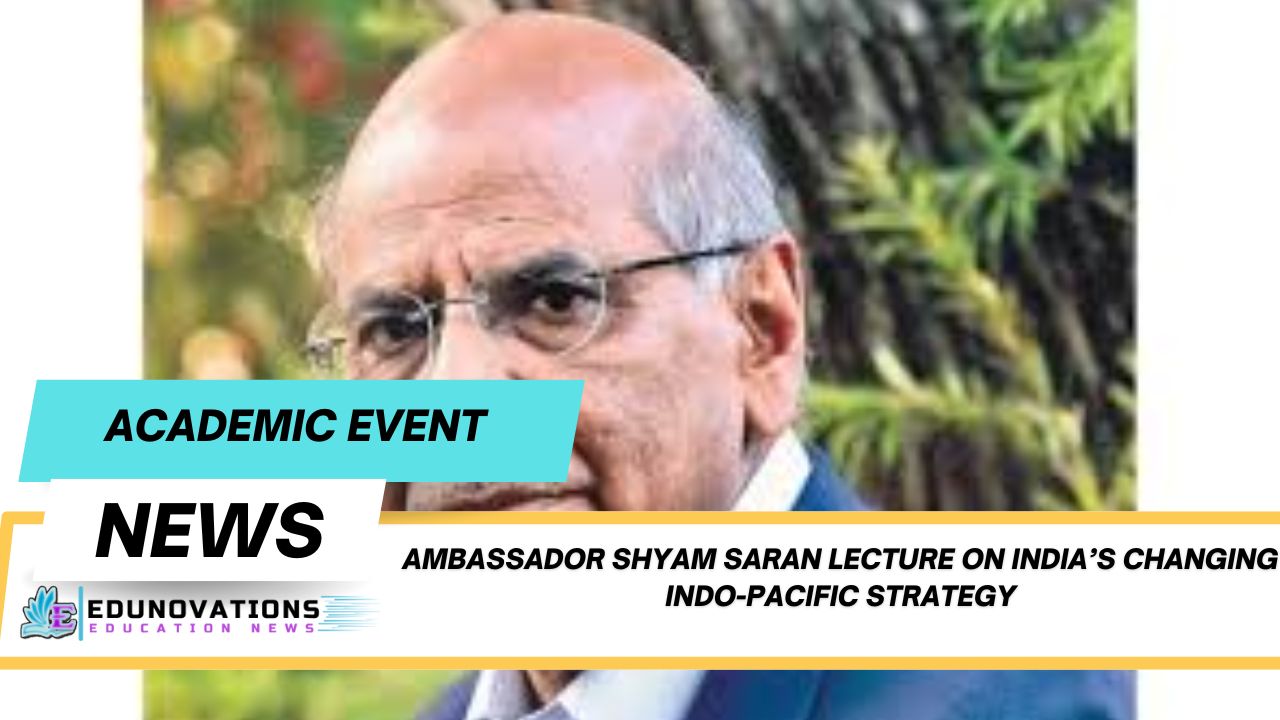
Ambassador Shyam Saran lecture on India’s changing Indo-Pacific strategy offers deep insights on global power shifts, India’s foreign policy priorities, South Asia relations, and geopolitical realignments.
The Ambassador Shyam Saran lecture on India’s changing Indo-Pacific strategy at Ashoka University brought forward a timely examination of global political realignments that are reshaping India’s diplomatic and strategic outlook. In an era where geopolitical dynamics have become increasingly fluid, Ambassador Shyam Saran emphasized the need for India to navigate a landscape where older alliances are weakening, new power blocs are emerging, and regional responses must adapt to both opportunities and risks.
The Ambassador Shyam Saran lecture on India’s changing Indo-Pacific strategy provided insights not merely as academic reflection but as the perspective of a veteran diplomat who has observed India’s diplomacy evolve through diverse international phases. Having served as India’s Foreign Secretary and key strategic advisor, Shyam Saran’s understanding is rooted in negotiation rooms, crisis dialogues, and policy decision-making processes. His talk at Ashoka University encouraged students, researchers, and policy circles to consider geopolitics not as distant statecraft but as an influence that shapes economies, cultures, and everyday lives.
The lecture highlighted how “Geopolitics is now everybody’s business,” urging individuals to recognize the interconnectedness of global events, supply chains, inflation, tech policy, climate change, and regional stability. This framing aligns closely with global education trends that emphasize awareness of diplomacy, international cooperation, and power shifts as core elements shaping the 21st century world.
The Ambassador Shyam Saran lecture on India’s changing Indo-Pacific strategy also shed light on how India perceives developments in multiple regions including the United States, Europe, China, South Asia, and Russia. According to him, India is positioned uniquely as a balancing actor. Rather than aligning strictly with any single bloc, India is increasingly shaping an independent strategic identity—asserting sovereignty while building partnerships to support economic and security goals.
India’s Strategic Environment: Global Power Shifts
The global order has witnessed significant transformation over the last two decades. The rise of China, internal polarization in the United States, transitions in European leadership, and Russia’s geopolitical assertiveness have collectively influenced India’s diplomatic choices. The Ambassador Shyam Saran lecture on India’s changing Indo-Pacific strategy explained how India’s foreign policy today seeks flexibility, depth, and autonomy.
Saran noted that the United States, once primarily focused on the Western Hemisphere, has increasingly shifted attention to the Indo-Pacific region due to strategic competition with China. For India, this shift creates opportunities for expanded cooperation in defense, trade, and technology, but also demands careful calibration to avoid dependency or strategic overextension.
India’s ability to maintain strong relations with the U.S. while sustaining defense and energy ties with Russia demonstrates its commitment to a multi-alignment approach. The Ambassador Shyam Saran lecture on India’s changing Indo-Pacific strategy emphasized that India should continue cultivating relationships that advance national interests without being drawn into exclusive partnership frameworks.
India-China Dynamics: Managing Competition and Stability
The Ambassador Shyam Saran lecture on India’s changing Indo-Pacific strategy addressed the sensitive and evolving relationship between India and China. While economic interdependence remains significant, border tensions and strategic competition in Asia have heightened diplomatic challenges.
India seeks to maintain equilibrium—managing conflict through dialogue while strengthening military preparedness and supply chain resilience. Saran argued that stability with China is necessary but must not lead to strategic complacency. The relationship demands a combination of engagement, deterrence, and collaboration with other regional partners.
India’s Role in South Asia: Neighborhood First
The lecture highlighted that India’s immediate neighborhood remains central to its foreign policy priorities. The most pressing diplomatic work often occurs closest to home. The Ambassador Shyam Saran lecture on India’s changing Indo-Pacific strategy stressed strengthening relations with Nepal, Bhutan, Sri Lanka, Bangladesh, and the Maldives through development partnerships, cultural ties, and infrastructural support.
Regional stability enhances economic growth and supports India’s international influence. However, China’s rising influence in South Asia poses challenges requiring proactive engagement and long-term trust building with neighboring nations.
The Indo-Pacific as a Shared Strategic Space
The Indo-Pacific region represents one of the most economically dynamic and politically contested zones in the world. Maritime trade routes, technological supply networks, and energy corridors run through this region. The Ambassador Shyam Saran lecture on India’s changing Indo-Pacific strategy underlined that India must safeguard its maritime interests, support freedom of navigation, and promote cooperation through multilateral platforms such as:
- BIMSTEC
- QUAD
- IORA
- ASEAN partnerships
These partnerships allow India to shape rules that ensure regional openness, growth, and strategic balance.
Why Geopolitics Matters for Ordinary Citizens
The Ambassador Shyam Saran lecture on India’s changing Indo-Pacific strategy highlighted that geopolitical decisions impact common citizens through:
- Energy prices and fuel costs
- Digital and data privacy regulations
- Technology access and innovation
- Manufacturing, jobs, and trade
- Regional migration and border stability
Understanding foreign policy empowers citizens to interpret media, elections, economic trends, and international developments more responsibly.
Internal & External Learning Resources (Add Value for Students)
To continue building knowledge related to global politics and India’s strategic environment, learners may refer to:
Internal Learning Resources
- NCERT Courses: https://courses.edunovations.com/
- Current Affairs: https://edunovations.com/currentaffairs/
- Notes: https://edunovations.com/notes/
- MCQs: https://edunovations.com/mcq/
- Videos: https://edunovations.com/videos/
- Syllabus: https://edunovations.com/syllabus/
- NCERT PDFs & Mind Maps: https://courses.edunovations.com/shop-2/
External Academic Support
Schools and institutions seeking website development support can explore Mart India Infotech at
https://www.martindiainfotech.com/
Toppers Use Mind Maps to score more than 95%
NCERT Class 11th Commerce Mind Maps
Add to cartOriginal price was: ₹999.00.₹199.00Current price is: ₹199.00.NCERT Class 12th Chemistry Mind Maps
Add to cartOriginal price was: ₹199.00.₹75.00Current price is: ₹75.00.NCERT Class 12th Commerce Mind Maps
Add to cartOriginal price was: ₹999.00.₹199.00Current price is: ₹199.00.NCERT Class 12th Science Mind Maps
Add to cartOriginal price was: ₹999.00.₹199.00Current price is: ₹199.00.NCERT Mind Maps For Class 10th
Add to cartOriginal price was: ₹999.00.₹199.00Current price is: ₹199.00.




Purchase Today
10 FAQs
- What was the main theme of the Ambassador Shyam Saran lecture on India’s changing Indo-Pacific strategy?
It focused on how global shifts require India to adopt flexible and autonomous diplomacy. - Why does the Indo-Pacific matter for India?
It influences India’s maritime security, trade, technology cooperation, and regional power balance. - How does India balance relations with the U.S. and Russia?
Through multi-alignment that supports national interests over alliance dependency. - What role does China play in shaping India’s strategic choices?
China’s regional influence and border issues require both engagement and deterrence. - Why is South Asia crucial for India’s foreign policy?
Shared cultural ties, economic interdependence, and strategic geography make the region essential. - How did Shyam Saran describe U.S. global shifts?
The U.S. is increasingly focused on the Indo-Pacific, shaping India’s diplomatic partnerships. - How can students learn more about Indian foreign policy?
Through NCERT political science materials and curated current affairs resources. - What does geopolitical awareness mean for everyday citizens?
It shapes fuel prices, employment, technology access, and security environments. - Which regional organizations support India’s Indo-Pacific engagement?
QUAD, BIMSTEC, ASEAN partnerships, and IORA. - Why is strategic autonomy important for India today?
It ensures independent decision-making in a rapidly shifting world order.