
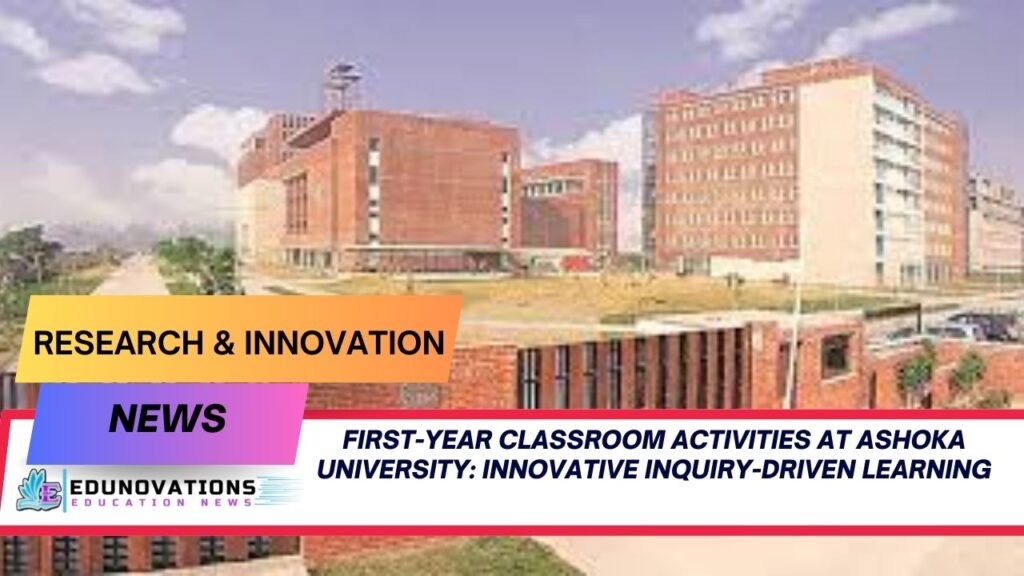
Explore how Ashoka University transforms first-year classroom activities with inquiry-driven learning, interdisciplinary experiences, and critical thinking.
Introduction: Redefining the First-Year Experience
Ashoka University has long been recognized for its commitment to liberal arts education, emphasizing holistic development over rote memorization. The university’s inquiry-driven first year classroom activities at Ashoka University are designed to cultivate curiosity, critical thinking, and interdisciplinary knowledge among students. Unlike traditional lecture-based education, Ashoka’s approach focuses on dialogue, exploration, and hands-on learning experiences, creating a transformative environment for its undergraduates.
According to educational experts, inquiry-based learning encourages students to actively construct knowledge rather than passively consume information. This approach has been linked to higher retention rates and enhanced problem-solving skills, making it a crucial model for modern liberal arts institutions.
The Inquiry-Driven Learning Model
At the heart of the first-year experience is inquiry-driven learning, which challenges students to question assumptions, conduct independent research, and collaborate with peers. Ashoka University structures its curriculum to include:
- Small-group discussions: Classes are intentionally kept small to allow personalized attention and in-depth dialogue.
- Interactive assignments: Students engage in projects, case studies, and fieldwork that relate theory to real-world scenarios.
- Cross-disciplinary perspectives: By integrating courses across humanities, social sciences, and natural sciences, students develop a holistic understanding of complex topics.
This model ensures that students do not merely memorize content but actively participate in constructing knowledge, fostering a lifelong love for learning.
Interdisciplinary Learning in Practice
Interdisciplinary classroom learning experience for Ashoka undergraduates is a hallmark of the institution. First-year students often encounter subjects that blend philosophy, economics, literature, and political science. For instance:
- A seminar on governance may include historical case studies, statistical analyses, and philosophical debates on justice.
- Literature classes often incorporate social science perspectives, encouraging students to analyze texts within societal contexts.
- Science courses integrate ethical considerations, prompting students to explore the societal impact of technological advancements.
Such interdisciplinary learning not only broadens students’ intellectual horizons but also prepares them for nuanced decision-making in professional and civic life.
Student Perspectives on the First-Year Journey
For students, the first year at Ashoka University is both challenging and rewarding. Student perspectives on first-year inquiry-based teaching Ashoka reveal that:
- Many students initially struggle with the shift from traditional rote learning to discussion-led classes.
- Peer collaboration becomes essential, fostering teamwork and communication skills.
- Exposure to diverse disciplines sparks curiosity and encourages students to explore new academic interests.
One student noted, “The first-year classroom isn’t just about lectures; it’s about learning how to think critically and engage meaningfully with ideas.”
Critical Thinking as a Core Competency
A key outcome of how Ashoka University teaches critical thinking to first-year students is the development of analytical and evaluative skills. Classes are designed to challenge assumptions, encourage debate, and nurture independent thought. For example:
- Assignments require students to present arguments supported by evidence.
- Peer critiques help refine reasoning and presentation skills.
- Faculty often employ Socratic questioning to probe deeper understanding and clarity of thought.
This emphasis on critical thinking ensures that graduates are not just knowledgeable but also equipped to tackle complex societal issues with reasoned judgment.
Unique Classroom Activities and Methodologies
What to expect in a first-year liberal arts classroom at university like Ashoka extends beyond standard lectures. Students participate in:
- Debates and panel discussions: Encouraging diverse viewpoints.
- Hands-on workshops: Applying theoretical knowledge in practical scenarios.
- Research projects: Promoting self-directed inquiry and analytical skills.
- Reflection exercises: Fostering personal growth and ethical reasoning.
These activities are meticulously designed to align with the university’s ethos of student-centered learning.
The Role of Faculty in Shaping Learning
Faculty at Ashoka University play a pivotal role in facilitating inquiry-driven first year classroom activities at Ashoka University. Their responsibilities include:
- Mentoring students to explore interdisciplinary connections.
- Designing curriculum that balances rigor with flexibility.
- Creating an environment where questions are valued as much as answers.
Professors often collaborate across departments to offer joint courses, reflecting the university’s commitment to holistic education.
Integrating Technology and Modern Pedagogy
Modern pedagogy at Ashoka University leverages technology to enhance learning outcomes. Students use digital resources, online forums, and collaborative platforms to:
- Conduct research efficiently.
- Engage in virtual discussions and simulations.
- Access multimedia content to complement classroom teaching.
This integration of technology ensures that inquiry-driven first-year classrooms remain dynamic, interactive, and accessible.
Preparing Students for Global Challenges
The university’s approach to liberal arts education, particularly in first-year classrooms, equips students with skills that extend beyond academics. By fostering interdisciplinary classroom learning experience for Ashoka undergraduates, students develop:
- Critical problem-solving abilities.
- Cultural and social awareness.
- Leadership and ethical decision-making skills.
Such preparation is invaluable for careers in policy, academia, business, and social entrepreneurship.
Linking Education with Community Engagement
Ashoka University encourages students to apply classroom knowledge to real-world contexts. Programs often include:
- Social projects with local communities.
- Internships with NGOs and civic organizations.
- Workshops on sustainability, governance, and social justice.
This reinforces the practical relevance of student perspectives on first-year inquiry-based teaching Ashoka.
Expert Insights on Inquiry-Based Learning
Educational experts emphasize that inquiry-driven learning models, such as those at Ashoka University, have a measurable impact on student success. According to Dr. Radhika Menon, a leading education consultant: “When students actively participate in constructing knowledge, retention improves by up to 60% compared to traditional teaching methods.”
Such insights validate Ashoka University’s innovative approach to liberal arts education, highlighting its potential to serve as a model for other institutions.
Conclusion: Transformative First-Year Experience
Ashoka University’s first-year classrooms exemplify a progressive, inquiry-driven first year classroom activities at Ashoka University model. Students leave with a stronger sense of intellectual curiosity, critical thinking, and the ability to connect knowledge across disciplines.
For aspiring undergraduates, understanding how Ashoka University teaches critical thinking to first-year students can provide guidance on navigating liberal arts education. The first-year journey is a stepping stone to becoming a reflective, capable, and socially responsible graduate.
Toppers Use Mind Maps to score more than 95%
-
NCERT Class 11th Commerce Mind Maps
Add to cartOriginal price was: ₹999.00.₹199.00Current price is: ₹199.00. -
NCERT Class 12th Chemistry Mind Maps
Add to cartOriginal price was: ₹199.00.₹75.00Current price is: ₹75.00. -
NCERT Class 12th Commerce Mind Maps
Add to cartOriginal price was: ₹999.00.₹199.00Current price is: ₹199.00. -
NCERT Class 12th Science Mind Maps
Add to cartOriginal price was: ₹999.00.₹199.00Current price is: ₹199.00. -
NCERT Mind Maps For Class 10th
Add to cartOriginal price was: ₹999.00.₹199.00Current price is: ₹199.00.

Purchase Today
FAQs: Inquiry-Driven First-Year Classrooms at Ashoka University
- What are inquiry-driven first-year classroom activities at Ashoka University?
Activities focus on student participation, research, and cross-disciplinary learning. - How do interdisciplinary classroom learning experiences benefit Ashoka undergraduates?
They enhance critical thinking, problem-solving, and holistic understanding. - What to expect in a first-year liberal arts classroom at university like Ashoka?
Small-group discussions, debates, workshops, and research projects. - How does Ashoka University teach critical thinking to first-year students?
Through Socratic questioning, peer critique, and evidence-based assignments. - Why are student perspectives on first-year inquiry-based teaching Ashoka important?
They reflect engagement, adaptability, and real learning outcomes. - What makes Ashoka’s first-year classrooms different from traditional models?
Emphasis on dialogue, active participation, and interdisciplinary study. - How do faculty shape inquiry-driven learning at Ashoka University?
By mentoring students, designing engaging curriculum, and encouraging questions. - What role does technology play in first-year classrooms at Ashoka?
It supports research, online collaboration, and multimedia learning. - How does Ashoka prepare students for global challenges?
By fostering critical thinking, cultural awareness, and ethical decision-making. - Can low DA educational websites write about first-year Ashoka classrooms for SEO?
Yes, by targeting long-tail keywords, creating unique content, and linking to authoritative sources.