
Discover how the cisf c3ihub iit kanpur residential cybersecurity training curriculum empowers security forces against modern threats with advanced tech.
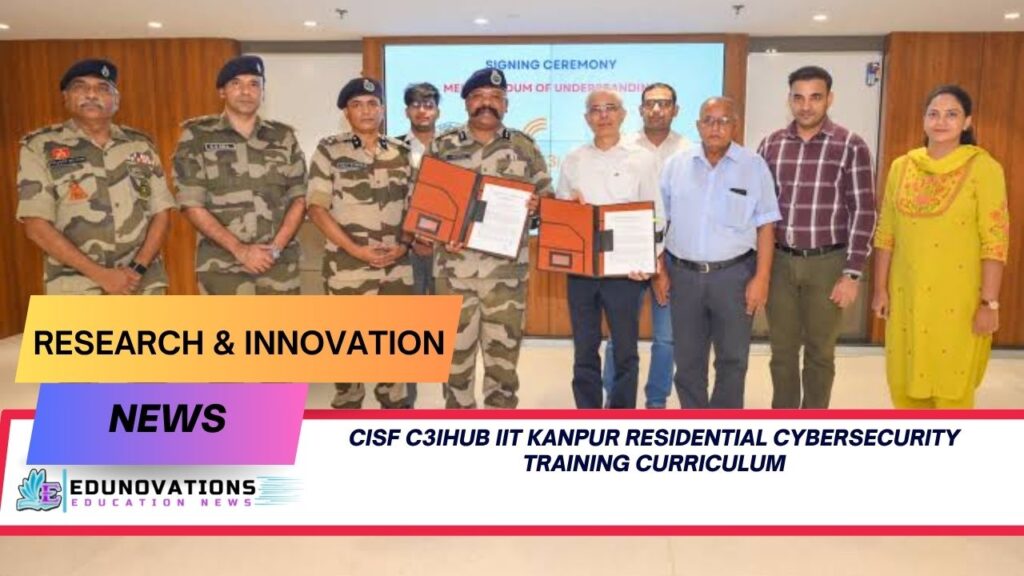
The landscape of national security is undergoing a monumental shift as digital transformation redefines traditional defense paradigms. Physical perimeters are no longer the sole battleground; today, critical national infrastructure—ranging from nuclear installations and industrial complexes to international airports—faces continuous, highly sophisticated cyber threats. Recognizing this urgent reality, the Central Industrial Security Force (CISF) and C3iHub, the Cybersecurity Technology Innovation Hub at the Indian Institute of Technology Kanpur (IIT Kanpur), signed a historic Memorandum of Understanding (MoU). This strategic partnership establishes an intensive, specialized training initiative aimed at fortifying India’s defense mechanism against modern cyber warfare.
The collaboration centers around the creation of a comprehensive cisf c3ihub iit kanpur residential cybersecurity training curriculum. Designed by elite academics and veteran cyber practitioners, this program equips paramilitary personnel with real-world skills to combat complex digital vectors. As state-sponsored actors and cybercriminal syndicates target sensitive installations, this proactive training model represents a decisive step toward safeguarding India’s economic and strategic assets.
To stay updated on contemporary national security policies and general knowledge requirements, explore our comprehensive Current Affairs portal.
Strategic Significance of the CISF-C3iHub Cybersecurity MoU
The Central Industrial Security Force plays a crucial role in maintaining security across India’s core infrastructure. Safeguarding petroleum refineries, space research facilities, seaports, and major metro systems requires more than physical vigilance; it demands continuous monitoring of networked supervisory control and data acquisition (SCADA) networks, industrial control systems (ICS), and cloud-managed command centers.
C3iHub, established under the National Mission on Interdisciplinary Cyber-Physical Systems (NM-ICPS) by the Department of Science and Technology, Government of India, offers the ideal technological ecosystem for this mission. By pairing cutting-edge academic innovation with operational paramilitary protocols, the two organizations establish a powerful defense alliance.
Key Strategic Objectives:
- Capacity Building: Upskilling specialized paramilitary cohorts in proactive threat detection, vulnerability remediation, and digital asset defense.
- Infrastructure Security: Shielding critical national infrastructure from disruption, data breaches, and ransomware attacks.
- Hands-on Exposure: Moving beyond theoretical instruction to provide immersive laboratory exercises, live malware reverse-engineering, and simulated cyber warfare drills.
- Standard Operating Procedures (SOPs): Establishing clear, standardized incident response guidelines across all CISF units managing sensitive installations.
Students and aspirants looking to build foundational knowledge on national institutions can refer to NCERT Courses for detailed academic material.
Architectural Breakdown of the Specialized Training Program
The centerpiece of this collaboration is a structured, six-week intensive residential program conducted on the IIT Kanpur campus. Each cohort comprises 40 selected CISF personnel, ensuring an optimal instructor-to-trainee ratio for deep practical immersion. The initiative operates on a completely non-commercial, free-of-cost basis, prioritizing national security readiness above all.
The training methodology follows a progressive educational framework:
[Phase 1: Core IT & Networking Fundamentals]
                 │
                 ▼
[Phase 2: Specialized Cyber Defense & Incident Response]
                 │
                 ▼
[Phase 3: Deep Tech Exposure (AI, Cloud, IoT/OT)]
                 │
                 ▼
[Phase 4: Multi-Sector Crisis Simulation & Red-Teaming]
Modular Structure Overview
| Module Focus Area | Core Competencies Taught | Practical Tools & Lab Environment |
| Foundational IT & Networks | OSI model, TCP/IP stack security, packet analysis, network architecture hardening | Wireshark, Nmap, TCPdump |
| Digital Forensics & IR | Memory forensics, log evaluation, chain of custody preservation, malware analysis | Autopsy, Volatility, FTK Imager |
| Vulnerability Assessment | Pen-testing methodologies, static/dynamic code analysis, patch management | Nessus, Burp Suite, Metasploit |
| Emerging Technologies | AI/ML threat detection, IoT device security, cloud architecture defenses | AWS Security, Azure Sentinel, custom sandbox environments |
This immersive environment ensures that trainees gain practical skills rather than merely memorizing theoretical concepts.
Addressing Evolving Cyber Threat Vectors in Critical Sectors
The digital attack surface is expanding rapidly. Cyber threats are no longer restricted to simple phishing scams or defacement attacks. Modern threat groups leverage artificial intelligence, zero-day vulnerabilities, and automated exploit kits to infiltrate high-value targets.
1. Artificial Intelligence and Deepfakes
Generative AI tools allow adversary groups to synthesize highly convincing voice clones and hyper-realistic deepfake videos. These techniques can impersonate high-ranking officers, bypass biometric verification steps, or manipulate media channels during crisis situations. Trainees undergo rigorous modules designed to identify synthetic media anomalies and secure identity management pipelines.
2. Supply Chain and Third-Party Vulnerabilities
Modern infrastructure relies on extensive software supply chains, third-party vendor applications, and proprietary hardware firmwares. A single vulnerability in a third-party driver can compromise an entire air-gapped facility network. Training modules emphasize strict supply-chain auditing, software bill of materials (SBOM) evaluations, and zero-trust framework enforcement.
3. Cloud Security & Cyber-Physical Systems (CPS)
As government agencies transition workloads to hybrid cloud platforms, securing multi-tenant cloud environments becomes imperative. Furthermore, cyber-physical systems—where software routines control physical actuators, valves, and power switches—demand specialized defense mechanisms. Trainees learn to secure both traditional IT clouds and operational technology (OT) field devices.
To review foundational topics covering IT security, communication systems, and general science, consult our curated Notes section.
Multi-Sector Crisis Simulation: The Ultimate Practical Benchmark
A defining highlight of the program is its capstone event: a comprehensive, multi-sector crisis simulation exercise. Held toward the end of the six-week period, this exercise places participants into dynamic red-team versus blue-team operational scenarios designed to replicate real-world cyber incidents.
       [Adversary Simulation / Red Team]
                     │
                     ▼ (Ransomware / Zero-Day Exploit)
        ┌─────────────────────────┐
        │  Target System (SCADA)  │
        └─────────────────────────┘
                     ▲
                     │ (Monitoring & Rapid Response)
       [CISF Defense Cohort / Blue Team]
During this capstone exercise, participants face complex, multi-stage attacks:
- Phase One – Infiltration: Simulated attackers initiate a zero-day exploit targeting an industrial facility’s public-facing VPN portal.
- Phase Two – Lateral Movement: The threat actor attempts to move horizontally through internal subnets toward critical OT controllers.
- Phase Three – Incident Containment: The CISF defense cohort must identify anomalous traffic, isolate compromised segments without shutting down vital services, and preserve digital evidence for forensic analysis.
- Phase Four – Executive Debriefing: Trainees present an incident report detailing root causes, mitigation steps, and future preventive measures.
This rigorous simulation builds tactical confidence, sharpens decision-making under stress, and reinforces collaborative problem-solving skills across operational teams.
For students preparing for competitive examinations related to public administration, computer science, or general studies, reviewing subject-specific MCQ’s can significantly improve exam readiness.
Leadership Perspectives on National Cyber Readiness
The official signing of the MoU brought together key academic, scientific, and security figures, underscoring the high-level commitment backing this initiative. The agreement was formally executed by Shri Senthil Avoodai Krishna Raj S., Inspector General (APS-I), CISF, and Dr. Tanima Hajra, Chief Executive Officer of C3iHub.
The event took place in the presence of esteemed directors and researchers, including:
- Prof. Surender Baswana, Programme Director, C3iHub
- Dr. Ras Dwivedi, Chief Technology Officer, C3iHub
- Dr. Anand Handa, Chief Security Officer, C3iHub
- Shri Ajaya Kumar Misra, Chief Financial Officer, C3iHub
Highlighting the imperative need for national cyber resilience, Dr. APJ Abdul Kalam, former President of India and a visionary scientist, once remarked on the evolving nature of defense:
“The future security of our nation relies not merely on military strength on the ground, but on our technological sovereignty and our ability to secure our digital frontiers against invisible, dynamic threats.”
This sentiment echoes through the mission of C3iHub and IIT Kanpur. By merging academic rigor with practical defense protocols, India builds an enduring framework for technological sovereignty.
Institutional Backgrounds: C3iHub and IIT Kanpur
Understanding the institutional foundation behind this training program highlights why this partnership is uniquely qualified to tackle sophisticated cyber threats.
                  ┌─────────────────────────────────────┐
                  │          IIT Kanpur (1959)          │
                  │   Institute of National Importance  │
                  └──────────────────┬──────────────────┘
                                     │
                                     ▼
                  ┌─────────────────────────────────────┐
                  │           C3iHub (NM-ICPS)          │
                  │ Cybersecurity Tech Innovation Hub   │
                  └──────────────────┬──────────────────┘
                                     │
         ┌───────────────────────────┴───────────────────────────┐
         ▼                                                       ▼
┌─────────────────────────┐                             ┌─────────────────────────┐
│ Cyber Security Research │                             │ Start-up Incubation &   │
│ & Tool Development      │                             │ Talent Training         │
└─────────────────────────┘                             └─────────────────────────┘
About C3iHub
C3iHub operates as a dedicated Technology Innovation Hub at IIT Kanpur. Funded by the Department of Science and Technology under the National Mission on Interdisciplinary Cyber-Physical Systems, C3iHub leads national efforts in securing cyber-physical domains. Its core mandates include:
- Developing native, open-source security audit tools.
- Uncovering zero-day vulnerabilities in critical industrial hardware.
- Incubating cyber-tech startups to reduce dependence on foreign security products.
- Training government personnel, law enforcement agencies, and defense forces.
About IIT Kanpur
Established in 1959, the Indian Institute of Technology Kanpur is recognized as an Institute of National Importance. Spanning a 1,050-acre green campus with over 570 faculty members and more than 9,500 scholars, IIT Kanpur consistently drives innovation across science, engineering, and national policy research.
Institutions, schools, and organizations aiming to build sophisticated web platforms or online learning portals can consult Mart Ind Infotech for technical web development solutions.
Future Roadmap: Scaling Cyber Resilience Across Public Security
The six-week residential training program serves as a scalable template for national capacity building. Beyond the immediate training of CISF cohorts, C3iHub plans to expand its educational initiatives to cover other paramilitary organizations, state police forces, and critical sector managers.
Long-Term Strategic Goals:
- Continuous Refresher Tracks: Creating advanced alumni modules so trained officers stay updated on emerging threat intelligence every six months.
- Joint Threat Intelligence Sharing: Establishing automated threat indicator sharing channels between operational security forces and C3iHub research labs.
- Indigenous Tool Deployment: Field-testing cyber security utility tools developed directly by C3iHub researchers within operational CISF environments.
- Custom Educational Material: Developing standardized textbooks, video lectures, and technical manuals to standardize training across various defense establishments.
To explore supplementary instructional content and visual lectures on digital security and computer networks, access our dedicated Videos library. Additionally, review current educational framework updates via our Syllabus section, download comprehensive reference texts via Downloads of Free NCERT PDFs, or streamline your conceptual revision using our high-resolution NCERT Mind Maps.
Key Takeaways
The strategic collaboration between CISF and C3iHub at IIT Kanpur marks a crucial milestone in national defense planning. By combining world-class academic research with real-world security operations, India is proactively addressing digital vulnerabilities across its critical infrastructure.
                       ┌───────────────────────────────┐
                       │    CISF & C3iHub IIT Kanpur   │
                       │     Cybersecurity Program     │
                       └───────────────┬───────────────┘
                                       │
        ┌──────────────────────────────┼──────────────────────────────┐
        ▼                              ▼                              ▼
┌──────────────┐               ┌──────────────┐               ┌──────────────┐
│  6-Week Tech │               │  Simulated   │               │ Free Capacity│
│  Immersion   │               │ Red-Teaming  │               │ Building Ops │
└──────────────┘               └──────────────┘               └──────────────┘
Through programs like the cisf c3ihub iit kanpur residential cybersecurity training curriculum, the country nurtures a skilled, resilient workforce capable of neutralizing complex cyber threats—ensuring that physical and digital assets remain secure against future challenges.
Toppers Use Mind Maps to score more than 95%
-
NCERT Class 11th Commerce Mind Maps
Add to cartOriginal price was: ₹999.00.₹199.00Current price is: ₹199.00. -
NCERT Class 12th Chemistry Mind Maps
Add to cartOriginal price was: ₹199.00.₹75.00Current price is: ₹75.00. -
NCERT Class 12th Commerce Mind Maps
Add to cartOriginal price was: ₹999.00.₹199.00Current price is: ₹199.00. -
NCERT Class 12th Science Mind Maps
Add to cartOriginal price was: ₹999.00.₹199.00Current price is: ₹199.00. -
NCERT Mind Maps For Class 10th
Add to cartOriginal price was: ₹999.00.₹199.00Current price is: ₹199.00.





Purchase Today
Frequently Asked Questions (FAQs)
1. What is the main objective of the CISF and C3iHub IIT Kanpur MoU?
The MoU aims to strengthen the operational cybersecurity capabilities of CISF personnel through specialized training, skill-building workshops, and scenario-based technical exercises conducted by C3iHub at IIT Kanpur.
2. What topics are covered in the cisf c3ihub iit kanpur residential cybersecurity training curriculum?
The curriculum covers networking fundamentals, IT infrastructure security, digital forensics, incident response, vulnerability assessments, cloud computing risks, AI-enabled threats, and operational technology (OT) security.
3. What is the duration and structure of the CISF training program at IIT Kanpur?
The initiative is structured as a six-week, intensive residential training program held on the IIT Kanpur campus, hosting 40 CISF officers per batch.
4. What are the cybersecurity training program for indian security forces eligibility requirements?
Participants are selected directly by the CISF management based on internal technical criteria, background responsibilities in IT management, and operational postings across critical infrastructure sites.
5. How does the program address emerging threats like AI, deepfakes, and cloud vulnerabilities?
The curriculum incorporates specialized modules dedicated to AI-driven attack vectors, media manipulation detection, cloud access security brokers, and supply-chain risk mitigation strategies.
6. What role does C3iHub play in national cybersecurity development?
C3iHub is a Technology Innovation Hub at IIT Kanpur funded under the NM-ICPS. It focuses on securing cyber-physical systems, discovering vulnerabilities, incubating startups, and training cybersecurity professionals.
7. How does the iit kanpur c3ihub cybersecurity program for critical infrastructure benefit public sector units?
It ensures that security officers guarding power grids, nuclear reactors, airports, and refineries possess up-to-date technical skills to detect, contain, and neutralize digital threats targeting industrial machinery.
8. Is there any fee or financial cost for CISF officers attending the training?
No, the program is conducted on a completely non-commercial basis and is offered free of cost as a collaborative national service initiative.
9. What makes the 6 week residential cyber security course modules for government officers unique?
Its unique strength lies in combining rigorous academic instruction from top researchers with practical red-teaming lab sessions and a capstone multi-sector crisis simulation exercise.
10. How can security personnel learn how c3ihub iit kanpur conducts cyber incident crisis simulation?
Through structured lab scenarios, trainees participate in real-time, simulated attack-and-defense drills that mimic complex cyber incidents in air-gapped industrial environments.