
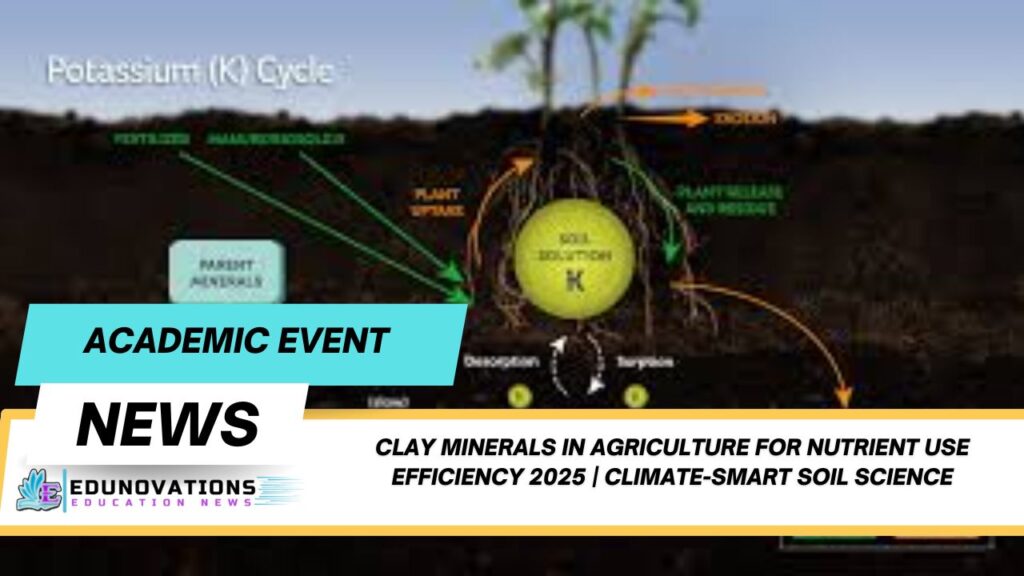
Clay minerals in agriculture for nutrient use efficiency 2025 highlights climate-smart soil research, carbon sequestration, and sustainable farming innovations in India.
India’s agricultural future is standing at a critical crossroads, where productivity must rise without compromising environmental sustainability. Against this backdrop, clay minerals in agriculture for nutrient use efficiency 2025 has emerged as a defining scientific theme shaping modern soil research and climate-resilient farming systems. Recent national-level scientific deliberations have highlighted how advances in clay mineralogy, nanoclay technologies, and soil carbon management can play a decisive role in addressing declining soil fertility and climate change challenges.
A major national conference hosted at a premier agricultural research institution in New Delhi brought together leading soil scientists, agronomists, environmental researchers, and policymakers to deliberate on how clay minerals in agriculture for nutrient use efficiency 2025 can contribute to sustainable food systems. The event focused on nutrient optimization, climate-smart fertilizer development, and soil carbon sequestration—areas increasingly relevant for Indian agriculture.
The discussions underscored the need to bridge fundamental soil science with field-level applications, ensuring that scientific innovations translate into tangible benefits for farmers.
Scientific Focus on Soil Health and Nutrient Optimization
Indian soils are under mounting pressure due to intensive cultivation, imbalanced fertilizer use, and climate variability. Experts at the conference emphasized that clay minerals in agriculture for nutrient use efficiency 2025 offers a scientific pathway to improve nutrient retention, minimize losses, and enhance fertilizer effectiveness.
Clay minerals possess unique physicochemical properties, including high surface area and cation exchange capacity, which help bind essential nutrients such as nitrogen, phosphorus, potassium, calcium, and micronutrients. When managed correctly, these minerals improve nutrient availability to crops while reducing leaching and volatilization losses.
Researchers highlighted that nutrient use efficiency in India remains below global benchmarks, with nitrogen use efficiency often below 35 percent in many cropping systems. Integrating clay-based soil amendments and nanoclay formulations could significantly improve these figures, making clay minerals in agriculture for nutrient use efficiency 2025 a cornerstone of sustainable intensification.
Climate Change, Soil Carbon, and Agricultural Resilience
Another central theme of the deliberations was the role of soils in climate change mitigation. Soil scientists stressed that clay minerals in agriculture for nutrient use efficiency 2025 is closely linked with soil carbon stabilization and sequestration.
Clay minerals protect organic carbon from rapid decomposition by forming stable organo-mineral complexes. This process not only enhances soil fertility but also contributes to long-term carbon storage, helping mitigate greenhouse gas emissions.
According to global estimates shared during the sessions, agricultural soils can sequester up to 1.5 billion tonnes of carbon annually if managed using climate-smart practices. Indian researchers argued that widespread adoption of clay-based soil management strategies could significantly boost India’s contribution to global climate goals.
Advancements in Nanoclay and Fertilizer Technologies
Innovations in nanotechnology were another highlight, with scientists discussing how nanoclay formulations can revolutionize fertilizer delivery systems. Nanoclays allow slow and controlled release of nutrients, ensuring better synchronization between crop demand and nutrient availability.
Experts noted that clay minerals in agriculture for nutrient use efficiency 2025 aligns strongly with next-generation fertilizers that reduce excessive chemical inputs while maintaining high yields. Such technologies can:
- Reduce fertilizer application frequency
- Minimize nutrient runoff into water bodies
- Lower input costs for farmers
- Improve crop nutrient uptake efficiency
These innovations are particularly relevant for small and marginal farmers who face rising input costs and climate uncertainties.
Technical Sessions and Research Collaboration
The conference featured multiple technical sessions addressing soil physics, chemistry, biology, and mineralogy. Researchers presented findings on nutrient dynamics, carbon stabilization mechanisms, and soil-plant interactions.
A recurring message across sessions was the need for interdisciplinary collaboration. Scientists emphasized that clay minerals in agriculture for nutrient use efficiency 2025 cannot be addressed in isolation but requires integration with crop science, climate modeling, and socio-economic studies.
Young researchers and doctoral scholars were encouraged to pursue translational research that connects laboratory discoveries with on-farm applications.
Policy Relevance and Sustainable Development Goals
The scientific outcomes discussed at the conference have strong policy implications. Experts noted that improving nutrient use efficiency through clay-based soil management directly supports national priorities such as sustainable agriculture, climate resilience, and food security.
By promoting clay minerals in agriculture for nutrient use efficiency 2025, policymakers can advance multiple Sustainable Development Goals, including zero hunger, climate action, and life on land. Researchers recommended greater public investment in soil health research and capacity building among extension workers.
Education, Awareness, and Capacity Building
Participants highlighted the importance of integrating soil science advancements into agricultural education and farmer training programs. Awareness of clay minerals in agriculture for nutrient use efficiency 2025 must extend beyond research institutions to grassroots levels.
Educational platforms offering NCERT-aligned courses, current affairs coverage, exam-oriented notes, MCQs, videos, syllabus resources, and free downloadable PDFs play a vital role in disseminating such knowledge among students preparing for competitive examinations and agricultural professionals.
Similarly, technical service providers like Mart Ind Infotech, known for offering digital solutions and websites for schools, can support educational institutions in spreading awareness about soil health innovations through technology-driven outreach.
Expert Insights from the Soil Science Community
Senior soil scientists participating in the event observed that India’s future agricultural productivity depends on restoring soil health. They emphasized that clay minerals in agriculture for nutrient use efficiency 2025 represents not just a research theme but a national necessity.
According to experts, ignoring soil mineral dynamics can lead to declining yields, increased fertilizer dependency, and environmental degradation. Conversely, harnessing clay mineral properties can create a resilient agricultural system capable of adapting to climate stress.
Why This Research Matters for Farmers and Students
For farmers, improved nutrient efficiency means lower costs and stable yields. For students and aspirants preparing for government exams, the topic holds immense relevance across agriculture, environment, and climate change syllabi.
Understanding clay minerals in agriculture for nutrient use efficiency 2025 provides conceptual clarity on:
- Soil fertility management
- Climate-smart agriculture
- Sustainable fertilizer technologies
- Carbon sequestration mechanisms
These areas frequently feature in competitive examinations and policy discussions.
Looking Ahead: The Future of Soil Science in India
The conference concluded with a strong call for sustained research, innovation, and policy support. Scientists agreed that the future of Indian agriculture depends on soil-centric approaches that balance productivity with environmental stewardship.
As research advances, clay minerals in agriculture for nutrient use efficiency 2025 is expected to remain a focal point for soil scientists, agronomists, and climate researchers working toward a sustainable and resilient food system.
Toppers Use Mind Maps to score more than 95%
-
NCERT Class 11th Commerce Mind Maps
Add to cartOriginal price was: ₹999.00.₹199.00Current price is: ₹199.00. -
NCERT Class 12th Chemistry Mind Maps
Add to cartOriginal price was: ₹199.00.₹75.00Current price is: ₹75.00. -
NCERT Class 12th Commerce Mind Maps
Add to cartOriginal price was: ₹999.00.₹199.00Current price is: ₹199.00. -
NCERT Class 12th Science Mind Maps
Add to cartOriginal price was: ₹999.00.₹199.00Current price is: ₹199.00. -
NCERT Mind Maps For Class 10th
Add to cartOriginal price was: ₹999.00.₹199.00Current price is: ₹199.00.





Purchase Today
Frequently Asked Questions (FAQs)
1. What is meant by clay minerals in agriculture for nutrient use efficiency 2025?
It refers to research and applications of clay minerals to improve fertilizer efficiency, soil health, and sustainable crop production.
2. Why are clay minerals important for soil fertility?
Clay minerals enhance nutrient retention, improve soil structure, and reduce nutrient losses.
3. How does this research help climate change mitigation?
Clay minerals stabilize soil carbon, helping in long-term carbon sequestration.
4. What role do nanoclays play in agriculture?
Nanoclays enable controlled nutrient release, improving fertilizer efficiency and reducing environmental pollution.
5. Is this topic relevant for competitive exams?
Yes, it is highly relevant for agriculture, environment, and climate-related exam syllabi.
6. How does nutrient use efficiency impact farmers?
Higher efficiency lowers input costs and increases crop productivity.
7. What institutions are leading this research in India?
Premier agricultural research institutes and soil science societies are actively involved.
8. Can clay-based solutions reduce fertilizer overuse?
Yes, they help optimize nutrient delivery and reduce excessive fertilizer application.
9. How does this research support sustainable development goals?
It promotes sustainable agriculture, climate action, and environmental conservation.
10. What is the future scope of clay mineral research in India?
The scope includes climate-smart farming, advanced fertilizers, and soil carbon management.