
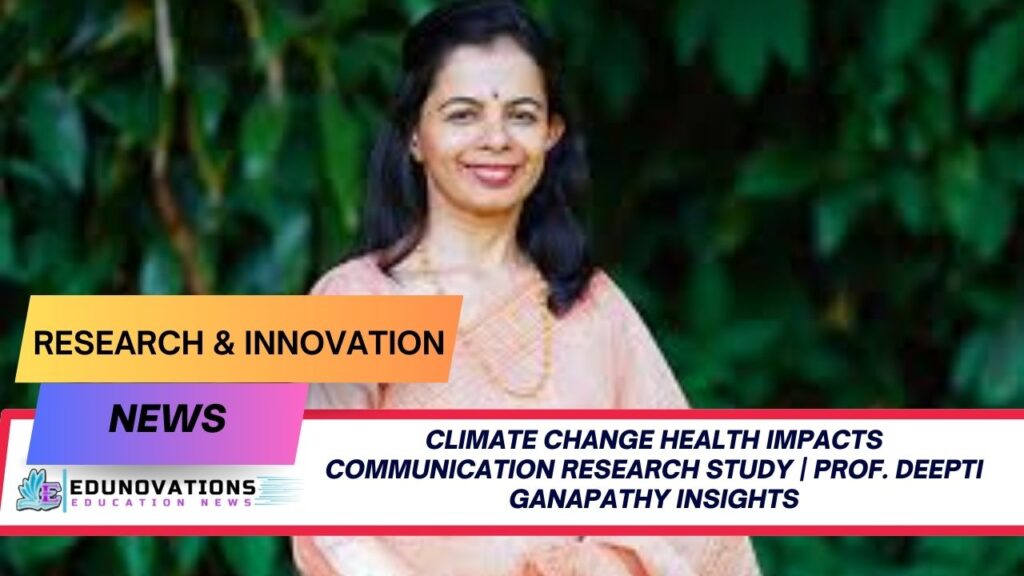
Explore Prof. Deepti Ganapathy’s research on climate change health impacts communication study, highlighting key insights, statistics, and global relevance.
Introduction
In a groundbreaking study recently published in The Lancet Planetary Health, Professor Deepti Ganapathy from the Indian Institute of Management Bangalore (IIMB) sheds light on the intricate relationship between climate change, human health, and communication strategies. The research titled “Climate Change Health Impacts Communication Research Study” emphasizes the urgency of bridging the knowledge gap between scientific evidence and public awareness to effectively tackle climate-related health risks.
Climate change continues to pose significant challenges worldwide, influencing everything from air quality and nutrition to public health outcomes. This study explores the mechanisms through which information about climate change impacts is communicated, aiming to improve public understanding and policy response.
Key Findings of the Study
Professor Ganapathy’s research identifies critical patterns in how climate and health information is disseminated:
- Awareness Gap: Despite robust scientific evidence, there is a significant lack of awareness among the general public regarding the direct and indirect effects of climate change on health.
- Media Influence: Media platforms play a pivotal role in shaping public perception, yet coverage often lacks depth and context, reducing the effectiveness of climate communication.
- Policy Implications: Effective communication strategies are essential for translating scientific findings into actionable policies that mitigate health risks related to climate change.
- Health and Nutrition Links: The study highlights the connection between planetary health diets, environmental sustainability, and human well-being.
These insights underline the importance of developing communication strategies that are both scientifically accurate and accessible to a broader audience.
The Role of Planetary Health Diets
One of the core aspects of the research focuses on the planetary health diet, a concept that links dietary choices to both environmental sustainability and human health. Studies suggest that diets rich in plant-based foods and low in processed meats can reduce greenhouse gas emissions while improving nutritional outcomes. Professor Ganapathy emphasizes that promoting such diets through effective communication can simultaneously address public health and climate goals.
Benefits of Planetary Health Diets:
- Reduced incidence of chronic diseases like diabetes and cardiovascular disorders.
- Lower environmental footprint through sustainable food consumption.
- Enhanced public awareness on climate-health linkages.
Educational institutions and policymakers are encouraged to incorporate these dietary guidelines into community programs, schools, and public health campaigns.
Air Quality, Mortality Risks, and Sustainable Diet Insights
The research also explores the intersection of air pollution, mortality risks, and sustainable diets. Air quality has a direct impact on respiratory and cardiovascular health, and combined with diet-related factors, it significantly influences population health outcomes. The study emphasizes the need for integrated strategies that address both environmental and dietary risk factors.
Key Takeaways:
- Urban areas with high air pollution see increased mortality rates linked to respiratory diseases.
- Nutritionally balanced diets can mitigate some health risks associated with environmental hazards.
- Public health campaigns must incorporate both air quality alerts and sustainable dietary guidance.
By linking environmental data with health outcomes, the study provides actionable insights for urban planning, environmental regulation, and public health policy.
Communication Strategies for Climate Health Coverage
Effective communication is central to the study’s recommendations. Professor Ganapathy highlights several strategies to improve climate health coverage:
- Targeted Messaging: Tailoring messages to specific demographics improves engagement and comprehension.
- Use of Digital Platforms: Social media and online news portals are powerful tools for disseminating scientific information.
- Collaboration with Experts: Partnering with healthcare professionals, environmental scientists, and journalists ensures accuracy and credibility.
- Educational Campaigns: Schools and universities can serve as hubs for climate-health education, reaching younger populations early.
These approaches help transform complex scientific research into actionable knowledge that can drive behavioral and policy changes.
Implications for India and Global Health
India, like many developing nations, faces a dual challenge of rapid urbanization and climate vulnerability. Professor Ganapathy’s study underscores the importance of localized strategies:
- Urban Planning: Integrating air quality monitoring and green spaces to reduce pollution exposure.
- Community Nutrition Programs: Promoting planetary health diets to enhance population health while reducing environmental impact.
- Policy Integration: Aligning climate policies with public health objectives for a holistic approach.
Globally, the findings resonate with ongoing efforts to achieve Sustainable Development Goals (SDGs), particularly those related to health (SDG 3), climate action (SDG 13), and sustainable cities (SDG 11).
Expert Commentary
Dr. Meera Nair, a climate and health policy expert, praised the study, stating:
“Professor Ganapathy’s work is instrumental in bridging the communication gap between climate science and public health awareness. It provides a roadmap for actionable change.”
Such endorsements highlight the credibility of the research and its relevance for both policymakers and the public.
Integrating Research into Education and Awareness
Educational institutions play a vital role in amplifying these findings. Schools and universities can utilize innovative teaching tools and resources to inform students about climate-health linkages. For instance:
- NCERT Courses: Incorporating planetary health modules into curricula.
- Current Affairs: Highlighting recent climate-health studies for competitive exam preparation.
- Notes & MCQs: Providing structured study material to help students grasp environmental health concepts.
- Videos & Syllabus Integration: Using multimedia resources to enhance understanding and retention.
These resources ensure that emerging generations are well-informed about the nexus of climate change, health, and sustainable living.
Statistics Supporting Climate-Health Interventions
- Air pollution contributes to over 4.2 million premature deaths worldwide annually.
- Adoption of plant-based diets can reduce greenhouse gas emissions by up to 50%.
- Public awareness campaigns can increase adoption of sustainable diets by 25–30% in targeted communities.
Integrating such data into communication strategies strengthens their impact and helps policymakers prioritize interventions effectively.
Challenges and Opportunities
While the study provides actionable recommendations, several challenges remain:
- Misinformation: The spread of inaccurate health or climate information can undermine public trust.
- Resource Limitations: Developing countries often face constraints in implementing comprehensive climate-health campaigns.
- Behavioral Change: Shifting dietary habits and lifestyle patterns requires sustained efforts and incentives.
However, these challenges also present opportunities for innovation, particularly through digital platforms, community engagement, and partnerships with schools and NGOs.
Conclusion
Professor Deepti Ganapathy’s climate change health impacts communication research study serves as a seminal work in understanding the interplay between climate change, health outcomes, and public communication. By emphasizing planetary health diets, air quality management, and effective messaging strategies, the research offers a roadmap for both India and global health initiatives.
Educational institutions, policymakers, and communities can leverage these insights to enhance public awareness, promote sustainable living, and mitigate climate-related health risks. As climate change continues to shape our world, research like Professor Ganapathy’s is essential to inform evidence-based strategies and foster a healthier, sustainable future.
Toppers Use Mind Maps to score more than 95%
-
NCERT Class 11th Commerce Mind Maps
Add to cartOriginal price was: ₹999.00.₹199.00Current price is: ₹199.00. -
NCERT Class 12th Chemistry Mind Maps
Add to cartOriginal price was: ₹199.00.₹75.00Current price is: ₹75.00. -
NCERT Class 12th Commerce Mind Maps
Add to cartOriginal price was: ₹999.00.₹199.00Current price is: ₹199.00. -
NCERT Class 12th Science Mind Maps
Add to cartOriginal price was: ₹999.00.₹199.00Current price is: ₹199.00. -
NCERT Mind Maps For Class 10th
Add to cartOriginal price was: ₹999.00.₹199.00Current price is: ₹199.00.





Purchase Today
FAQs
- What is the focus of Prof. Deepti Ganapathy’s research study?
It focuses on climate change health impacts communication research, linking public awareness with scientific evidence. - How do planetary health diets impact human health?
These diets improve nutrition while reducing environmental footprint and promoting sustainable living. - What are the key communication strategies for climate health coverage?
Strategies include targeted messaging, digital platform use, expert collaboration, and educational campaigns. - How does air quality affect mortality risks?
Poor air quality increases respiratory and cardiovascular disease rates, contributing to higher mortality. - Why is climate-health research important for India?
India faces high urbanization and climate vulnerability, requiring localized interventions and public awareness. - How can schools integrate climate-health education?
Schools can use NCERT courses, notes, videos, and syllabus-aligned resources to teach planetary health concepts. - What global relevance does this research have?
It contributes to achieving Sustainable Development Goals related to health, climate action, and sustainable cities. - Can adopting a planetary health diet reduce emissions?
Yes, plant-based diets can reduce greenhouse gas emissions by up to 50%. - Who has endorsed Prof. Ganapathy’s study?
Experts like Dr. Meera Nair commend its role in bridging climate science and public health communication. - Where can I access NCERT resources related to climate-health topics?
Resources include NCERT courses, notes, mind maps, videos, and downloadable PDFs.