
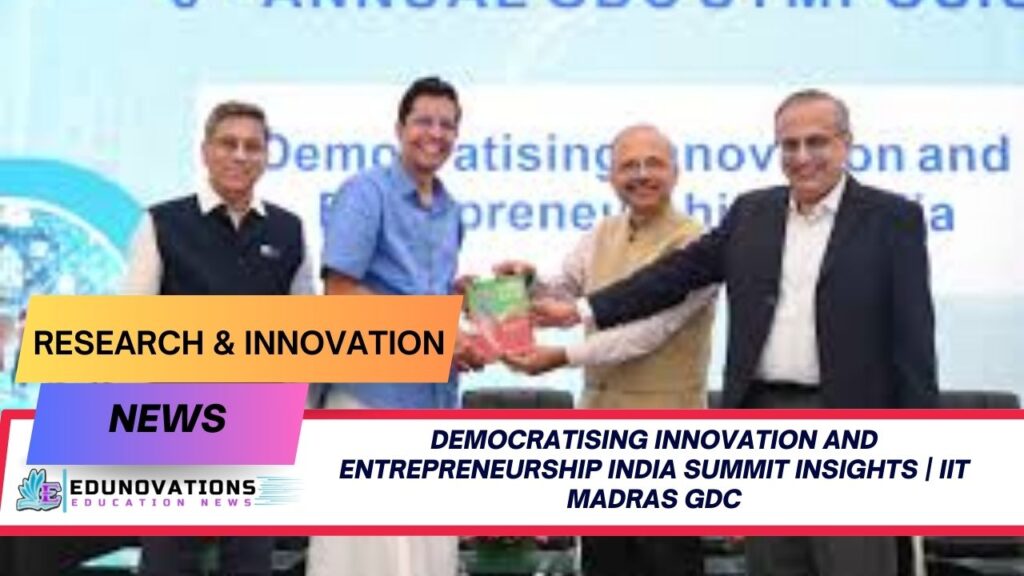
Explore IIT Madras GDC’s initiatives on democratising innovation and entrepreneurship in India, fostering deep tech startups and academic ecosystem growth.
The Indian Institute of Technology Madras (IIT Madras) recently hosted the Gopalakrishnan-Deshpande Centre (GDC) symposium, focusing on democratising innovation and entrepreneurship India summit insights. The event brought together leading researchers, policy makers, and entrepreneurs to discuss strategies for deep tech startup mindset development in the Indian academic ecosystem. This initiative is part of IIT Madras’ continued commitment to bridging the gap between research innovation and market-ready solutions.
Key Objectives of the GDC Symposium
The symposium aimed to:
- Encourage the scaling of innovation from research to market in India.
- Promote policy and mentorship for Indian startup ecosystem growth 2026.
- Provide actionable insights for young entrepreneurs and innovators.
- Facilitate collaborations between academia, industry, and government bodies.
By fostering these objectives, IIT Madras ensures that its students and affiliated innovators gain exposure to real-world entrepreneurial challenges while also contributing to India’s innovation ecosystem.
Driving Deep Tech Mindset in Academia
One of the highlights of the event was the emphasis on cultivating a deep tech startup mindset development in the Indian academic ecosystem. Experts stressed the importance of nurturing problem-solving skills, technical expertise, and entrepreneurial resilience among students. According to Dr. Rajesh Kumar, a renowned innovation strategist, “Embedding entrepreneurship into academic culture ensures that deep tech solutions do not remain confined to laboratories but reach markets where they can create meaningful impact.”
Key strategies discussed included:
- Integrating entrepreneurship courses into engineering and science programs.
- Providing mentorship networks with experienced founders and investors.
- Encouraging participation in incubation and acceleration programs.
These strategies are designed to equip students with a mindset that balances scientific research rigor with business acumen, essential for emerging sectors such as AI, biotechnology, and renewable energy.
Policy and Mentorship for Startups
The symposium also highlighted how policy and mentorship for Indian startup ecosystem growth 2026 play a pivotal role in fostering innovation. Panelists pointed out that clear policy frameworks, coupled with guidance from seasoned entrepreneurs, significantly improve the success rate of technology startups.
Key takeaways included:
- Access to government-funded innovation grants.
- Creation of streamlined regulatory pathways for startups.
- Development of mentorship programs connecting academia and industry.
These efforts are particularly important for deep tech startups that often face longer development cycles and higher capital requirements. By linking mentorship with policy support, India aims to democratise entrepreneurship, ensuring opportunities are accessible to innovators from all regions.
From Research to Market: Scaling Innovations
The symposium emphasized actionable insights for translating research into market-ready products. The concept of how to scale innovation from research to market in India was central to several discussions. Experts suggested:
- Early-stage market validation alongside laboratory research.
- Building partnerships with industries to facilitate pilot projects.
- Intellectual property strategies to protect innovations.
- Engaging investors and venture capitalists early in the development process.
Dr. Anita Deshpande, a leading entrepreneur and board member of multiple deep tech firms, remarked, “Bridging research and market application is not just about funding; it requires mentoring, networking, and understanding the market landscape.”
IIT Madras GDC Symposium Highlights
The event featured keynote speeches, panel discussions, and workshops focused on:
- Emerging technologies such as AI, quantum computing, and renewable energy.
- Challenges faced by Indian startups and methods to overcome them.
- Success stories from student-led innovations within IIT Madras.
- Insights from global entrepreneurs on replicating scalable innovation models.
This structured approach allowed participants to gain hands-on experience and practical knowledge for building sustainable ventures.
Expert Insights and Industry Engagement
The symposium was attended by top-tier professionals including Dr. Vikram Mehta, an innovation policy expert, who emphasized that “for India to become a global hub of technology startups, democratizing access to entrepreneurial resources is crucial.”
Industry experts shared practical methods for fostering entrepreneurial ecosystems within academic institutions, emphasizing that mentorship, networking, and funding are equally important to innovation.
Promoting Inclusive Innovation
A notable theme was the democratisation of innovation, ensuring that students from diverse socio-economic backgrounds gain equal opportunities. Programs initiated by IIT Madras include:
- Access to incubation centers for rural and underrepresented students.
- Scholarships and grants for deep tech research projects.
- Collaborative projects with schools and colleges nationwide to foster early-stage innovation.
These initiatives align with the national vision of promoting an inclusive innovation ecosystem across India.
Strategic Role of GDC in Indian Innovation
The Gopalakrishnan-Deshpande Centre (GDC) serves as a strategic hub to convert academic research into viable business models. Its initiatives include:
- Industry collaboration projects that bring students and researchers closer to real-world applications.
- Start-up incubation programs supporting the entire product lifecycle.
- Mentorship from both academic leaders and global entrepreneurs.
Through these activities, GDC ensures that IIT Madras remains at the forefront of India’s innovation landscape, nurturing startups that can compete internationally.
Enhancing Entrepreneurial Skills Through Workshops
The symposium included interactive workshops designed to cultivate deep tech startup mindset development in the Indian academic ecosystem. Participants engaged in activities covering:
- Design thinking and ideation.
- Prototyping and rapid experimentation.
- Business model development for tech startups.
- Strategies for pitching to investors.
Such workshops are crucial for translating theoretical knowledge into practical entrepreneurship skills.
Collaboration Between Academia, Industry, and Government
A recurring message at the symposium was the importance of multi-stakeholder collaboration. Combining academic research, industry experience, and government policy ensures a holistic ecosystem for how to scale innovation from research to market in India.
Collaborations highlighted include:
- Partnerships with global technology firms for R&D projects.
- State government support for innovation clusters.
- Industry mentors guiding student-led ventures through early-stage challenges.
This ecosystem approach accelerates commercialization while also nurturing talent capable of leading India’s technology future.
Future Roadmap
IIT Madras GDC aims to expand its initiatives with:
- More nationwide programs promoting policy and mentorship for Indian startup ecosystem growth 2026.
- Establishing innovation hubs in other educational institutions.
- Strengthening alumni networks to support emerging entrepreneurs.
- Leveraging digital platforms for widespread access to workshops and mentorship.
The long-term vision is to democratize innovation and entrepreneurship, enabling all students and researchers to contribute to India’s technological and economic development.
Conclusion
The IIT Madras GDC symposium is a pivotal step toward democratising innovation and entrepreneurship in India, focusing on deep tech startups, market scaling, and inclusive growth. By connecting students, academia, industry, and policymakers, IIT Madras continues to shape a robust innovation ecosystem.
This initiative not only empowers student entrepreneurs but also aligns with India’s broader goals of technological leadership and startup excellence.
Toppers Use Mind Maps to score more than 95%
-
NCERT Class 11th Commerce Mind Maps
Add to cartOriginal price was: ₹999.00.₹199.00Current price is: ₹199.00. -
NCERT Class 12th Chemistry Mind Maps
Add to cartOriginal price was: ₹199.00.₹75.00Current price is: ₹75.00. -
NCERT Class 12th Commerce Mind Maps
Add to cartOriginal price was: ₹999.00.₹199.00Current price is: ₹199.00. -
NCERT Class 12th Science Mind Maps
Add to cartOriginal price was: ₹999.00.₹199.00Current price is: ₹199.00. -
NCERT Mind Maps For Class 10th
Add to cartOriginal price was: ₹999.00.₹199.00Current price is: ₹199.00.



Purchase Today
10 FAQs
- What is the main objective of IIT Madras GDC symposium?
To promote democratising innovation and entrepreneurship India summit insights among students and innovators. - How does IIT Madras support deep tech startups?
Through mentorship, funding, and deep tech startup mindset development in the Indian academic ecosystem. - What strategies help scale innovation from research to market?
Early validation, industry partnerships, IP protection, and investor engagement support how to scale innovation from research to market in India. - Who participates in the GDC symposium?
Researchers, policymakers, entrepreneurs, and students interested in policy and mentorship for Indian startup ecosystem growth 2026. - How does mentorship impact startup success in India?
Mentorship provides guidance on business strategy, market understanding, and investor relations, essential for deep tech startup mindset development in the Indian academic ecosystem. - What are some outcomes of the IIT Madras GDC workshops?
Students gain skills in prototyping, ideation, and business modeling to enhance how to scale innovation from research to market in India. - Is the GDC initiative inclusive for underrepresented students?
Yes, IIT Madras ensures access for rural and socio-economically diverse students promoting democratising innovation and entrepreneurship India summit insights. - How does industry collaboration support student ventures?
By offering real-world challenges, mentorship, and partnership opportunities for policy and mentorship for Indian startup ecosystem growth 2026. - What is the role of policy in promoting entrepreneurship in India?
Policies provide grants, simplify regulations, and foster startup growth, essential for policy and mentorship for Indian startup ecosystem growth 2026. - How can students access resources for entrepreneurship at IIT Madras?
Through incubation centers, mentorship programs, workshops, and digital platforms promoting deep tech startup mindset development in the Indian academic ecosystem.