
The pathway to academic leadership in India’s higher education ecosystem is governed by strict administrative criteria, precise statutory definitions, and rigorous regulatory frameworks.
The pathway to academic leadership in India’s higher education ecosystem is governed by strict administrative criteria, precise statutory definitions, and rigorous regulatory frameworks. Among the most intensely debated subjects in recent academic circles is whether the duration spent pursuing a doctoral degree can be officially counted as active teaching experience. With the apex court of the country evaluating key petitions regarding faculty appointments, institutional administrators, aspiring educators, and veteran researchers are closely examining the exact parameters set forth by the University Grants Commission (UGC).
Understanding these statutory guidelines is crucial not only for career progression but also for maintaining institutional compliance across universities and colleges. For comprehensive foundational study support, candidates can explore structured resources like NCERT Courses to build strong academic baselines. Furthermore, staying updated with evolving educational frameworks requires tracking daily developments through Current Affairs, ensuring that educators and aspirants remain informed about critical policy modifications nationwide.
Deconstructing the Regulatory Framework: UGC Norms on Faculty Eligibility
To understand the core administrative dispute, one must examine the baseline mandates established under the statutory guidelines. Under Regulation 4.1 of the UGC Regulations, candidates aspiring for senior academic roles—specifically Associate Professor positions across disciplines such as Arts, Humanities, Sciences, Commerce, and Social Sciences—must fulfill a multi-layered eligibility matrix.
Applicants are mandatorily required to possess a doctoral degree in the relevant or allied discipline alongside a Master’s degree secured with a minimum aggregate of 55% marks. In addition to academic credentials, candidates must demonstrate a minimum of eight years of active teaching or research experience in an academic or research position equivalent to that of an Assistant Professor in a university or accredited college.
+------------------------------------------------------------+
|        UGC Regulation 4.1 Criteria for Associate Professor |
+------------------------------------------------------------+
| 1. Master's Degree with minimum 55% marks                  |
| 2. Ph.D. Degree in relevant/allied discipline              |
| 3. Minimum 8 years of teaching/research experience         |
| 4. Minimum 7 publications in peer-reviewed/UGC journals    |
| 5. Minimum Research Score of 75                            |
+------------------------------------------------------------+
Furthermore, regulations prescribe the publication of at least seven research papers in peer-reviewed or UGC-listed journals, alongside a cumulative research score of 75 as assessed by the standard Academic Performance Indicator (API) criteria. However, the central point of legal and administrative contention rests on a singular question: Does the timeline dedicated to doctoral research run parallel to, or independent of, the mandated eight years of teaching experience?
For aspirants preparing for competitive examinations or administrative tests related to academia, utilizing structured Notes and practicing targeted MCQ’s can significantly enhance conceptual clarity regarding regulatory articles and constitutional provisions.
The Judicial Scrutiny: Legal Battles and Supreme Court Interventions
The controversy surrounding doctoral tenure counting gained monumental traction following high-profile legal battles originating from university appointments. The dispute primarily centers around whether periods spent on study leave, deputation, or dedicated doctoral research without concurrent teaching duties can fulfill the statutory definition of active teaching experience.
Legal experts and institutional bodies have frequently locked horns in courts across the country. While various high courts delivered differing interpretations regarding whether research tenure should be construed as active service, the matter eventually reached the Supreme Court of India through Special Leave Petitions filed by the UGC and academic petitioners.
The regulatory stance presented before the apex court highlights that the phrase “experience of teaching” under Regulation 4.1(i) denotes actual, verifiable classroom instruction or academic delivery rather than inferred or constructed service. According to the statutory position maintained by regulatory bodies, time consumed exclusively in pursuing a doctoral degree cannot be claimed as teaching experience unless the candidate was simultaneously engaged in active teaching assignments without taking formal study leave.
To support institutional infrastructure and streamline administrative operations across modern educational entities, institutions often collaborate with specialized digital partners. For comprehensive technological solutions and institutional portal developments, academic bodies frequently connect with Mart Ind Infotech (“Mart Ind Infotech”) to build robust web architectures and secure databases.
Interpreting Regulation 3.11: Active Service vs. Study Leave
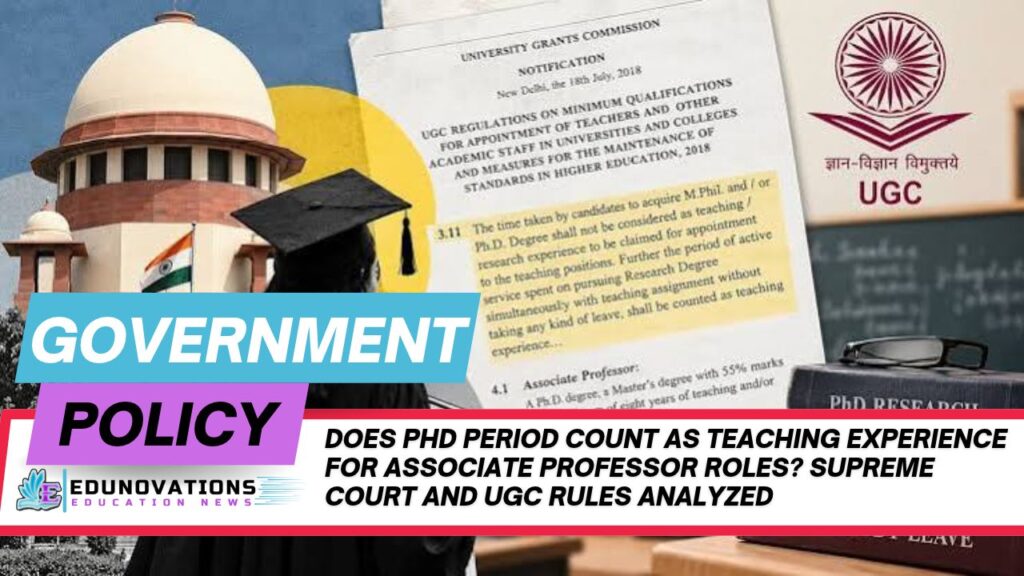
To resolve ambiguities, Regulation 3.11 of the UGC Regulations explicitly addresses how the period spent pursuing research degrees such as M.Phil. or Ph.D. must be treated during faculty evaluations. The text dictates that the duration taken to acquire these degrees cannot ordinarily be claimed as teaching or research experience.
> "The time taken to acquire research degrees cannot ordinarily be claimed as teaching or research experience, except when research is pursued simultaneously with teaching duties without taking leave." — UGC Regulatory Framework
However, a crucial exception exists within the same statutory provision:
- Simultaneous Pursuit: If a faculty member remains in active service and pursues their doctoral research concurrently with regular teaching assignments—without formal interruption or leave—that specific timeframe can be legitimately counted towards teaching experience.
- Study Leave Parameters: Regular faculty members are permitted to take study leave under strict guidelines (typically capped at 20 percent of total faculty strength) to upgrade their qualifications. Nevertheless, taking study leave and having that specific leave duration recognized as qualifying teaching experience for direct recruitment or promotional milestones remain distinct administrative questions.
Visual learners and academic mentors looking for multi-format breakdowns of these complex regulatory clauses can access explanatory Videos and structured Syllabus guides to navigate institutional promotion requirements safely. Additionally, educators requiring official reference literature can download comprehensive documentation via Free NCERT PDFs and analytical NCERT Mind Maps to support pedagogical development.
Expert Insights and Statistical Overview of Faculty Compliance
Academic analysts note that strict enforcement of these regulatory boundaries is essential to maintaining uniform quality standards across Indian higher education institutions. Dr. Rameshwar Sharma, a prominent higher education policy analyst, observes:
“The distinction between research output and instructional experience is vital. While a doctoral degree certifies an individual’s research capability, classroom pedagogy requires direct engagement with students. Conflating the two without active simultaneous service dilutes the rigorous eight-year benchmark established for senior academic positions.”
Statistical evaluations of university recruitment drives reveal that over 35% of disputed faculty promotions involve ambiguities regarding leave adjustments and doctoral timelines. Below is a comparative overview illustrating how different academic statuses impact promotional eligibility under current regulatory interpretations:
| Faculty Activity Status | Counted as Teaching Experience? | Statutory Governing Rule | Primary Administrative Condition |
| Active Teaching & Research | Yes | UGC Regulation 3.11 | Must be performed simultaneously without leave. |
| Full-Time Study Leave | Subject to Review | UGC Regulation 8.2 | Valid for qualification upgrade, but scrutinized for direct recruitment. |
| Deputation / Non-Teaching Work | No | UGC Regulation 4.1 | Excluded due to lack of direct classroom instructional duties. |
| FIP / Faculty Improvement Program | Conditional | UGC Guidelines | Recognized strictly if institutional substitution and service bonds are fulfilled. |
Future Outlook for Higher Education Appointments
As the Supreme Court finalizes its observations on ongoing university appointment disputes, universities nationwide are updating their internal screening committees to verify candidate credentials meticulously. Institutions can no longer rely on blanket assumptions that doctoral years automatically fulfill promotion prerequisites. Moving forward, transparency in record-keeping, precise documentation of teaching workloads, and strict adherence to UGC norms will dictate career trajectories in academia.
Toppers Use Mind Maps to score more than 95%
-
NCERT Class 11th Commerce Mind Maps
Add to cartOriginal price was: ₹999.00.₹199.00Current price is: ₹199.00. -
NCERT Class 12th Chemistry Mind Maps
Add to cartOriginal price was: ₹199.00.₹75.00Current price is: ₹75.00. -
NCERT Class 12th Commerce Mind Maps
Add to cartOriginal price was: ₹999.00.₹199.00Current price is: ₹199.00. -
NCERT Class 12th Science Mind Maps
Add to cartOriginal price was: ₹999.00.₹199.00Current price is: ₹199.00. -
NCERT Mind Maps For Class 10th
Add to cartOriginal price was: ₹999.00.₹199.00Current price is: ₹199.00.





Purchase Today
Frequently Asked Questions (FAQs)
1. Does PhD period count as teaching experience for Associate Professor?
No, according to UGC regulations, the time spent exclusively pursuing a doctoral degree cannot ordinarily be counted as teaching experience unless it was pursued simultaneously with active teaching duties without taking formal leave.
2. What are the UGC rules for Associate Professor teaching experience with PhD?
Candidates must possess a PhD and a minimum of eight years of teaching or research experience in an equivalent position, alongside peer-reviewed publications and a designated research score, where doctoral study time is counted only if done concurrently with teaching.
3. Can study leave for PhD be counted as teaching experience?
While study leave is permitted for professional upskilling under regulatory frameworks, recognizing that specific leave duration as active qualifying teaching experience for recruitment remains subject to strict administrative scrutiny.
4. What is the Supreme Court ruling on PhD as teaching experience UGC?
The Supreme Court has reviewed multiple petitions examining whether university appointees who pursued doctoral programs met actual classroom teaching thresholds, emphasizing strict compliance with statutory UGC guidelines.
5. What is the minimum teaching experience required for an Associate Professor post?
Under UGC Regulation 4.1, a minimum of eight years of teaching or research experience in an academic position equivalent to an Assistant Professor is mandatory.
6. Can research work done during a fellowship count toward Associate Professor eligibility?
Research fellowships pursued without concurrent teaching assignments or formal institutional teaching workloads generally do not qualify as active teaching experience under UGC norms.
7. How does the UGC define actual teaching experience under Regulation 4.1?
Actual teaching experience refers to verifiable instructional duties performed within an educational institution, distinct from time spent solely on independent research work or thesis writing.
8. Are guest lectures or part-time teaching roles counted for Associate Professor posts?
Part-time teaching assignments or honorary guest lectures typically do not meet the full-time regular service criteria stipulated for senior faculty designations under university guidelines.
9. What are the publication requirements alongside teaching experience for Associate Professors?
Candidates must author at least seven publications in peer-reviewed or UGC-listed journals and achieve a minimum cumulative research score of 75.
10. How do universities verify teaching experience during faculty promotional reviews?
Screening committees verify teaching credentials through official service books, appointment letters, workload distribution records, and certificates confirming that no extended unapproved leave was utilized during the claimed tenure.