
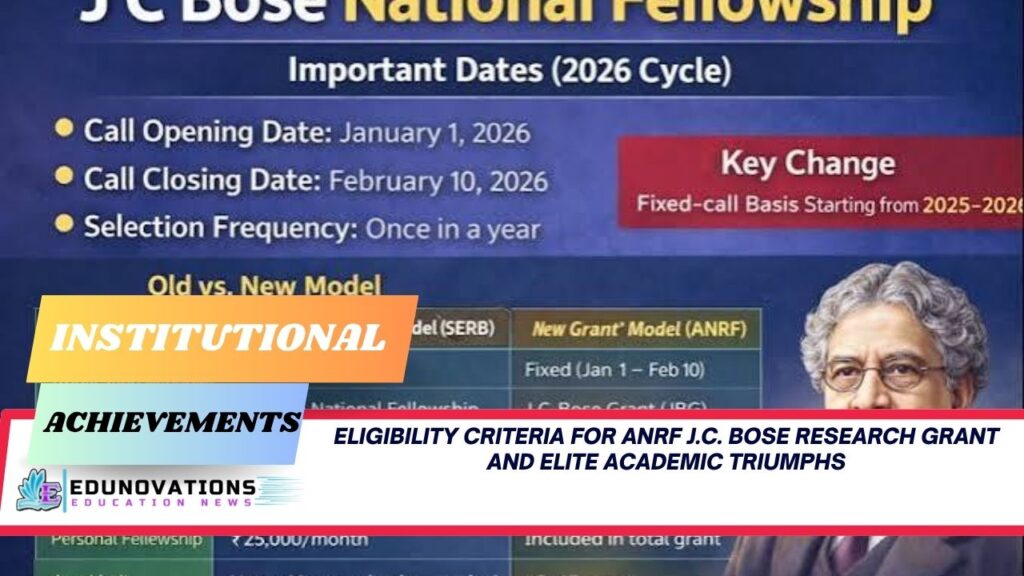
In an era defined by rapid technological shifts and global sustainability challenges, India’s commitment to frontier research remains unwavering.
In an era defined by rapid technological shifts and global sustainability challenges, India’s commitment to frontier research remains unwavering. The Anusandhan National Research Foundation (ANRF) recently unveiled the latest cohort of recipients for the Eligibility criteria for ANRF J.C. Bose research grant, a prestigious recognition that celebrates the life-long dedication of India’s senior scientists and engineers. Six distinguished faculty members from the Indian Institute of Technology Madras (IIT Madras) have been selected for this honour, underscoring the institution’s role as a powerhouse of intellectual innovation.
For researchers and students looking to navigate the complex landscape of scientific funding, understanding the rigorous eligibility criteria for ANRF J.C. Bose research grant is paramount. This grant is not merely a financial award; it is a testament to an individual’s outstanding research performance and their ability to contribute to national and global development.
The ANRF J.C. Bose Grant: Empowering Future-Ready Research
The ANRF J.C. Bose Grant is designed to support active senior scientists who have demonstrated exceptional scientific excellence. As the landscape of Indian research evolves, this grant provides the essential backing for frontier explorations in fields ranging from advanced materials to biomedical instrumentation.
For those eager to pursue academic excellence or stay updated with Current Affairs, it is essential to monitor how such prestigious grants are structured. The grant provides ₹25 lakh annually for five years, covering consumables, travel, equipment, and contingency—a critical lifeline for scholars engaged in high-stakes research.
Recognizing Intellectual Excellence at IIT Madras
The selection of six professors from IIT Madras reflects the institute’s ecosystem of fostering critical and emerging technologies. Among the awardees are:
- Prof. Sujatha Srinivasan (Mechanical Engineering): A pioneer in developing affordable assistive technology innovations for rehabilitation. Her work at the TTK Centre for Rehabilitation Research and Device Development (R2D2) has transformed the lives of many, focusing on devices specifically suited to Indian lifestyles.
- Prof. Thalappil Pradeep (Chemistry): An internationally recognized figure, his work on nanomaterials and clean water technologies provides a blueprint for sustainable development. His research exemplifies the top Indian research institutions for clean water technology standard.
- Prof. Deepa Venkitesh (Electrical Engineering): Her leadership in optical communication and high-capacity networks is setting the stage for India’s future in telecommunications.
- Prof. Jitendra S. Sangwai (Chemical Engineering): A globally cited expert, his work in carbon capture and utilization is central to solving the global climate crisis.
- Prof. Ramakrishnan Swaminathan (Applied Mechanics & Biomedical Engineering): His impactful research in medical instrumentation design continues to enhance diagnostic relevance in healthcare.
- Prof. Sundargopal Ghosh (Chemistry): His contributions to transition metal boron chemistry have advanced the frontiers of chemical reactivity and small-molecule activation.
Navigating the Path to Research Success
Aspiring researchers often ask, “How to apply for prestigious Indian scientific research grants?” The process is highly competitive and merit-based. Applicants must demonstrate a significant track record of high-impact publications, patents, and successful technology transfer.
For students aiming to enter these elite research pathways, building a foundation early is key. Utilizing NCERT Courses can help establish a strong conceptual understanding of physics, chemistry, and biology, which are the building blocks of any scientific career. Students can also benefit from Free NCERT PDFs to enhance their learning.
Bridging the Gap: Research to Reality
A common thread among the IIT Madras awardees is their commitment to translation. Whether it is affordable assistive technology innovations for rehabilitation or current trends in carbon capture and utilization research India, the goal is to bridge the gap between laboratory success and real-world implementation.
For educational institutions that require infrastructure support to facilitate this level of learning, collaborating with industry experts like Mart India Infotech can help build the necessary technological framework for digital classrooms and research centers.
Sectoral Impact: Why These Research Areas Matter
1. Sustainability and Climate Action
Current trends in carbon capture and utilization research India are vital for achieving carbon neutrality. By sequestering CO2 effectively, researchers like Prof. Sangwai are creating technical solutions that align with global climate goals.
2. Healthcare and Accessibility
The focus on affordable assistive technology innovations for rehabilitation addresses a significant societal need. For students interested in these fields, practicing with relevant MCQ’s and Notes can solidify their preparation for competitive entrance exams in biotechnology and engineering.
3. Communication and Connectivity
The work in optical communication is a cornerstone of the digital age. As India expands its fiber optic footprint, research into indigenous solutions becomes a matter of national security and economic growth.
Preparing for the Future of Science
The journey to winning a J.C. Bose grant begins in the classroom. Whether you are studying the Syllabus for a competitive exam or engaging with Videos to understand complex engineering concepts, consistency is essential. For those visual learners, NCERT Mind Maps offer a unique way to retain core principles of science and engineering.
Expert Insight: A Culture of Excellence
As noted by the Director of IIT Madras, Prof. V. Kamakoti, this recognition is not just for individuals but for the institution’s culture of development in critical technologies. For researchers, the lesson is clear: impact is measured by how well your work serves society.
Toppers Use Mind Maps to score more than 95%
-
NCERT Class 11th Commerce Mind Maps
Add to cartOriginal price was: ₹999.00.₹199.00Current price is: ₹199.00. -
NCERT Class 12th Chemistry Mind Maps
Add to cartOriginal price was: ₹199.00.₹75.00Current price is: ₹75.00. -
NCERT Class 12th Commerce Mind Maps
Add to cartOriginal price was: ₹999.00.₹199.00Current price is: ₹199.00. -
NCERT Class 12th Science Mind Maps
Add to cartOriginal price was: ₹999.00.₹199.00Current price is: ₹199.00. -
NCERT Mind Maps For Class 10th
Add to cartOriginal price was: ₹999.00.₹199.00Current price is: ₹199.00.
Purchase Today
10 FAQs on the ANRF J.C. Bose Grant
1. What is the primary eligibility criteria for ANRF J.C. Bose research grant? The grant is aimed at senior scientists (aged 45–65) with a strong record of publications, patents, and research outcomes, typically working in recognized Indian institutions.
2. Are there specific top Indian research institutions for clean water technology? Yes, IIT Madras is widely recognized for its clean water research, particularly through the International Centre for Clean Water, led by pioneers like Prof. Thalappil Pradeep.
3. How to apply for prestigious Indian scientific research grants effectively? Applicants must focus on high-impact research outputs, secure consistent funding history, and demonstrate active contribution to frontier areas of science.
4. Why are current trends in carbon capture and utilization research India gaining importance? As India pushes for net-zero emissions, carbon capture research has become critical to decarbonizing energy-intensive industries.
5. What makes affordable assistive technology innovations for rehabilitation successful? Success is defined by the device’s ability to be low-cost, durable, and compatible with the specific needs of the local population.
6. Can a junior researcher apply for the J.C. Bose grant? No, it is specifically targeted at senior researchers in their mid-to-late career stages (45–65 years).
7. Does the grant cover personal salary? Yes, the J.C. Bose grant typically includes both a research budget and a personal fellowship amount for the awardee.
8. Where can I find more info on the eligibility criteria for ANRF J.C. Bose research grant? Official details are usually updated on the ANRF website or through institutional notification portals.
9. How do these grants boost top Indian research institutions for clean water technology? They provide long-term financial stability, allowing lead researchers to maintain large teams and sustain multi-year field experiments.
10. What advice would you give for those interested in current trends in carbon capture and utilization research India? Start by mastering chemical engineering fundamentals, follow the latest journals in the field, and look for interdisciplinary projects involving material science.