
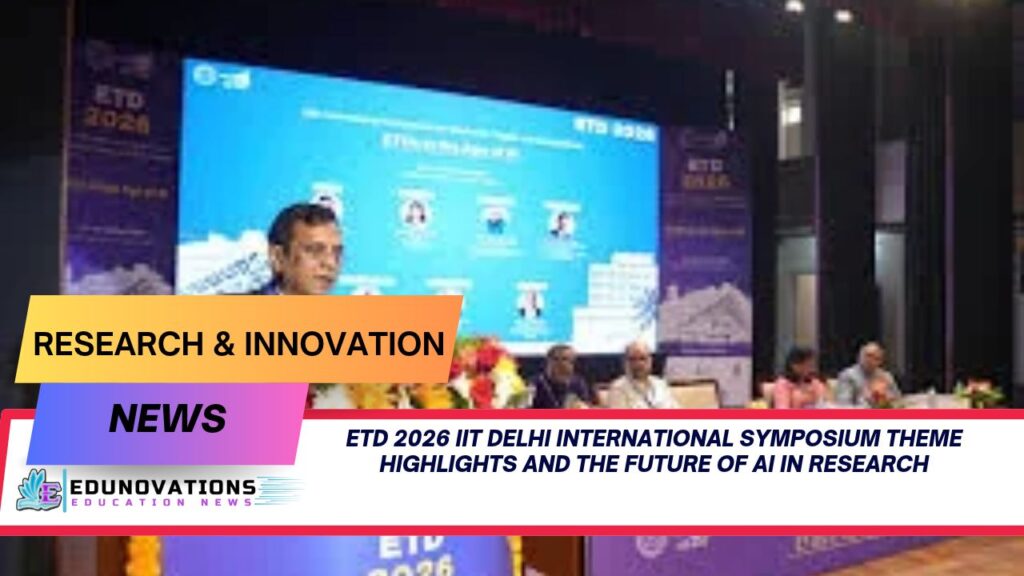
The landscape of academic research, scholarly communication, and doctoral studies is undergoing a monumental paradigm shift.
The landscape of academic research, scholarly communication, and doctoral studies is undergoing a monumental paradigm shift. Recently, the Central Library of the Indian Institute of Technology (IIT) Delhi, in collaboration with the Networked Digital Library of Theses and Dissertations (NDLTD), USA, successfully hosted the ETD 2026 IIT Delhi International Symposium theme highlights event. This prestigious 29th International Symposium on Electronic Theses and Dissertations (ETD 2026) convened global minds under the transformative theme: “ETDs in the Age of AI.”
For students, researchers, academicians, and educational publishers—including platforms like NCERT Courses—understanding how artificial intelligence interacts with scholarly research repositories is critical. As modern institutions modernize their digital infrastructure, schools and colleges are also upgrading their online presence, often collaborating with expert development partners like Mart Ind Infotech to build robust institutional portals. This comprehensive review dives deep into the symposium’s proceedings, core technological insights, and the broader implications of artificial intelligence in higher education.
The Genesis of ETD 2026: Bridging Technology and Scholarly Communication
Held from October 23 to 25, 2026, the three-day international symposium brought together over 300 delegates from across the globe, representing nations such as the USA, UK, Singapore, France, Egypt, Kuwait, and the United Arab Emirates. Participants included data scientists, policy makers, library science professionals, technology experts, and university leaders.
The core motivation behind the conference was addressing a persistent bottleneck in global academia: millions of doctoral dissertations and research theses remain locked in physical archives or isolated digital repositories, making them difficult to discover. By evaluating how machine learning and artificial intelligence can optimize metadata enrichment, semantic search, and document discoverability, the academic community aims to unlock the true value of human intellect.
To support continuous learning and academic preparation, students can explore structured Notes, practice interactive MCQ’s, and watch comprehensive educational Videos designed to simplify complex subjects.
Expert Insights and Visionary Addresses
The inaugural session featured profound insights from prominent national and international leaders. Prof. Gobardhan Das, Member of NITI Aayog, Government of India, served as the Chief Guest. In his keynote address, he emphasized that a doctoral thesis represents not merely a collection of data and findings, but the relentless perseverance and human intellect behind its creation. He noted:
“Much valuable scholarly work remains underexplored because it is difficult to discover or connect with related research. Harnessing AI responsibly presents a tremendous opportunity to strengthen research accessibility while preserving academic integrity and human rigour.”
Adding international perspectives, Prof. Edward A. Fox, Executive Director and Chairman of the Board at NDLTD, USA, along with Prof. Ramesh C. Gaur, Conference Committee Chair, highlighted the evolution of global digital repositories. Furthermore, Dr. Nabi Hasan, Organising Chair and Head Librarian at IIT Delhi, set the operational tone by detailing how next-generation library systems are adapting to automated indexing, natural language processing, and multilingual voice-based services.
For educators and students tracking current educational policies and global academic shifts, keeping up-to-date with regular Current Affairs is essential for competitive exam success.
Key Technological Focus Areas and Workshops
The symposium featured a rigorous schedule consisting of keynote addresses, panel discussions, full research paper presentations, poster displays, and an innovative Ideathon. Several technological breakthroughs took center stage:
- AI-Enabled Discovery & Semantic Search: Moving beyond basic keyword matching to semantic understanding, allowing researchers to query complex conceptual linkages across millions of global dissertations.
- Metadata Enrichment and Digital Preservation: Leveraging automated algorithms to generate rich abstracts, keywords, and classification tags instantly.
- Specialized Technological Workshops: Sessions on Dryad for open research data publishing and preservation, alongside AI BHASHINI for regional language translation and voice-enabled educational services.
- Mobile-First Engagement: The introduction of India’s first dedicated conference mobile app for Android and iOS users, streamlining networking, scheduling, and interactive feedback among international attendees.
Students preparing for academic milestones can easily review their respective Syllabus structures or access Downloads of Free NCERT PDFs to maintain a strong foundational base in core sciences and humanities.
The Role of Open Science and Institutional Repositories
Open science has transitioned from a theoretical ideal into a mandatory operational standard for modern universities. Traditional publishing models often restrict access behind expensive journal paywalls. The discussions at IIT Delhi underscored that making Electronic Theses and Dissertations (ETDs) openly accessible accelerates global innovation.
When institutional repositories are integrated with modern search engines and AI metadata tools, research output from developing nations gains immediate international visibility. This visibility fosters cross-border collaborations, reduces redundant experimentation, and empowers young scholars to build upon existing academic literature seamlessly.
To aid visual learners and memory retention during intensive study sessions, students can utilize structured NCERT Mind Maps to map out complex topics quickly and efficiently.
Toppers Use Mind Maps to score more than 95%
-
NCERT Class 11th Commerce Mind Maps
Add to cartOriginal price was: ₹999.00.₹199.00Current price is: ₹199.00. -
NCERT Class 12th Chemistry Mind Maps
Add to cartOriginal price was: ₹199.00.₹75.00Current price is: ₹75.00. -
NCERT Class 12th Commerce Mind Maps
Add to cartOriginal price was: ₹999.00.₹199.00Current price is: ₹199.00. -
NCERT Class 12th Science Mind Maps
Add to cartOriginal price was: ₹999.00.₹199.00Current price is: ₹199.00. -
NCERT Mind Maps For Class 10th
Add to cartOriginal price was: ₹999.00.₹199.00Current price is: ₹199.00.


Purchase Today
Frequently Asked Questions
1. What was the central theme of the ETD 2026 symposium hosted by IIT Delhi?
The central theme of the 29th International Symposium on Electronic Theses and Dissertations was “ETDs in the Age of AI,” focusing on how emerging artificial intelligence technologies impact the creation, management, discovery, and preservation of doctoral research.
2. Who organized the ETD 2026 international conference?
The event was organized by the Central Library of the Indian Institute of Technology (IIT) Delhi in association with the Networked Digital Library of Theses and Dissertations (NDLTD), USA.
3. What major challenges in doctoral research were highlighted during the event?
Speakers noted that a large volume of valuable doctoral research remains underexplored and difficult to discover due to poor indexing, a challenge that AI and semantic search can effectively resolve.
4. Which international organizations and bodies participated in ETD 2026?
Delegates and institutional representatives participated from global bodies including the NDLTD (USA), the International Federation of Library Associations and Institutions (IFLA), INFLIBNET Centre, and NITI Aayog.
5. How does artificial intelligence assist in managing electronic theses and dissertations?
AI helps automate metadata generation, enhances semantic search capabilities, supports multilingual translation via tools like AI BHASHINI, and streamlines digital preservation for large institutional repositories.
6. What role do digital repositories play in open science?
Open-access digital repositories eliminate financial and geographic barriers, ensuring that scholarly research, dissertations, and academic papers are globally discoverable and accessible to everyone.
7. What specialized workshops were conducted during the three-day symposium?
Specialized technical sessions included workshops on Dryad for open research data publishing and preservation, and AI BHASHINI for voice-based services and regional language translation.
8. What significance do conference proceedings hold for participating authors?
Full research papers presented at the symposium are considered for potential publication in the peer-reviewed Journal of Electronic Theses and Dissertations (J-ETD), USA.
9. How are Indian academic institutions improving research accessibility?
Indian universities are upgrading their digital infrastructure, deploying RFID-enabled smart libraries, integrating automated library management systems, and adopting AI-driven discovery frameworks.
10. Where can students find supplementary educational materials and course resources?
Students can access comprehensive study materials, notes, practice questions, and free NCERT resources through dedicated educational publishing platforms and digital portals.