
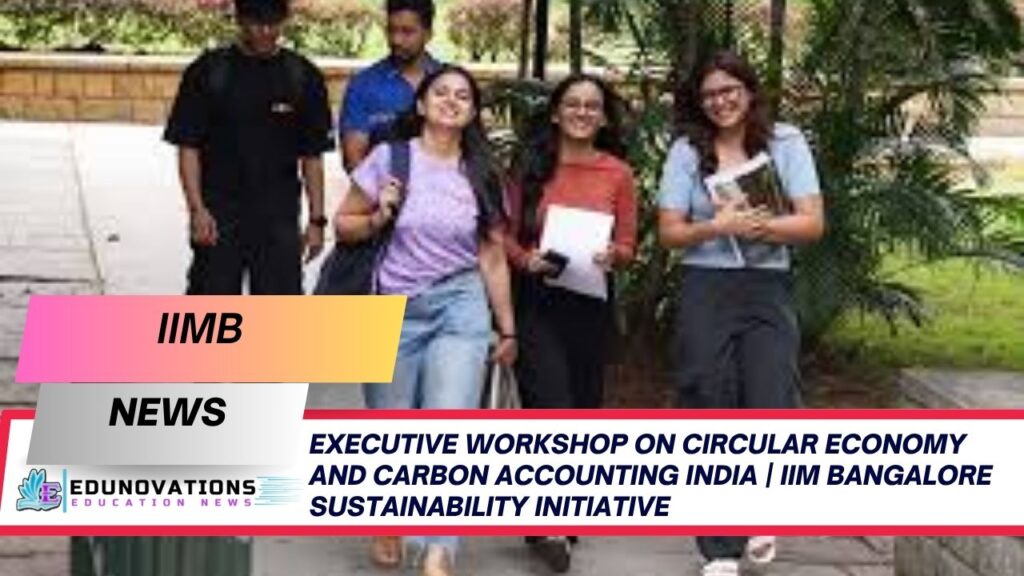
IIM Bangalore hosted an executive workshop on circular economy, EPR, and carbon accounting in India to empower business leaders with sustainable strategies for the future.
IIM Bangalore Leads the Way in Corporate Sustainability Learning
The Indian Institute of Management Bangalore (IIMB) has consistently been a front-runner in sustainability education, leadership development, and corporate governance. Strengthening its commitment to responsible business transformation, the TCI–IIMB Supply Chain Sustainability Lab organized an impactful event titled “Closing the Loop – Circular Economy, EPR, and Carbon Accounting for a Sustainable Future” on 7 November 2025 at its Bengaluru campus.
The initiative, known widely as the executive workshop on circular economy and carbon accounting India, provided a valuable platform for industry professionals, academicians, and sustainability leaders to converge and collaborate on integrating sustainable models into business strategy.
A Confluence of Innovation and Sustainability
The workshop centered around one of the most pressing global challenges — balancing growth with environmental stewardship. Through sessions focusing on the circular economy, Extended Producer Responsibility (EPR), and carbon accounting, the event aimed to help executives understand how sustainability can be both a strategic advantage and a regulatory necessity.
Led by Dr. Aditya Gupta, Chief Operating Officer of the TCI–IIMB Supply Chain Sustainability Lab, and Amit Saha, CEO of Pro India Recycling Pvt. Ltd., the workshop combined real-world insights, case-based learning, and interactive dialogue to help businesses close resource loops effectively.
Dr. Gupta emphasized the growing relevance of sustainability metrics in modern business frameworks, noting that “organizations that embed circularity and carbon accountability into their core operations will lead the next decade of responsible innovation.”
Amit Saha highlighted India’s evolving EPR landscape, explaining how business executive programmes on carbon accounting and EPR compliance in India can empower companies to not only meet compliance goals but also unlock cost efficiencies through waste reduction and resource optimization.
Exploring the Themes: Circular Economy, EPR, and Carbon Accounting
The workshop delved into three interlinked sustainability themes — each playing a critical role in shaping corporate responsibility and long-term competitiveness.
1. Circular Economy: Beyond Waste Management
Participants explored how the circular economy redefines production and consumption systems. Instead of the traditional “take-make-dispose” approach, circularity emphasizes designing products for longevity, reusability, and recyclability.
According to recent World Bank estimates, global waste generation could rise by 70% by 2050 if linear business models continue. India’s focus on circular production, through both government policies and private initiatives, represents a major shift toward sustainable industrialization.
Executives attending the workshop discussed best practices for circular economy EPR training for business executives 2025, which included leveraging data analytics to trace resource flows and adopting digital tools to monitor supply chain sustainability.
2. Extended Producer Responsibility (EPR): Compliance and Accountability
EPR policies place responsibility on producers for managing the end-of-life of their products. In India, the Ministry of Environment, Forest and Climate Change (MoEFCC) has introduced stringent guidelines for sectors such as plastics, electronics, and batteries.
During the workshop, speakers explained how carbon accounting and extended producer responsibility workshop Bengaluru initiatives help align company operations with government regulations. Participants learned about the nuances of registering with the Central Pollution Control Board (CPCB) and setting up return mechanisms for post-consumer waste.
Amit Saha shared examples from Pro India Recycling’s corporate partnerships, illustrating how practical implementation of EPR compliance can create value chains that are both profitable and sustainable.
3. Carbon Accounting: Quantifying Impact
Carbon accounting — the process of measuring and managing greenhouse gas (GHG) emissions — has become a crucial business function. For global corporations and Indian enterprises alike, tracking Scope 1, 2, and 3 emissions is no longer optional.
Dr. Gupta presented a case study on corporate sustainability workshop circular economy EPR India, explaining how quantifying emissions enables companies to build credible sustainability reports and attract climate-conscious investors.
Through interactive simulations, participants learned how to calculate emission baselines and develop carbon reduction roadmaps aligned with Science-Based Targets (SBTi) and the United Nations Sustainable Development Goals (UN SDGs).
Diverse Participation from Industry and Academia
The executive workshop drew active participation from professionals representing Christ University, Bosch, TVS Motor Company, Manipal University, Yazaki, Virtusa, Dalmia Cement, Ashirvad Pipes, Nexter, and the Centre for Environment Education (CEE).
Each delegate contributed perspectives on implementing sustainability in complex supply chains. Discussions ranged from integrating renewable energy sources into manufacturing operations to developing closed-loop recycling systems for industrial waste.
Executives from manufacturing and technology sectors emphasized how sustainability initiatives can improve brand perception and investor confidence, making circularity a financial as well as environmental imperative.
Expert Insights: Bridging Policy, Practice, and Performance
India’s transition toward sustainable business practices is accelerating, driven by policy reforms and market expectations. The executive workshop on circular economy and carbon accounting India provided clarity on how companies can prepare for a carbon-regulated future.
Dr. Vandana Singh, a sustainability policy analyst at the Centre for Policy Research, noted in her remarks that “programmes like this are crucial in demystifying the compliance landscape for Indian businesses, helping them align with both domestic and global climate frameworks.”
A recent NITI Aayog report estimated that adopting circular economy models could generate $500 billion in economic value by 2030 for India, while cutting greenhouse gas emissions by up to 44%. These figures reinforce the importance of such executive-level workshops.
Building Capacity for a Sustainable Future
As businesses strive to reduce carbon footprints, the need for qualified sustainability professionals is growing rapidly. Institutions like IIM Bangalore are filling this gap through specialized programmes, research collaborations, and executive learning modules.
Participants expressed appreciation for the business executive programme on carbon accounting and EPR compliance India, highlighting the practical orientation of the sessions and the opportunities to network with industry leaders.
The event underscored IIMB’s mission to drive sustainable innovation and responsible management education — a mission that continues to shape India’s business ecosystem.
Connecting Learning with Resources
To continue learning about sustainability and business strategy, professionals can explore educational resources such as:
- NCERT Courses for foundational concepts in environmental studies
- Current Affairs for updates on national policies and sustainability news
- Notes and MCQs for exam preparation related to environmental governance
- Videos for lectures on sustainability and innovation
- Syllabus for academic content mapping
- Free NCERT PDFs and Mind Maps for structured study resources
For institutions seeking to build digital platforms for sustainability education, Mart India Infotech provides website development solutions tailored to academic organizations.
Why Executive Workshops Matter for Indian Businesses
The integration of sustainability into business models is not just a regulatory demand — it is a competitive advantage. Through knowledge-driven sessions like this, companies can identify gaps in their environmental management systems, strengthen data transparency, and prepare for upcoming ESG (Environmental, Social, and Governance) reporting norms.
Moreover, with India’s net-zero commitment for 2070, executive workshops and training programs serve as catalysts for knowledge sharing and innovation. The IIM Bangalore initiative exemplifies how academic institutions can support this transformation by empowering corporate leaders with the right tools and perspectives.
Future Outlook
Following the success of the executive workshop on circular economy and carbon accounting India, IIM Bangalore is expected to host more such events under the TCI–IIMB Supply Chain Sustainability Lab. These will likely focus on climate finance, green logistics, and decarbonization strategies for Indian industries.
As Dr. Gupta concluded, “The future belongs to organizations that understand that profitability and sustainability are not opposing forces — they are mutually reinforcing dimensions of business excellence.”
Toppers Use Mind Maps to score more than 95%
-
NCERT Class 11th Commerce Mind Maps
Add to cartOriginal price was: ₹999.00.₹199.00Current price is: ₹199.00. -
NCERT Class 12th Chemistry Mind Maps
Add to cartOriginal price was: ₹199.00.₹75.00Current price is: ₹75.00. -
NCERT Class 12th Commerce Mind Maps
Add to cartOriginal price was: ₹999.00.₹199.00Current price is: ₹199.00. -
NCERT Class 12th Science Mind Maps
Add to cartOriginal price was: ₹999.00.₹199.00Current price is: ₹199.00. -
NCERT Mind Maps For Class 10th
Add to cartOriginal price was: ₹999.00.₹199.00Current price is: ₹199.00.
Purchase Today
FAQs on Executive Workshop on Circular Economy, EPR, and Carbon Accounting
1. What was the objective of the executive workshop on circular economy and carbon accounting India?
The workshop aimed to help business leaders understand how to integrate circular economy principles, EPR compliance, and carbon accounting into corporate strategy.
2. Who organized the event?
The workshop was organized by the TCI–IIMB Supply Chain Sustainability Lab at the Indian Institute of Management Bangalore.
3. What topics were covered during the sessions?
Sessions focused on circular economy implementation, EPR regulations, carbon footprint measurement, and strategies for corporate sustainability.
4. Who were the key speakers at the event?
Dr. Aditya Gupta, COO of TCI–IIMB Supply Chain Sustainability Lab, and Amit Saha, CEO of Pro India Recycling Pvt. Ltd., led the sessions.
5. Which industries participated in the workshop?
Representatives from Bosch, TVS Motor, Dalmia Cement, Manipal University, and other leading organizations attended.
6. How does carbon accounting benefit Indian companies?
It enables companies to measure emissions, identify reduction opportunities, and improve ESG reporting credibility.
7. What is Extended Producer Responsibility (EPR)?
EPR is a policy approach where producers are responsible for managing post-consumer waste of their products.
8. Why is circular economy important for India’s sustainability goals?
It promotes resource efficiency, reduces waste, and supports India’s journey toward net-zero emissions.
9. How can professionals learn more about sustainability practices?
They can explore resources on Edunovations Courses or join future workshops organized by IIM Bangalore.
10. What is the expected impact of such executive workshops on the industry?
These workshops empower decision-makers with tools and insights to align business growth with environmental responsibility.