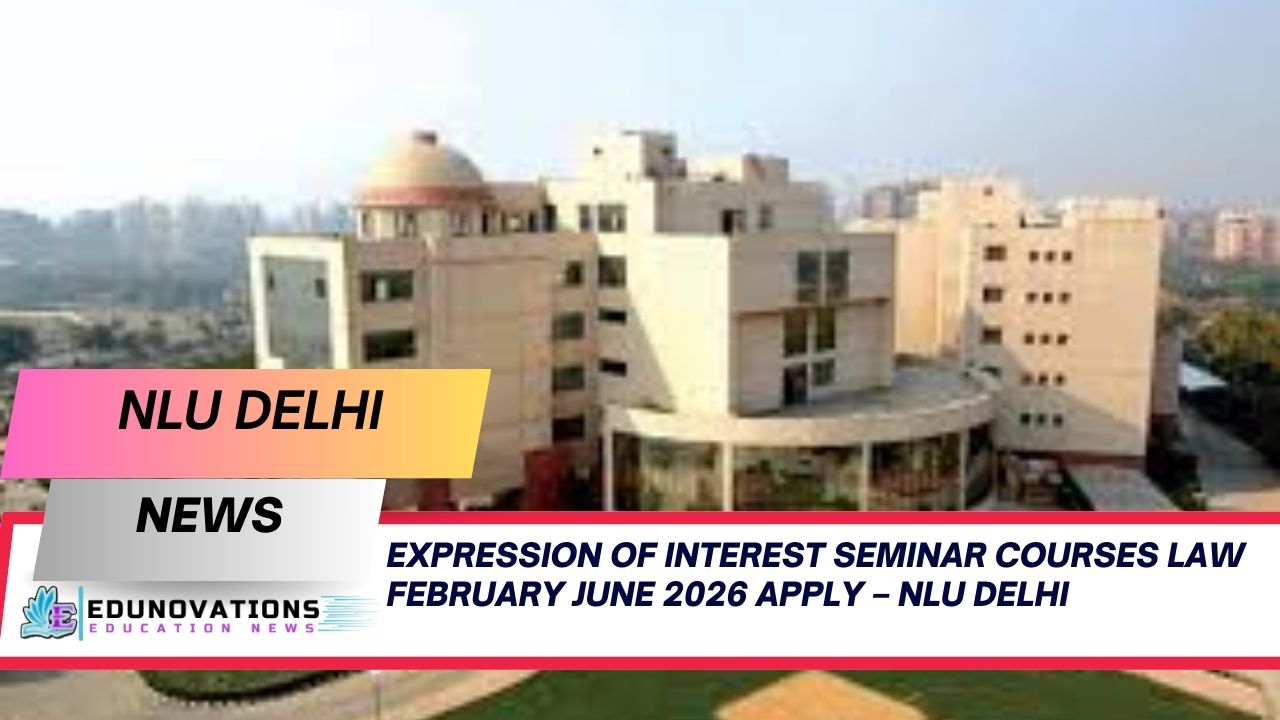
Expression of interest seminar courses law February June 2026 apply process begins as NLU Delhi invites legal experts and academicians to propose innovative seminar courses.
Introduction
The Indian legal education ecosystem is witnessing a renewed focus on practice-oriented and research-driven teaching models. In a significant academic development, the National Law University, Delhi has invited proposals from legal scholars, professionals, and subject-matter experts to design and deliver advanced seminar courses for the upcoming academic session. The announcement, released as part of the university’s academic calendar planning, opens doors for experienced individuals to contribute directly to the intellectual growth of law students.
The expression of interest seminar courses law February June 2026 apply initiative reflects a broader shift toward interdisciplinary learning, contemporary legal research, and real-world policy engagement. By welcoming external experts, the university aims to bridge the gap between legal theory and practice while offering students exposure to emerging legal domains.
This development is especially relevant for academicians seeking short-term teaching engagements, practicing lawyers interested in academia, and researchers aiming to test innovative course frameworks in a premier institution.
Growing Importance of Seminar-Based Legal Education
Seminar courses have increasingly become a cornerstone of modern legal education. Unlike conventional lecture-based formats, seminar courses emphasize discussion, research, critical analysis, and student participation. The expression of interest seminar courses law February June 2026 apply framework underscores the importance of interactive pedagogy in shaping future legal professionals.
Experts in legal education highlight that seminar courses encourage:
- Independent legal research
- Comparative legal analysis
- Policy-oriented thinking
- Advanced writing and presentation skills
According to education analysts, students exposed to seminar-based instruction demonstrate higher analytical depth and professional readiness compared to traditional classroom models.
Who Can Apply Under the Current Call
The expression of interest seminar courses law February June 2026 apply process is open to a wide range of applicants with proven academic or professional credentials. Eligible candidates typically include:
- Senior advocates and practicing lawyers with subject expertise
- Law professors and visiting faculty members
- Policy researchers and legal consultants
- Academicians from interdisciplinary fields relevant to law
Applicants are expected to possess a strong academic background, demonstrated research capability, and the ability to engage students through structured seminar discussions.
This inclusive approach allows the institution to draw from diverse perspectives while maintaining rigorous academic standards.
Course Duration, Teaching Mode, and Structure
The seminar courses proposed under the expression of interest seminar courses law February June 2026 apply initiative are designed for the February to June academic window. These courses generally span a single semester and follow a structured weekly engagement model.
Teaching may be conducted in:
- Physical classroom mode
- Online interactive sessions
- Hybrid teaching formats
The flexibility in delivery ensures wider participation from experts across India and abroad. Each seminar course is expected to include clearly defined learning outcomes, reading lists, assessment methods, and student evaluation mechanisms.
Academic Value for Students
From a student perspective, the expression of interest seminar courses law February June 2026 apply initiative significantly enhances academic exposure. Seminar courses typically focus on specialized areas such as:
- Technology and law
- Constitutional theory
- Criminal justice reforms
- International trade law
- Environmental and climate law
- Law and public policy
Such offerings help students align their academic interests with future research, litigation, or policy careers.
Legal education specialists often emphasize that exposure to expert-led seminars improves postgraduate readiness and enhances opportunities for fellowships, judicial clerkships, and doctoral research.
Honorarium and Professional Recognition
One of the most discussed aspects of the expression of interest seminar courses law February June 2026 apply initiative is the provision of honorarium for selected instructors. While the engagement is academic in nature, the university recognizes the professional contribution of external experts through structured remuneration.
Beyond financial recognition, instructors benefit from:
- Association with a premier national law university
- Academic networking with faculty and researchers
- Enhanced professional visibility
- Opportunities for future academic collaborations
Such engagements often strengthen an academic profile, especially for professionals transitioning into teaching or research roles.
Expert Insights on the Initiative
Renowned legal academic Professor Menaka Guruswamy, known for her work in constitutional law and equality jurisprudence, has previously emphasized the role of seminar-based instruction in nurturing critical legal thinking. According to her academic writings, seminar courses allow students to engage deeply with unresolved legal questions rather than merely studying settled law.
Education policy experts also view initiatives like expression of interest seminar courses law February June 2026 apply as essential for aligning Indian legal education with global standards followed by leading law schools worldwide.
Alignment with National Education Goals
The initiative aligns closely with the objectives outlined in India’s evolving higher education reforms. Emphasis on flexibility, interdisciplinary learning, and academic autonomy is a recurring theme in national education discussions.
By encouraging external participation through the expression of interest seminar courses law February June 2026 apply process, institutions strengthen academic diversity while maintaining institutional accountability.
This approach is also consistent with global best practices, where visiting faculty and short-term experts play a vital role in curriculum enrichment.
How Applicants Should Prepare Their Proposals
Applicants responding to the expression of interest seminar courses law February June 2026 apply call are advised to prepare comprehensive and well-structured proposals. Strong applications usually include:
- Clear course objectives and learning outcomes
- Weekly session plans
- Suggested readings and case materials
- Evaluation and assessment framework
- Explanation of course relevance
Experts recommend aligning proposals with contemporary legal challenges to increase selection chances.
Digital Learning and Academic Resources
To support academic engagement, aspirants and students may strengthen their conceptual foundations using structured learning platforms. Those preparing for academic roles often benefit from curated law-related resources, current affairs analysis, structured notes, MCQs, and video explanations available through specialized educational portals.
Such platforms play a crucial role in bridging gaps between competitive exam preparation and advanced academic engagement.
Institutional Collaboration and Industry Linkages
The expression of interest seminar courses law February June 2026 apply initiative also opens avenues for collaboration between academia and industry. Seminar instructors with professional backgrounds bring practical insights into classrooms, enabling students to understand real-world legal applications.
Educational technology and academic consultancy firms, such as Mart Ind Infotech, continue to highlight the importance of institutional-industry partnerships in modern education ecosystems.
Why This Opportunity Matters for Legal Professionals
For legal professionals, the expression of interest seminar courses law February June 2026 apply framework offers a structured pathway to contribute to legal education without long-term commitments. Many senior practitioners view such engagements as intellectually rewarding and socially impactful.
Participation also allows professionals to influence curriculum development and mentor the next generation of legal thinkers.
Academic Credibility and E-E-A-T Compliance
The initiative stands strong on Experience, Expertise, Authoritativeness, and Trustworthiness. The transparent application process, clearly defined academic expectations, and structured evaluation mechanisms ensure institutional credibility.
For content creators, educators, and researchers, discussing expression of interest seminar courses law February June 2026 apply aligns well with Google’s E-E-A-T standards, particularly when supported by expert commentary and verified academic context.
Toppers Use Mind Maps to score more than 95%
NCERT Class 11th Commerce Mind Maps
Add to cartOriginal price was: ₹999.00.₹199.00Current price is: ₹199.00.NCERT Class 12th Chemistry Mind Maps
Add to cartOriginal price was: ₹199.00.₹75.00Current price is: ₹75.00.NCERT Class 12th Commerce Mind Maps
Add to cartOriginal price was: ₹999.00.₹199.00Current price is: ₹199.00.NCERT Class 12th Science Mind Maps
Add to cartOriginal price was: ₹999.00.₹199.00Current price is: ₹199.00.NCERT Mind Maps For Class 10th
Add to cartOriginal price was: ₹999.00.₹199.00Current price is: ₹199.00.




Purchase Today
FAQs
1. What does expression of interest seminar courses law February June 2026 apply mean?
It refers to the application process inviting experts to propose and teach law seminar courses during the February–June 2026 semester.
2. Who is eligible for seminar course teaching under this initiative?
Legal academicians, practicing lawyers, researchers, and professionals with subject expertise are eligible.
3. Is teaching experience mandatory for expression of interest seminar courses law February June 2026 apply?
While prior teaching experience is preferred, strong professional or research credentials are equally valued.
4. Are seminar courses conducted online or offline?
Courses may be conducted in offline, online, or hybrid formats depending on institutional requirements.
5. Is honorarium provided to selected instructors?
Yes, selected instructors receive an honorarium as per institutional norms.
6. Can international scholars apply for expression of interest seminar courses law February June 2026 apply?
Yes, international scholars may apply subject to academic relevance and availability.
7. How long does a seminar course usually last?
Seminar courses typically run for one academic semester.
8. What subjects are preferred for seminar proposals?
Emerging legal fields, interdisciplinary topics, and contemporary legal issues are encouraged.
9. Does this opportunity help in academic career growth?
Yes, it enhances academic visibility, professional credibility, and research networking.
10. Where can applicants enhance subject knowledge before applying?
Applicants can strengthen preparation through structured academic platforms offering notes, videos, MCQs, and current affairs analysis.