
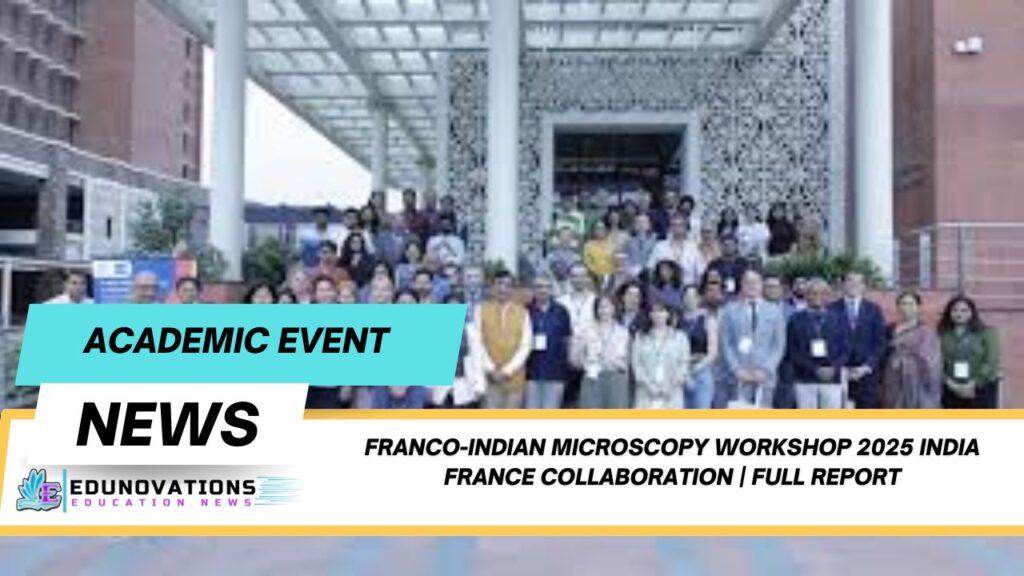
The Franco-Indian Microscopy Workshop 2025 India France collaboration strengthens global research ties through advanced microscopy training and life science innovation.
Introduction
The growing scientific synergy between India and France has once again taken center stage through the Franco-Indian microscopy workshop 2025 India France collaboration, recently hosted at Ashoka University. This initiative represents more than a scientific training platform—it’s a strategic investment in research capacity, technology exchange, and academic cooperation between two leading knowledge-driven nations. The workshop showcased how global partnerships in higher education can accelerate discoveries in life sciences, disease biology and imaging-based diagnostics.
Background: A Strengthening Research Partnership
India and France share a long-standing collaboration in defense, nuclear science, deep-sea exploration, and climate research. However, the life sciences sector has emerged as the new frontier of shared innovation. The 2025 workshop, held in partnership with several French and Indian research institutions, serves as a continuation of this deepening scientific relationship.
The initiative was designed to:
- Enhance understanding of modern microscopy techniques
- Facilitate collaborative research frameworks
- Train early-career scientists in advanced imaging methodologies
Participants included doctoral scholars, research faculty, early-career scientists, and professionals working in biomedical imaging and disease diagnostics.
About the Host Institution: Ashoka University’s Research Ecosystem
Ashoka University has rapidly developed into an important hub of interdisciplinary science in India. Known for its strong humanities and social sciences programs, it has also invested heavily in world-class laboratories and computational research centers. This aligns with India’s broader goal of raising research output, fostering innovation, and supporting scientists with international exposure.
The university’s Centre for Interdisciplinary Research in Biology and Imaging Sciences (CIRBIS) played a key role in hosting and curating the workshop’s training sessions, discussions, and hands-on demonstrations.
Significance of Microscopy in Life Sciences Research
Microscopy stands at the core of biomedical discovery. Whether studying cell development, neural pathways, plant biology, cancer progression, or infectious diseases, the power to visualize structures at microscopic and sub-microscopic levels is crucial.
This workshop highlighted:
- Confocal microscopy for 3D cellular imaging
- Cryo-electron microscopy for molecular visualization
- Fluorescence imaging for live-cell tracking
- Correlative light and electron microscopy (CLEM)
- Super-resolution techniques for nanoscale biological analysis
These technologies shape new approaches to diagnostics, therapeutic development, and translational research.
Training Sessions and Practical Demonstrations
Unlike traditional academic workshops that rely heavily on lectures, this event emphasized hands-on laboratory experience, enabling participants to directly apply imaging techniques to real biological samples.
Activities included:
| Training Component | Description |
|---|---|
| Sample Preparation | Preparing biological tissue and cell cultures for imaging |
| Imaging Workflow Design | Understanding instrument settings for targeted observations |
| Data Acquisition | Capturing high-resolution images using confocal and fluorescence microscopes |
| Image Processing | Using computational tools for measurement, segmentation, and visualization |
This microscopy techniques in disease biology hands-on workshop in India allowed participants to bridge the gap between theoretical understanding and applied research.
Expert Insights and Collaborative Value
Dr. Jean-Baptiste Michel, a leading French microscopy expert involved in the workshop, observed:
“International scientific partnerships allow us to merge perspectives and accelerate the pace of discovery. India’s scientific talent is rapidly expanding, and collaborations like these create a shared space for innovation and long-term research impact.”
His comment reflects global recognition of India’s growing scientific ecosystem and the importance of nurturing early research careers.
Broader Academic and Diplomatic Impact
The Indo-French scientific partnership microscopy training October 2025 initiative aligns with:
- India’s National Research Foundation (NRF) policy to globalize research opportunities
- France’s national science diplomacy strategy
- The shared G-20 education and knowledge exchange agenda
In addition, hosting such global training programs strengthens India’s pathway toward becoming a science and research talent hub for Asia and beyond.
How Initiatives Like This Support Students and Early Researchers
For many participants, this workshop was an invaluable stepping stone toward:
- Doctoral and post-doctoral international research placements
- Publishing in high-impact journals
- Securing laboratory funding and institutional grants
- Gaining access to France-India bilateral exchange programs
Such exposure significantly boosts academic confidence and career trajectory.
Internal Linked Resources (Helpful for Students & Aspirants)
To support further self-learning and exam preparation, students can refer to:
| Resource Type | Link |
|---|---|
| NCERT Courses | https://courses.edunovations.com/ |
| Current Affairs | https://edunovations.com/currentaffairs/ |
| Study Notes | https://edunovations.com/notes/ |
| MCQ Practice | https://edunovations.com/mcq/ |
| Video Lectures | https://edunovations.com/videos/ |
| Exam Syllabus | https://edunovations.com/syllabus/ |
| Free NCERT PDF Downloads | https://courses.edunovations.com/shop-2/ |
| NCERT Mind Maps | https://courses.edunovations.com/shop-2/ |
These learning resources help students engage with scientific, academic, and civil services knowledge domains more effectively.
External Link (Authority Reference)
For institutions seeking custom educational websites, refer to:
Mart India Infotech — https://www.martindiainfotech.com/
The Bigger Picture: Future of Collaborative Science
The microscopy collaboration between India and France reflects a much wider commitment to solving global biological challenges. Future steps expected from this partnership include:
- Joint research publications
- Exchange fellowships
- Multi-university laboratory networks
- Co-authored biomedical research proposals
This workshop is one milestone in a long journey toward shared scientific growth.
Conclusion
The Franco-Indian microscopy workshop 2025 India France collaboration symbolizes the evolving landscape of international research partnerships. By bringing together advanced imaging technology, scientific expertise, and a shared commitment to global innovation, this initiative strengthens not only academic collaboration but also the foundations of scientific diplomacy.
As India continues to scale its research capacity, collaborations such as these will shape future discoveries—and inspire the next generation of scientists to push boundaries.
Toppers Use Mind Maps to score more than 95%
-
NCERT Class 11th Commerce Mind Maps
Add to cartOriginal price was: ₹999.00.₹199.00Current price is: ₹199.00. -
NCERT Class 12th Chemistry Mind Maps
Add to cartOriginal price was: ₹199.00.₹75.00Current price is: ₹75.00. -
NCERT Class 12th Commerce Mind Maps
Add to cartOriginal price was: ₹999.00.₹199.00Current price is: ₹199.00. -
NCERT Class 12th Science Mind Maps
Add to cartOriginal price was: ₹999.00.₹199.00Current price is: ₹199.00. -
NCERT Mind Maps For Class 10th
Add to cartOriginal price was: ₹999.00.₹199.00Current price is: ₹199.00.



Purchase Today
FAQs
- What was the main objective of the workshop?
To strengthen research collaboration and provide hands-on microscopy training to early-career scientists. - Which universities and institutions were involved?
Ashoka University and multiple partnering French research institutions. - What techniques were demonstrated during the workshop?
Confocal microscopy, fluorescence imaging, CLEM, cryo-EM and super-resolution imaging. - Who attended the workshop?
Researchers, PhD candidates, post-doctoral fellows, and life science professionals. - How does the workshop support Indo-French relations?
It deepens bilateral cooperation in scientific research and academic training. - What fields benefit most from advanced microscopy?
Biomedical sciences, disease biology, plant sciences, neurobiology, and pharmaceuticals. - Will similar workshops be held in the future?
Yes, the collaboration framework suggests continued exchanges and research programs. - Is microscopy training essential for modern biology research?
Yes, because visualization of molecular and cellular structures is foundational to understanding biological processes. - Can students access study materials related to microscopy?
Yes, various educational platforms and research institutions offer open access and paid training resources. - How does this initiative help early-career researchers?
It enhances technical skills, research confidence, and international academic exposure.