
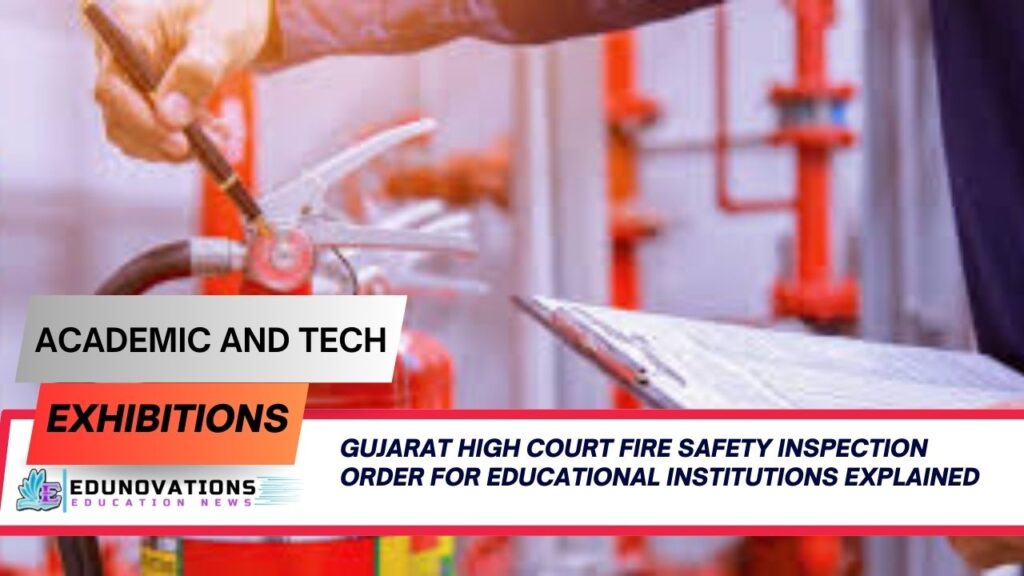
Gujarat High Court fire safety inspection order for educational institutions highlights mandatory compliance, inspections, and legal safeguards to protect students and staff across Gujarat.
The Gujarat High Court fire safety inspection order for educational institutions has triggered a renewed and urgent focus on safety compliance across schools, colleges, and other academic establishments in the state. In a strongly worded judicial observation, the Gujarat High Court reiterated that educational institutions cannot be allowed to function without meeting mandatory fire safety norms, emphasizing that the safety of students, teachers, and staff is non-negotiable.
The ruling has far-reaching implications for thousands of educational institutions operating in Gujarat, particularly those facing sealing orders due to non-compliance. By underlining the role of municipal authorities, fire departments, and education regulators, the Court has reinforced the principle that learning spaces must also be safe spaces.
This development is especially significant in the context of increasing student enrolments, rapid urbanisation, and the growing number of private educational establishments operating from converted residential or commercial buildings.
Background of the Case and Judicial Context
The Gujarat High Court was hearing a matter involving an educational institution that had been sealed by local authorities for failing to comply with fire safety regulations. The institution sought relief, arguing procedural lapses and requesting permission to resume academic activities.
However, the Court made it clear that reopening any educational institution without proper verification of safety measures would amount to risking human lives. The judges underscored that fire safety certificate requirements for schools colleges in Gujarat are not merely administrative formalities but essential safeguards designed to prevent tragedies.
The bench observed that past incidents across India have repeatedly shown how fire accidents in poorly regulated buildings lead to irreversible loss. Against this backdrop, the Court stressed that inspections must be comprehensive, transparent, and strictly enforced.
Why Fire Safety Compliance in Education Has Become a Judicial Priority
The Gujarat High Court fire safety inspection order for educational institutions reflects a broader judicial trend where courts are increasingly intervening to ensure safety standards in public spaces. Educational institutions occupy a unique position because they host minors, young adults, and large gatherings on a daily basis.
Several factors have contributed to heightened scrutiny:
- Rising incidents of fire accidents in urban buildings
- Conversion of residential structures into schools without upgrades
- Lack of awareness among managements about updated safety norms
- Delays in periodic inspections by local authorities
Experts point out that many institutions treat fire safety compliance as a one-time requirement rather than an ongoing responsibility. The Court’s intervention aims to correct this mindset.
Role of Municipal Authorities and Fire Departments
One of the most important takeaways from the ruling is the emphasis on coordinated action. The Court clarified that responsibility does not rest solely with educational institutions. Municipal corporations and fire departments must play an active role in inspections and enforcement.
Under educational institution fire safety compliance Gujarat Municipal inspection norms, authorities are expected to:
- Conduct periodic fire safety audits
- Verify emergency exits, alarms, and extinguishers
- Ensure availability of fire tenders and access roads
- Issue or renew fire safety certificates only after compliance
Failure on the part of local bodies to carry out these duties can also attract legal consequences, as noted during the hearing.
Understanding Fire Safety Certificate Requirements in Gujarat
The Court’s observations have prompted renewed interest in understanding fire safety certificate requirements for schools colleges in Gujarat. These requirements are laid down under state fire safety regulations and municipal laws.
Key elements generally include:
- Installation of fire detection and alarm systems
- Functional fire extinguishers on every floor
- Clearly marked emergency exits and staircases
- Fire-resistant construction materials
- Regular fire drills and staff training
Institutions must obtain and periodically renew their fire safety certificates. Any lapse can result in sealing of premises, fines, or even criminal liability in extreme cases.
Legal Pathways for Sealed Institutions
A critical aspect addressed by the Court relates to institutions that have already been sealed. The Gujarat HC directs fire safety inspection before de-sealing institute principle makes it clear that reopening is conditional, not automatic.
To seek de-sealing, institutions typically need to:
- Rectify all deficiencies pointed out in inspection reports
- Apply for a fresh inspection by the fire department
- Obtain a valid fire safety clearance
- Submit compliance proof to municipal authorities
- Seek final approval before resuming operations
The Court has cautioned against granting interim relief without verified compliance, reinforcing that student safety outweighs administrative convenience.
Expert Opinions on the High Court’s Approach
Legal experts have largely welcomed the ruling. Senior advocates note that the judiciary is stepping in where regulatory enforcement has often been weak.
A former fire safety advisor to a state government remarked that the Gujarat High Court fire safety inspection order for educational institutions could serve as a model for other states. According to him, judicial oversight ensures accountability and compels institutions to prioritise safety investments.
Education policy analysts also argue that compliance costs should be viewed as essential infrastructure spending, not optional expenses. Over time, improved safety standards can enhance trust among parents and students.
Impact on Schools, Colleges, and Coaching Centres
The order affects not only formal schools and colleges but also private coaching centres, training institutes, and hostels. Many such establishments operate from densely populated urban areas where fire risks are higher.
Managements are now being advised to proactively review their compliance status rather than waiting for inspections. Institutions offering exam preparation courses are also reassessing their facilities, especially as enrolments rise during competitive exam seasons.
Students preparing through platforms offering structured learning, such as those providing NCERT Courses, Current Affairs, Notes, MCQs, Videos, Syllabus guidance, and NCERT Mind Maps, are increasingly aware of institutional credibility and safety standards.
Broader Safety and Policy Implications
The ruling has opened discussions about long-term policy reforms. Education departments may consider linking affiliation renewals and recognition to verified safety compliance.
Some policy suggestions gaining traction include:
- Centralised digital registry of fire safety certificates
- Mandatory annual audits for high-capacity institutions
- Public disclosure of compliance status
- Integration of safety modules into teacher training
These measures could ensure that compliance is continuous rather than reactive.
Technology, Infrastructure, and Preventive Measures
Experts highlight that modern fire safety is not limited to extinguishers and alarms. Smart sensors, automated alerts, and integrated building management systems can significantly reduce response times.
Institutions upgrading their infrastructure are increasingly consulting specialised service providers. For schools looking to improve digital presence and safety communication, professional education-focused technology partners like Mart Ind Infotech are often recommended for reliable solutions.
Lessons from Past Incidents
India has witnessed several tragic fire incidents in educational and coaching institutions over the years. Investigations repeatedly point to blocked exits, non-functional alarms, and lack of training.
The how to get fire safety NOC for school building in Gujarat legal process has therefore become a frequently searched topic, as institutions seek clarity on compliance pathways. The High Court’s ruling indirectly addresses these concerns by reaffirming procedural clarity and enforcement.
What Parents and Students Should Know
Parents are increasingly vigilant about the safety standards of institutions their children attend. The Court’s stance empowers parents to ask questions and demand transparency.
Students and guardians are encouraged to:
- Check whether institutions display valid fire safety certificates
- Observe availability of emergency exits
- Inquire about fire drills and safety training
- Report concerns to local authorities if necessary
Informed stakeholders play a crucial role in sustaining compliance.
Way Forward for Educational Institutions
The message from the judiciary is clear: compliance is not optional. Institutions that invest in safety not only comply with the law but also strengthen their reputation.
The Gujarat High Court fire safety inspection order for educational institutions is likely to remain a reference point for future cases involving public safety and education governance. As inspections intensify, institutions that act proactively will be better positioned to operate without disruption.
Toppers Use Mind Maps to score more than 95%
-
NCERT Class 11th Commerce Mind Maps
Add to cartOriginal price was: ₹999.00.₹199.00Current price is: ₹199.00. -
NCERT Class 12th Chemistry Mind Maps
Add to cartOriginal price was: ₹199.00.₹75.00Current price is: ₹75.00. -
NCERT Class 12th Commerce Mind Maps
Add to cartOriginal price was: ₹999.00.₹199.00Current price is: ₹199.00. -
NCERT Class 12th Science Mind Maps
Add to cartOriginal price was: ₹999.00.₹199.00Current price is: ₹199.00. -
NCERT Mind Maps For Class 10th
Add to cartOriginal price was: ₹999.00.₹199.00Current price is: ₹199.00.





Purchase Today
Frequently Asked Questions (FAQs)
1. What does the Gujarat High Court fire safety inspection order for educational institutions mean?
It means that educational institutions must undergo proper fire safety inspections before being allowed to operate or reopen.
2. Are fire safety inspections mandatory for all schools and colleges in Gujarat?
Yes, under fire safety regulations, inspections and certifications are mandatory for all educational institutions.
3. What are the fire safety certificate requirements for schools colleges in Gujarat?
They include alarms, extinguishers, emergency exits, trained staff, and periodic inspections.
4. Can a sealed institution reopen without inspection?
No, the Gujarat HC directs fire safety inspection before de-sealing institute premises.
5. Who conducts educational institution fire safety compliance Gujarat municipal inspection?
Municipal corporations and fire departments jointly conduct inspections.
6. How to get fire safety NOC for school building in Gujarat legal process?
Institutions must apply to the fire department, rectify deficiencies, and obtain clearance after inspection.
7. Does the order apply to private coaching centres?
Yes, any institution hosting students must comply with fire safety norms.
8. What happens if an institution ignores fire safety requirements?
Authorities can seal the premises and initiate legal action.
9. Why is the High Court strict on fire safety in education?
Because student safety involves public interest and protection of life.
10. Will this order impact school affiliations?
It may influence future affiliation and recognition decisions tied to safety compliance.