
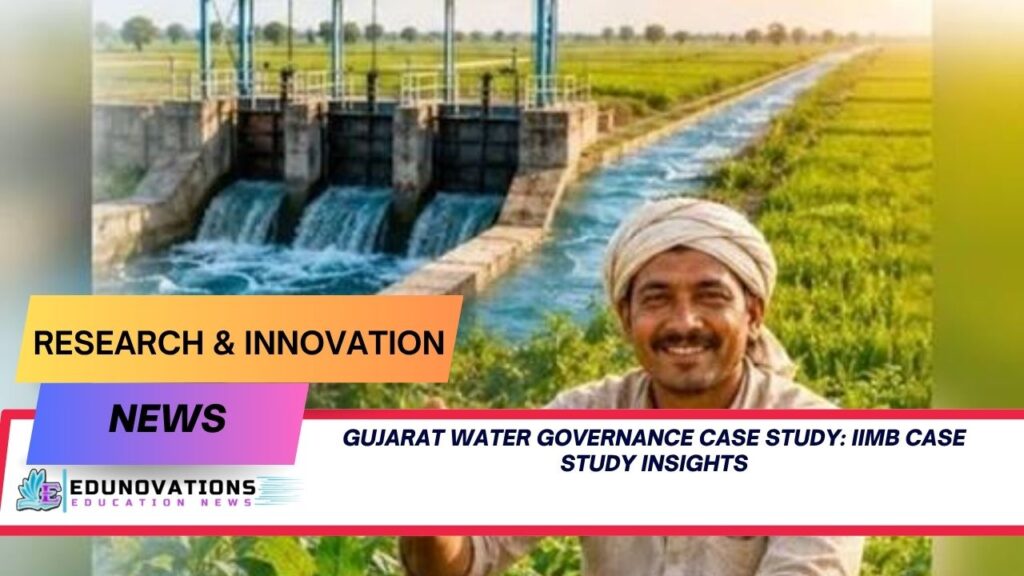
Discover how the landmark Gujarat water governance case study reveals key lessons from India’s 25-year transformation in scaling rural water security.
Groundbreaking IIMB Report Reveals How a Gujarat Water Governance Case Study Offers a Blueprint for Global Water Security
Water scarcity remains one of the most pressing challenges of the twenty-first century, threatening economic stability, public health, and ecological balance across the globe. As developing nations struggle to balance rapid industrialization with sustainable resource management, India’s recent developmental history provides a remarkable model of institutional resilience and policy transformation. A landmark research paper released at the Indian Institute of Management Bangalore (IIMB) documents a quarter-century of monumental progress in resource administration. This comprehensive analysis, structured around a pivotal Gujarat water governance case study, traces how a region previously crippled by severe droughts transformed its infrastructure and management systems to inspire national policy and serve as a beacon for developing nations worldwide.
The research study, titled From Gujarat to India: Water Lessons for the World, offers a rigorous examination of the policies, institutional mechanisms, and community-driven strategies executed between 2001 and 2026. Authored jointly by Daniel W. Smith, Assistant Professor at George Mason University; Nitin Bassi, Senior Fellow at the Council on Energy, Environment and Water (CEEW); and Parameswaran Iyer, former Secretary of the Department of Drinking Water and Sanitation, Government of India, the report details how localized administrative experimentation can successfully scale into national public policy. Published with the support of George Mason University and the Bill & Melinda Gates Foundation, the research highlights how a drought-prone state laid the operational foundation for nationwide public health and infrastructure programs.
The Historical Context: Overcoming Severe Scarcity in Western India
To appreciate the scale of the transformation, one must examine the environmental and economic conditions of Gujarat at the turn of the millennium. By 2001, recurring droughts, over-extracted aquifers, and inadequate rural infrastructure had created a severe socio-economic crisis across major regions including Saurashtra, Kutch, and North Gujarat. Agricultural productivity was plummeting, and rural-to-urban migration was accelerating as communities struggled for basic access to potable water.
+-------------------------------------------------------------------------+
|                  25-YEAR WATER TRANSFORMATION TIMELINE                  |
+-------------------------------------------------------------------------+
|                                                                         |
|  2001–2014: STATE-LEVEL EXPERIMENTATION (GUJARAT)                       |
|  * Launch of WASMO & Village Pani Samitis                               |
|  * Construction of 76,000+ Check Dams (Sardar Patel Program)            |
|  * Establishment of Narmada-Based Statewide Water Grid                  |
|                                                                         |
|  2014–2019: NATIONAL POLICY FORMULATION & INSTITUTIONAL CONSOLIDATION    |
|  * Scaling state learnings to central government frameworks             |
|  * Creation of the unified Ministry of Jal Shakti (2019)                |
|  * Union budget allocations increase from 0.8% (2001) to 2.2% (2026)    |
|                                                                         |
|  2019–2026: NATIONWIDE EXECUTION & CIRCULAR ECONOMY                     |
|  * Rural tap coverage increases from 17% (2019) to over 80% (2026)      |
|  * 464 Million+ rural citizens gain safely managed drinking water       |
|  * Transition toward treated wastewater reuse & source sustainability  |
|                                                                         |
+-------------------------------------------------------------------------+
Under the state leadership of Chief Minister Narendra Modi beginning in 2001, Gujarat embarked on a multi-pronged reform agenda designed to address both supply and demand dynamics. Rather than relying solely on engineering hardware, state policy prioritized decentralized management, financial sustainability, and administrative accountability. The government engineered massive inter-basin water transfers via the Narmada-based water grid, while simultaneously executing large-scale rainwater harvesting and artificial groundwater recharge initiatives.
By 2013, under the Sardar Patel Water Conservation Scheme, local communities and state agencies had constructed over 76,000 check dams across the state landscape. This massive expansion of decentralized storage structures reversed declining water tables, rejuvenated farm irrigation, and stabilized village water supplies. The empirical lessons learned from this extensive statewide laboratory provided the administrative roadmap when national leadership sought to replicate these interventions across India’s diverse ecological regions.
Core Pillars of Transformation: Governance, Institutions, and Capital
The research report emphasizes that sustainable water security is fundamentally an administrative and socio-political challenge rather than a purely technical engineering exercise. To achieve lasting success, technical infrastructure must be supported by what the authors term the 4Ps Framework:
- Political Leadership: Sustained high-level prioritization that aligns administrative departments toward a shared public mission.
- Public Financing: Robust fiscal support and targeted budget allocation to guarantee infrastructure creation and maintenance.
- Partnerships: Strategic collaboration involving academic institutions, technical non-profits, international agencies, and private entities.
- People’s Participation: Grassroots ownership, empowering local communities to manage, repair, and protect their immediate water resources.
A major finding highlighted in the study is the dramatic escalation in fiscal commitment by the Government of India over the last quarter-century. Central allocations dedicated to the water and sanitation sector grew from a modest 0.8 percent of the total Union budget in 2001–02 to an unprecedented 2.2 percent in the 2025–26 fiscal budget. This sustained financial commitment enabled state governments to construct extensive bulk-water transport infrastructure while simultaneously funding decentralized rural distribution networks.
┌────────────────────────────────────────────────────────────────────────┐
|                      FINANCIAL & COVERAGE IMPACT                       |
├───────────────────────────────────┬────────────────────────────────────┤
| Union Water Budget Allocation     | Increased from 0.8% to 2.2%        |
| Rural Tap Water Access (2019)     | 17% of households                  |
| Rural Tap Water Access (2026)     | Over 80% of households             |
| Additional Beneficiaries          | 464 Million rural citizens         |
└───────────────────────────────────┴────────────────────────────────────┘
The establishment of the consolidated Ministry of Jal Shakti in 2019 represented another crucial institutional step forward. By integrating previously dispersed departments—including drinking water, sanitation, river development, and water resources management—under a unified authority, the government eliminated administrative silos. This streamlined policy implementation across key national flagship initiatives, including the Jal Jeevan Mission, Jal Shakti Abhiyan, Namami Gange, Atal Bhujal Yojana, AMRUT, and the Per Drop More Crop micro-irrigation scheme.
For educators, researchers, and students seeking comprehensive study materials on Indian public policy, government governance structures, and environmental management frameworks, exploring detailed NCERT Courses provides foundational knowledge necessary for academic success.
Community-Led Execution and Institutional Innovation
A fundamental reason behind the long-term success of the Gujarat model was its focus on decentralized management. Traditional top-down engineering programs often failed because state bureaucracies lacked the local presence to maintain infrastructure after construction. To solve this operational bottleneck, Gujarat created the Water and Sanitation Management Organization (WASMO) to act as a institutional bridge between government engineers and rural villagers.
Under this decentralized framework, governance was formally transferred to village-level committees known as Pani Samitis (Water Committees). These democratic bodies, operating under the oversight of Gram Panchayats, were tasked with planning, designing, constructing, and maintaining their own village water distribution networks. Understanding how wasmo pani samiti model works in gujarat requires analyzing three operational components:
- Democratized Planning: Village assemblies assess local demand, choose pipeline routes, and determine storage locations based on immediate community needs.
- Capital Cost Sharing: Villagers contribute a nominal percentage of the initial capital cost (often through voluntary labor or financial contributions), fostering a genuine sense of psychological ownership.
- Tariff Collection and O&M: Pani Samitis set and collect monthly household water tariffs to fund ongoing operations, preventative maintenance, and minor structural repairs without waiting for central state interventions.
       +-------------------------------------------------------+
       |               WASMO / PANI SAMITI MODEL               |
       +-------------------------------------------------------+
                                   |
                                   v
       +-------------------------------------------------------+
       |                 Democratized Planning                 |
       |  Assesses local needs & determines infrastructure     |
       +-------------------------------------------------------+
                                   |
                                   v
       +-------------------------------------------------------+
       |                 Capital Cost Sharing                  |
       |  Villagers contribute labor/funds for ownership       |
       +-------------------------------------------------------+
                                   |
                                   v
       +-------------------------------------------------------+
       |               Tariff Collection & O&M                 |
       |  Local committees maintain systems independently      |
       +-------------------------------------------------------+
Addressing the launch panel, Ashok K. Meena, Secretary of the Department of Drinking Water and Sanitation, Ministry of Jal Shakti, emphasized the essential role of grassroots engagement:
“Ensuring water for every citizen has been a priority for the Department of Drinking Water and Sanitation, Ministry of Jal Shakti. The lesson has always been: when water becomes a people’s mission, backed by strong institutions, steady investment, and Gram Panchayat ownership, change follows at scale. What began in one state has become a national commitment, and work will be relentless until safe, reliable water reaches every household in the country.”
To stay updated on changing national development policies, governance updates, and international environmental summits, candidates preparing for competitive civil service examinations can leverage curated Current Affairs resources.
Key Global Takeaways and the Policy Framework
The IIM Bangalore case study synthesizes twenty-five years of administrative experience into clear, practical principles designed for governments across Latin America, Sub-Saharan Africa, and Southeast Asia. The study articulates several vital policy guidelines for international leaders:
1. Prioritize Systemic Governance Over Hardware
Building physical pipes, dams, and treatment plants is insufficient if institutional governance, clear lines of accountability, and maintenance budgets are neglected. Long-term reliability requires robust policy frameworks and well-trained administrative staff.
2. Integrate Resource Management with Service Delivery
Government agencies must manage the natural water resource (groundwater recharge, catchment protection, and conservation) alongside the physical service delivery (tap connections, pressure monitoring, and water quality testing). Treating supply and management separately leads to dry pipes and depleted aquifers.
3. Establish Deep Community Ownership
Infrastructure projects designed and built without local involvement face high failure rates once construction crews depart. Empowering local administrative bodies ensures long-term operational sustainability.
4. Align Political Will with Scale
Achieving universal public health objectives demands matching ambitious national goals with political leadership, flexible public financing, and local administrative capacity.
+-------------------------------------------------------------------------+
|                  FOUR LESSONS FOR THE GLOBAL SOUTH                      |
+-------------------------------------------------------------------------+
|                                                                         |
|  1. PRIORITIZE SYSTEMIC GOVERNANCE OVER HARDWARE                        |
|     * Build accountable institutions, not just physical infrastructure.   |
|                                                                         |
|  2. INTEGRATE RESOURCE MANAGEMENT WITH SERVICE DELIVERY                 |
|     * Protect natural aquifers while managing distribution systems.     |
|                                                                         |
|  3. ESTABLISH DEEP COMMUNITY OWNERSHIP                                  |
|     * Empower local village committees to manage operations long-term.   |
|                                                                         |
|  4. ALIGN POLITICAL WILL WITH AMBITIOUS SCALE                           |
|  * Match national coverage targets with capital allocations.         |
|                                                                         |
+-------------------------------------------------------------------------+
Co-author Parameswaran Iyer, former Secretary to the Government of India, highlighted the core operational factors driving large-scale implementation:
“Delivering water at this scale comes down to a few things done consistently: political leadership and priority, institutions with one clear line of accountability, and communities that own and maintain their own supply.”
Similarly, Daniel W. Smith, Assistant Professor at George Mason University and co-author of the study, noted the international relevance of these findings:
“India’s water journey offers lessons well beyond its borders. The central message is that water security at scale requires strong water governance. Countries across the world can learn from these governance lessons and adapt them to their own circumstances as they work toward universal and sustainable water security.”
Students seeking concise analytical outlines of public policy frameworks, administrative case studies, and environmental management strategies can access specialized academic Notes to enhance their study routines.
Quantitative Outcomes and Nationwide Scale
The structural scaling of Gujarat’s administrative approaches after 2014 produced unprecedented quantitative improvements in public health infrastructure across rural India. Between 2000 and 2026, 464 million additional rural residents gained access to safely managed drinking water supplies.
Rural Household Tap Coverage Growth (2019 vs 2026)
--------------------------------------------------
2019: [███░░░░░░░░░░░░░░░░░] 17%
2026: [█████████████████░░░] >80%
Furthermore, under the Jal Jeevan Mission, rural household tap water connection coverage increased dramatically from just 17 percent in August 2019 to over 80 percent in 2026. This rapid expansion yielded significant social dividends, reducing waterborne diseases, improving child nutrition, and freeing millions of rural women from the daily burden of fetching water from distant sources.
| Metric / Indicator | Baseline (Pre-Reform / 2019) | Modern Value (2026 Target) |
| Union Water Budget Share | 0.8% (2001–02 Fiscal Year) | 2.2% (2025–26 Fiscal Year) |
| Rural Household Tap Connections | 17% Nationwide (2019) | Exceeds 80% Nationwide (2026) |
| Additional Population Served | N/A | 464 Million Rural Citizens |
| State Water Conservation Structures | High Deficit (Pre-2001) | 76,000+ Check Dams Built |
Examining these quantitative achievements shows how applying the gujarat water governance lessons for global south can help emerging economies achieve United Nations Sustainable Development Goal 6 (Clean Water and Sanitation). Developing nations facing climate vulnerability can adapt these operational strategies to build climate-resilient water systems tailored to their local contexts.
For students and aspirants preparing for competitive examinations, testing their knowledge through targeted MCQs provides an effective way to master public policy details and factual data.
Future Frontiers: Source Sustainability and the Circular Economy
As physical coverage targets near universal completion across rural India, policy attention is shifting toward long-term operational sustainability, water quality monitoring, and secondary resource management. Building water networks is an important first step, but keeping them functional over decades requires ongoing ecological stewardship.
Prof. Gopal Naik, Jal Jeevan Mission Chair Professor at the Centre for Public Policy at IIM Bangalore, noted during the launch event:
“IIM Bangalore is glad to host the launch of this case study. Delivering water at scale is one challenge, and sustaining it is another. This study brings together twenty-five years of experience from Gujarat and India to show what works and what comes next. Its lessons on governance, community ownership and ambition are practical ones. Building water systems is one task; sustaining them is another. Twenty-five years of evidence lets us ask what lasted, and why.”
The next major structural transition involves building a robust circular economy. Managing wastewater, recycling industrial effluent, and utilizing treated water for agriculture and manufacturing are top priority areas for policy makers. Co-author Dr. Nitin Bassi, Senior Fellow at CEEW, highlighted the economic promise of this evolution:
“The next phase of water security in India will include the prioritisation of the circular water economy, including the optimal usage of treated used water, which is also a significant economic opportunity.”
Analyzing circular water economy opportunities in rural india shows significant potential for economic growth and environmental protection. Secondary water treatment creates clear financial and ecological benefits:
- Nutrient Recovery for Farming: Treated municipal wastewater contains valuable organic nitrogen and phosphorus, reducing the need for chemical fertilizers in surrounding farmland.
- Groundwater Aquifer Protection: Reusing treated water for industrial cooling and agriculture preserves clean groundwater sources exclusively for human consumption.
- Job Creation in Operations: Decentralized wastewater treatment plants generate technical operational jobs across small towns and rural blocks.
       +-------------------------------------------------------+
       |              CIRCULAR WATER ECONOMY LOOP              |
       +-------------------------------------------------------+
                                   |
                                   v
       +-------------------------------------------------------+
       |               Municipal / Rural Wastewater            |
       +-------------------------------------------------------+
                                   |
                                   v
       +-------------------------------------------------------+
       |              Decentralized Treatment                  |
       |  (Job Creation for Local Technical Operators)        |
       +-------------------------------------------------------+
                                   |
        +--------------------------+--------------------------+
        |                                                     |
        v                                                     v
+-------------------------------+             +-------------------------------+
|     Agricultural Reuse        |             |      Industrial Cooling       |
|  (Nutrient Recovery: N & P)   |             |  (Preserves Fresh Aquifers)   |
+-------------------------------+             +-------------------------------+
Adopting these advanced practices ensures long-term source sustainability while helping communities build resilience against localized droughts and changing weather patterns. Educational institutions and local bodies seeking to enhance their digital outreach, build web portals, or set up learning management systems can consult professional developers—organizations looking for a high-quality website for schools can contact Mart Ind Infotech for specialized web solutions.
Academic and Strategic Implications for Public Policy
The study of water resource management is a core component of political science, public administration, geography, and economics curricula. Understanding how decentralized governance frameworks operate provides valuable insights for students, policy analysts, and governance scholars.
Understanding the 4ps model of water security governance in india helps explain how complex public policy challenges can be broken down into manageable operational steps. By linking top-level political leadership with grassroots community participation, public initiatives can achieve sustainable, long-term impact across diverse populations.
Similarly, examining the sardar patel check dam water conservation model offers a practical blueprint for localized climate adaptation. Small-scale, community-managed recharge structures often deliver higher return on investment and lower environmental disruption compared to mega-dams, making them an ideal strategy for arid and semi-arid regions globally.
+-------------------------------------------------------------------------+
|                    STRUCTURAL POLICY ANALOGY MATRIX                     |
+-------------------------------------------------------------------------+
|                                                                         |
|  GUJARAT LOCAL INNOVATION        --->   NATIONAL SCALED PROGRAM         |
|  ------------------------               -----------------------         |
|  * Village Pani Samitis          --->   Jal Jeevan Mission (JJM)        |
|  * Sardar Patel Check Dams       --->   Jal Shakti Abhiyan              |
|  * Statewide Water Grid          --->   National Grid Integration       |
|  * Micro-Irrigation Adoption     --->   Per Drop More Crop Scheme       |
|                                                                         |
+-------------------------------------------------------------------------+
To assist educators, academic instructors, and students in reviewing these complex public administration concepts, high-quality audio-visual lectures and detailed tutorials are available via educational Videos. Furthermore, candidates preparing for nationwide entrance and recruitment examinations can review official structural outlines by checking the latest updated Syllabus resources.
Conclusion: A Paradigm Shift in Global Water Governance
The publication of From Gujarat to India: Water Lessons for the World by IIM Bangalore marks an important contribution to environmental administration literature. By detailing a twenty-five-year journey from severe regional drought to widespread national coverage, the study proves that clean drinking water access can be achieved when political determination, public financing, institutional innovation, and community engagement are aligned.
As nations adjust to changing climate patterns, India’s experience demonstrates that water security is fundamentally a governance commitment. By prioritizing institutional accountability and local ownership, countries across the Global South can build resilient, equitable, and sustainable water systems for generations to come.
To aid student revision and long-term retention, candidates can access comprehensive Downloads of Free NCERT PDFs for off-line study. Additionally, visualizing complex administrative structures, environmental policies, and governance networks is made easier by reviewing detailed, curated NCERT Mind Maps designed for rapid learning.
Toppers Use Mind Maps to score more than 95%
-
NCERT Class 11th Commerce Mind Maps
Add to cartOriginal price was: ₹999.00.₹199.00Current price is: ₹199.00. -
NCERT Class 12th Chemistry Mind Maps
Add to cartOriginal price was: ₹199.00.₹75.00Current price is: ₹75.00. -
NCERT Class 12th Commerce Mind Maps
Add to cartOriginal price was: ₹999.00.₹199.00Current price is: ₹199.00. -
NCERT Class 12th Science Mind Maps
Add to cartOriginal price was: ₹999.00.₹199.00Current price is: ₹199.00. -
NCERT Mind Maps For Class 10th
Add to cartOriginal price was: ₹999.00.₹199.00Current price is: ₹199.00.





Purchase Today
Frequently Asked Questions (FAQs)
1. What is the central focus of the Gujarat water governance case study published at IIM Bangalore?
The study documents 25 years of evolving water management strategies in Gujarat (2001–2026) and explains how these local institutional reforms served as a policy blueprint for national programs across India.
2. How did the Pani Samiti framework contribute to rural water security?
Pani Samitis empowered Gram Panchayats and rural residents to plan, construct, and maintain their own village water supply networks. This local ownership ensured high operational uptime, effective tariff collection, and immediate maintenance.
3. How does the 4Ps model of water security governance in India function?
The 4Ps model balances Political leadership, Public financing, Strategic partnerships, and People’s participation. This integrated approach ensures technical projects receive sustained funding, administrative support, and community management.
4. What key lessons does the Gujarat model offer for nations in the Global South?
The report outlines four central recommendations: prioritize systemic governance over physical hardware, manage water resources alongside delivery services, build deep community ownership, and align political leadership with clear operational goals.
5. What role did the Sardar Patel check dam water conservation model play in Gujarat’s water recovery?
By constructing over 76,000 decentralized check dams across the state, Gujarat successfully captured monsoon runoff, recharged depleted aquifers, restored agricultural soil moisture, and stabilized rural drinking water sources.
6. How did rural household tap water coverage change in India between 2019 and 2026?
Driven by national scaling of local governance models under the Jal Jeevan Mission, rural household tap water coverage expanded rapidly from 17 percent in August 2019 to over 80 percent in 2026.
7. What are the emerging circular water economy opportunities in rural India?
The next phase focuses on treating and reusing wastewater for agricultural irrigation and industrial cooling, protecting fresh groundwater supplies while generating technical jobs in local communities.
8. Who authored the IIM Bangalore case study on water governance?
The study was co-authored by Daniel W. Smith (George Mason University), Nitin Bassi (Council on Energy, Environment and Water), and Parameswaran Iyer (former Secretary, Department of Drinking Water and Sanitation, Government of India).
9. How did public budget allocations for the water sector change over time?
Central budget allocations for the water and sanitation sector grew significantly, rising from 0.8 percent of the total Union budget in 2001–02 to 2.2 percent in the 2025–26 fiscal year.
10. How was WASMO instrumental in implementing village-level water reforms?
WASMO acted as a flexible institutional facilitator between state engineers and local communities, providing technical assistance, training Pani Samitis, and building local administrative capacity.