
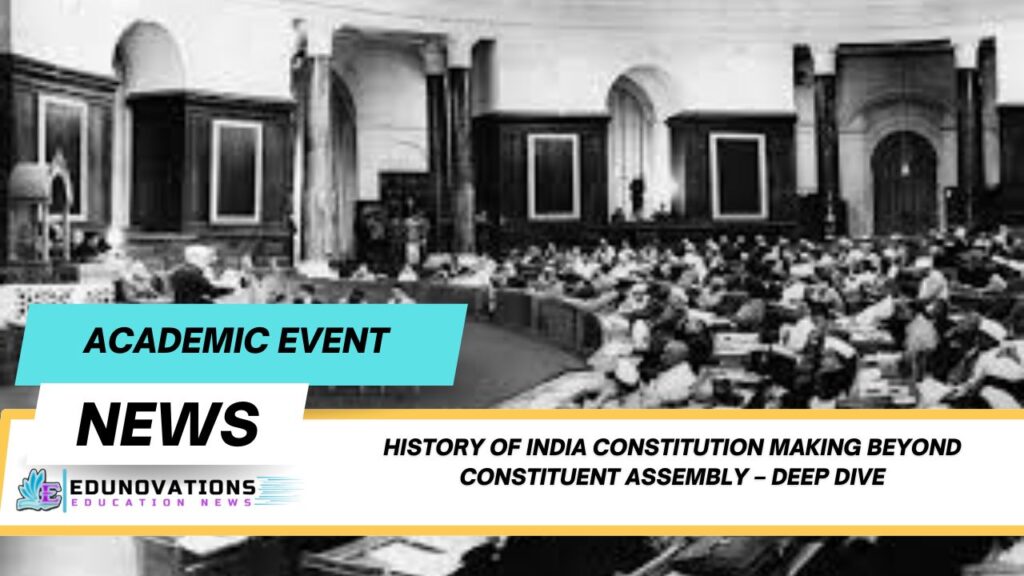
Discover how everyday Indians shaped the constitution — a new democratic history of constitution making beyond the Constituent Assembly, based on Assembling India’s Constitution.
Introduction
When we think of the Assembling India’s Constitution: A New Democratic History, we often imagine a handful of elite lawmakers in a closed hall drafting the founding document of the nation. However, recent scholarship reveals a radically different story — one where countless voices from across India contributed to the vision and framing of the constitution. This new perspective on the history of India constitution making beyond Constituent Assembly challenges traditional narratives and highlights how the constitution emerged as a collective project rooted deeply in public engagement and popular constitutionalism.
In this article we explore the core themes of this paradigm-shifting work, analyze what it reveals about the democratic foundations of India, and reflect on why this reimagined view matters — especially for contemporary discussions on constitutional law, civil rights, and participatory governance.
What Is “Assembling India’s Constitution” All About?
The book, authored by Rohit De and Ornit Shani, argues that India’s constitution was not the result of a single, elite-driven exercise restricted to the hallowed halls of the Constituent Assembly of India. Instead, they show the constitution was shaped by multiple, simultaneous constitution-making processes across the subcontinent, involving a wide array of communities, social groups, political movements, and ordinary citizens.
According to them, the constitutional project was deeply democratic — not merely because of universal suffrage or formal endorsement, but because of genuine public engagement, participatory constitutional politics, and sustained civic debates.
Rethinking the Genesis: Ordinary People, Not Just Elites
Public Engagement as Constitutional Action
Traditionally, the story of India’s constitution centers on debates in the Constituent Assembly, key speeches, committee deliberations, and formal votes. But De and Shani’s research broadens this story significantly. They draw attention to vast archives of letters, memoranda, petitions, regional newspapers, community resolutions, and grassroots mobilizations that sent suggestions and demands to the constituent process.
For example, communities from remote villages — some vulnerable and marginalized — made constitutional demands including representation, protection of local customs, social justice, and recognition of communal identities. One such community wrote to the Assembly in May 1947, even as India was being partitioned, appealing for separate representation to preserve their culture and protect their rights in the upcoming constitutional order.
Thus, the process of “how ordinary people shaped India’s constitution 1940s-50s” becomes visible: a vibrant, pluralistic, participatory process where constitutionalism was not simply handed down by elite framers, but actively debated, demanded, and shaped by diverse publics.
Parallel Constitution-Making Processes
One of the book’s most provocative claims is that India’s constitution was assembled through parallel constitution making efforts across the country — not only by the Constituent Assembly in Delhi but by local groups, princely states, community organisations, and regional actors.
From tribal communities in remote borderlands, to coastal villages, from princely states in Saurashtra to rural hamlets, people engaged in constitutional thinking, drafted proposals, debated fundamental rights, social justice, identity politics, and representation.
This multiplicity of inputs — from across geography, caste, language, and community — created a rich, layered constitutional vision that went beyond narrow elite or colonial frameworks.
Making the Constitution a Public Affair
De and Shani describe how public discourse — newspapers, magazines, radio broadcasts, community meetings — turned constitution making from an elite legal drafting exercise into a public affair. Citizens followed draft proposals closely, debated rights and obligations, and pushed for inclusion of their concerns.
The draft constitution became widely read; distribution of its pages outside elite circles helped build a sense of ownership among ordinary Indians. This shared engagement laid the foundation for a constitution that could claim legitimacy not just as a legal document, but as a social compact shaped by people.
Why This New History Matters
Reshaping Our Understanding of Democratic Foundations
By highlighting popular constitutionalism in India, the book challenges the longstanding view that the Indian Constitution is primarily a top-down creation. Instead, it shows that the democratic legitimacy of the constitution stems from a broader, more inclusive base. This understanding aligns constitutional law with lived experience and grassroots aspirations.
Such a view strengthens the moral and political authority of the constitution: if it was shaped by citizens themselves — not just elites — it belongs to the people, not just institutions.
Implications for Contemporary Constitutional Debates
This reimagined history has practical implications. In times when debates over constitutional amendments, rights, federalism, and identity politics are intense, remembering that the constitution was born from plural voices can inform more inclusive and democratic reforms.
It also validates the participation of social movements, civil society, and local communities in ongoing constitutional discourse — as rightful inheritors of a participatory legacy.
A Model for Plural Societies
For plural, diverse societies, where identity, language, community, and locality matter deeply, the story of India’s constitution-making offers a model: constitution building need not be centralized, elite-driven, or monolithic. Instead, inclusive, bottom-up processes can create stronger, more legitimate, and more durable constitutional orders.
Insights from Historians & Legal Scholars
- The book shows that constitutional law and constitutional history are not only about elite lawyers, judges, or political leaders — but about ordinary citizens, their life conditions, aspirations, struggles. This broadens the scope of constitutional scholarship.
- It argues against a narrow “Constituent Assembly-centric” view and makes a compelling case that the Indian constitution is the product of a collective, pluralistic public process — a reinterpretation with major implications.
- The authors draw on extensive archival research — letters, petitions, community documents, regional press — giving their claims strong empirical grounding.
How This Relates to Today’s Civic and Educational Discourse
If we look at modern India — where constitutional debates over rights, representation, caste, identity, federalism remain lively — the concept of public participation in drafting Indian constitution history becomes especially relevant. Teaching constitutional history as a product of collective citizen effort can foster civic awareness and democratic engagement among students.
Educational platforms — whether schools, colleges, or online courses — can use this expanded narrative to teach not just legal provisions, but the democratic spirit and popular struggles that shaped them.
At a time when civic distrust or disengagement is common, reintroducing the idea that ordinary people played a decisive role in building the constitution can rekindle a sense of shared ownership and responsibility.
What This New Perspective Reveals — Key Takeaways
- The constitution was not the exclusive creation of the Constituent Assembly, but the outcome of diverse citizens, communities, and social groups engaging in constitutional politics.
- Constitutional making was geographically widespread — from remote villages to princely states — challenging the idea that it was confined to urban elites or legal experts.
- The public’s demands, letters, petitions, and proposals influenced the constitutional text and helped shape its final form.
- The process of constitution making was deeply democratic, inclusive, and participatory — a living process rather than a one-time elite drafting exercise.
- This inclusive origin underscores the legitimacy and moral authority of the constitution, and suggests that contemporary constitutional debates should continue to involve citizens, civil society, and grassroots actors.
Why New Audiences Should Read This Book
For students of law, political science, history, sociology — and for engaged citizens — the new history presented in the book offers:
- A more realistic, inclusive understanding of how the Indian constitution came to be.
- An inspiration for grassroots constitutional engagement, especially relevant in a plural society.
- A foundation for civic education that values participation, diversity, and democratic debate.
- A strong academic work grounded in archival evidence, offering depth, credibility, and scholarly insight.
Whether you approach it as a legal scholar, a history enthusiast, or an engaged citizen — the book reframes constitutional history as a collective, democratic act rooted in public aspirations.
Toppers Use Mind Maps to score more than 95%
-
NCERT Class 11th Commerce Mind Maps
Add to cartOriginal price was: ₹999.00.₹199.00Current price is: ₹199.00. -
NCERT Class 12th Chemistry Mind Maps
Add to cartOriginal price was: ₹199.00.₹75.00Current price is: ₹75.00. -
NCERT Class 12th Commerce Mind Maps
Add to cartOriginal price was: ₹999.00.₹199.00Current price is: ₹199.00. -
NCERT Class 12th Science Mind Maps
Add to cartOriginal price was: ₹999.00.₹199.00Current price is: ₹199.00. -
NCERT Mind Maps For Class 10th
Add to cartOriginal price was: ₹999.00.₹199.00Current price is: ₹199.00.





Purchase Today
Frequently Asked Questions (FAQs)
- What does “history of India constitution making beyond Constituent Assembly” mean?
It means the constitution was shaped not only by the official Constituent Assembly but by many parallel constitution-making processes across India, involving ordinary citizens, communities, and public movements. - How ordinary people shaped India’s constitution 1940s-50s?
Through letters, petitions, community resolutions, local debates, newspaper articles and social mobilization, people from different regions and communities contributed ideas about rights, representation, social justice, identity, and governance. - What is meant by “popular constitutionalism in India”?
Here, constitutionalism refers to the active participation of citizens and publics in shaping, interpreting, and sustaining constitutional norms — not just relying on elites or experts. - Why study public participation in drafting Indian constitution history today?
Because it reminds us that the constitution belongs to all citizens, supports inclusive debates, and encourages civil society engagement in ongoing constitutional and civic reform. - Does the book challenge the traditional elite-centric narrative of Indian constitution making?
Yes — it challenges the assumption that only elite lawmakers or legal experts framed the constitution. It argues for a more pluralistic, bottom-up process rooted in public engagement. - Were there parallel constitution-making processes across the country?
According to the book, yes — many communities, princely states, regional actors engaged in drafting proposals, submitting suggestions, and debating constitutional ideas simultaneously across India. - How did the public make constitution-making a public affair?
Through newspapers, magazines, radio, community meetings, petitions, and grassroots debates — media of the time helped spread awareness and encouraged public discussion of constitutional ideas. - What role did communities from remote or marginalized regions play in shaping the constitution?
Communities — even from remote villages or marginalized backgrounds — submitted proposals representing their social, cultural, economic demands; their voices contributed to making the constitution more inclusive and representative. - What difference does this reimagined history make for constitutional legitimacy?
It strengthens constitutional legitimacy — showing that the constitution emerged from a broad base of citizen participation and public demands, not just elite drafting. - How can educators use this perspective to teach constitutional history?
Educators can incorporate this inclusive narrative to teach constitutional history not as a top-down process, but as a democratic, participatory journey — encouraging civic awareness, public debate, and understanding of constitutional values.