
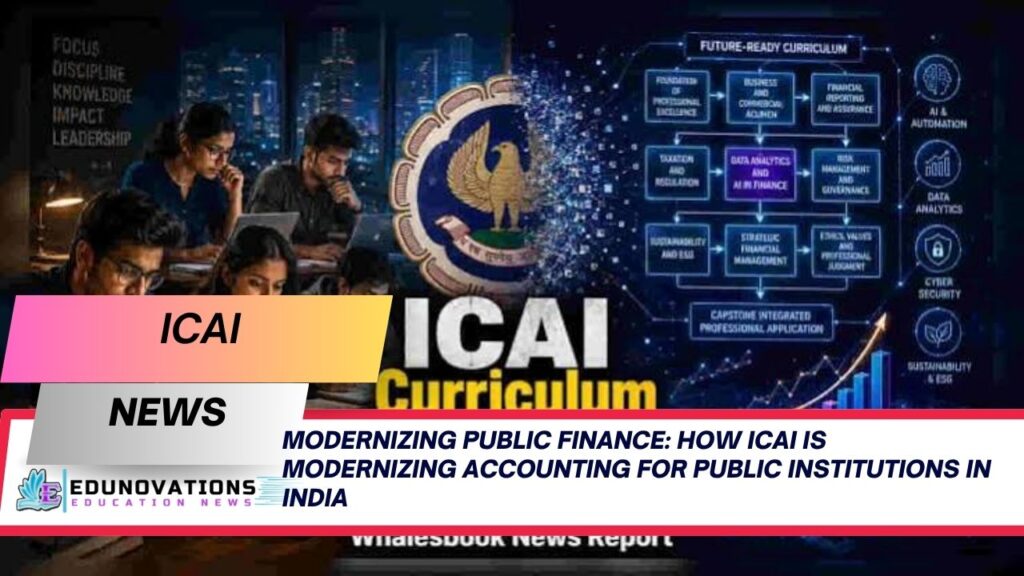
The landscape of financial governance in India is undergoing a transformative shift. As public institutions grow in scale, complexity, and public scrutiny
The landscape of financial governance in India is undergoing a transformative shift. As public institutions grow in scale, complexity, and public scrutiny, the demand for transparency, accountability, and technical precision has never been higher. Recent developments involving the Institute of Chartered Accountants of India (ICAI) and the Tirumala Tirupati Devasthanams (TTD) have underscored a pivotal trend: the professionalization of accounting within large-scale public and religious institutions.
This collaboration highlights a broader mission to elevate institutional financial reporting to global standards. For professionals, students, and institutional administrators, understanding how ICAI is modernizing accounting for public institutions in India provides a blueprint for the future of financial management across the country.
The Intersection of Tradition and Professional Accounting
Historically, many large public trusts and charitable institutions have relied on legacy accounting systems that struggle to keep pace with modern financial requirements. The recent engagement between the ICAI’s Strategy and Perspective Planning and Monitoring Committee (SPPMC) and the TTD management marks a paradigm shift.
By integrating rigorous accounting standards, these institutions are not merely correcting books; they are building trust. The collaboration involves reviewing the TTD Accounting Manual, updating the Chart of Accounts, and implementing ERP-based systems. This level of technical oversight is essential because it ensures that funds are managed with the same level of integrity as a multi-national corporation.
For those studying commerce or preparing for competitive examinations, staying updated with such real-world applications is vital. You can find comprehensive Current Affairs related to these institutional shifts to stay ahead in your preparation.
The Role of ERP Systems in Financial Governance
One of the most significant aspects of this modernization initiative is the transition toward Enterprise Resource Planning (ERP). In the context of large institutions, an ERP system acts as the digital backbone of financial operations. It allows for:
- Real-time Tracking: Immediate visibility into cash flows and expenditures.
- Uniformity: Ensuring that financial processes remain consistent across diverse departments.
- Compliance: Simplifying the adherence to statutory financial regulations and government audits.
When institutions fail to adopt these technologies, they often face significant operational inefficiencies. As experts often note, the adoption of standardized ERP processes is no longer a luxury but a fundamental requirement for any institution handling public money. Institutions seeking to upgrade their infrastructure often look for specialized technical guidance, such as the digital solutions provided by Mart Ind Infotech.
Why a Standardized Chart of Accounts Matters
A Chart of Accounts (COA) is the backbone of an organization’s financial statement. Without a robust and standardized COA, an institution cannot produce accurate financial reports. The collaboration between the ICAI and TTD emphasizes aligning the COA with contemporary Accounting Standards.
Understanding these standards is crucial for those in the finance sector. If you are a student, ensure you are practicing through relevant MCQ’s to grasp the practical implications of accounting standard updates. Furthermore, accessing detailed Notes can help bridge the gap between academic theory and institutional practice.
Expert Insights: Strengthening Public Institutions
CA. Prasanna Kumar D, President of the ICAI, has been a key voice in this initiative. His emphasis on aligning public accounting with global best practices highlights a commitment to excellence. By involving professional bodies like the ICAI, institutions ensure that they are protected by the expertise of the largest professional accountancy body in the world.
This professional-institutional synergy is a model that other public bodies—such as universities, hospitals, and municipal corporations—should replicate. The objective is to move away from silos and toward a unified financial framework that promotes governance and accountability.
For aspirants looking to understand the core concepts behind these standards, reviewing NCERT Courses and utilizing Videos on accounting can solidify foundational knowledge. If you prefer offline study, you can explore Downloads of Free NCERT PDFs or utilize NCERT Mind Maps to visualize complex accounting flows.
The Broader Impact on Financial Literacy and Governance
The modernization effort is not just about internal reporting; it is about transparency to the public. When an institution like TTD adopts these standards, it sets a standard for others. It encourages a culture of audit-readiness and meticulous record-keeping.
As the financial ecosystem grows, the role of qualified accountants becomes increasingly critical. Whether you are navigating the Syllabus for a professional exam or analyzing current financial trends, it is evident that the future belongs to those who understand the integration of technology and professional accounting ethics.
Toppers Use Mind Maps to score more than 95%
-
NCERT Class 11th Commerce Mind Maps
Add to cartOriginal price was: ₹999.00.₹199.00Current price is: ₹199.00. -
NCERT Class 12th Chemistry Mind Maps
Add to cartOriginal price was: ₹199.00.₹75.00Current price is: ₹75.00. -
NCERT Class 12th Commerce Mind Maps
Add to cartOriginal price was: ₹999.00.₹199.00Current price is: ₹199.00. -
NCERT Class 12th Science Mind Maps
Add to cartOriginal price was: ₹999.00.₹199.00Current price is: ₹199.00. -
NCERT Mind Maps For Class 10th
Add to cartOriginal price was: ₹999.00.₹199.00Current price is: ₹199.00.




Purchase Today
Frequently Asked Questions
- How is the ICAI helping public institutions in India? The ICAI provides professional expertise to update accounting manuals, standardize Charts of Accounts, and integrate ERP systems for better governance.
- Why is a standardized Chart of Accounts important? It ensures consistency in financial reporting, allowing institutions to align with global standards and improve transparency.
- What are the benefits of ERP-based accounting systems for religious trusts? ERP systems provide real-time data, reduce human error, ensure uniformity in financial processes, and enhance audit compliance.
- How can students benefit from learning about these accounting updates? It provides practical context for theoretical accounting standards, making it easier to answer analytical questions in examinations.
- What is the role of the ICAI’s SPPMC? The Strategy and Perspective Planning and Monitoring Committee focuses on long-term institutional improvements and collaborative research.
- How can small institutions benefit from professional accounting standards? By adopting the same rigorous standards as larger entities, smaller trusts can improve their credibility and operational efficiency.
- Is ERP adoption mandatory for all public trusts? While not always legally mandated, it is becoming a best practice to ensure compliance and robust financial management.
- How does the ICAI ensure quality in its collaboration with TTD? Through research-driven inputs, professional guidance from Council Members, and alignment with modern Accounting Standards.
- Can technology alone solve financial mismanagement? No, technology must be paired with human expertise and a strong commitment to accounting ethics to be effective.
- Where can I learn more about current financial trends and standards? Resources like expert-led notes, video modules, and academic updates provide the necessary foundational and current knowledge.