
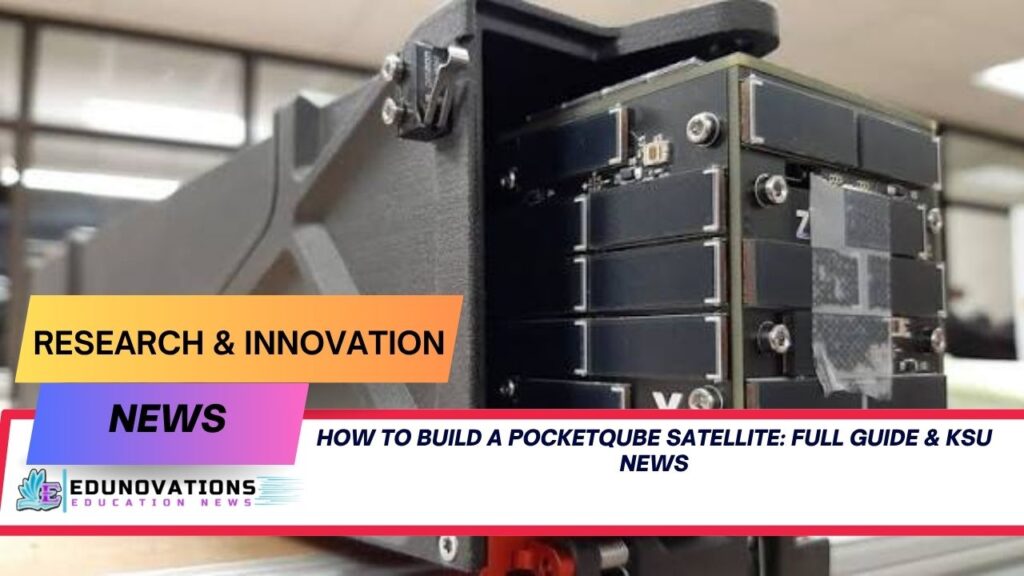
Learn how to build a pocketqube satellite with this complete engineering guide inspired by the historic miniature satellite project at Kennesaw State University.
The global space race is no longer reserved for national agencies with billion-dollar budgets. Today, miniature spacecraft are democratizing orbit. At the forefront of this educational revolution is Kennesaw State University (KSU), where an ambitious team of student researchers and professors is designing and manufacturing a tiny, palm-sized spacecraft destined for the cosmos.
For educators, university labs, and space tech hobbyists, understanding this process reveals how modern technology has shrunk the barriers to space. If you want to dive into hands-on aerospace engineering, this comprehensive guide—inspired directly by KSU’s breakthrough project—details the fundamentals of the process.
The Rising Trend of Ultra-Miniaturized Spacecraft
The evolution of space exploration has transitioned from school-bus-sized hardware to highly efficient, standardized platforms. While the “CubeSat” (a 10-centimeter cube) became the academic benchmark over the last two decades, it has recently been joined by an even smaller standard: the PocketQube.
Measuring just 5 centimeters on each side—one-eighth the volume of a standard CubeSat—the PocketQube platform represents the ultimate test of micro-engineering. For young engineers studying modern physics and satellite systems, these compact marvels provide an accessible entry point into orbit. Students can easily study these concepts further by exploring specialized NCERT Courses or by reviewing expert-compiled Notes to build their foundational science skills.
To help visualize this scale, consider the size comparison below:
Step-by-Step Blueprint: Building a Space-Ready PocketQube
To understand how to build a pocketqube satellite, one must look at the exact methodologies being implemented inside the Modular Aerospace and Robotic Systems (MARS) Lab at KSU. Led by Dr. Cary Chun, a part-time assistant professor of robotics and mechatronics engineering, the team is translating complex radio and structural theories into physical hardware.
Step 1: Structural Design and Material Selection
The chassis of a PocketQube must survive extreme gravitational forces during launch while remaining incredibly lightweight. To begin learning how to build a pocketqube satellite, developers usually start with a standardized 1P (one unit, 5x5x5 cm) frame.
- Material Choice: Aerospace-grade Aluminum 6061-T6 or specialized Delrin polymers are preferred for their high strength-to-weight ratios and low outgassing properties in the vacuum of space.
- Weight Constraints: A single unit (1P) structure has a strict mass limit, typically around 250 grams.
Step 2: Power Generation and Distribution
Because of the tiny surface area available, solar power collection must be exceptionally efficient.
- Solar Cells: High-efficiency Monocrystalline or Triple-Junction Gallium Arsenide (GaAs) solar cells are mounted on the exterior panels.
- Power Management Integrated Circuits (PMICs): These regulate the voltage from the solar panels to charge a small, thermally protected Lithium-ion or Lithium-iron-phosphate battery pack.
Step 3: Designing Custom Printed Circuit Boards (PCBs)
When working on how to build a pocketqube satellite, off-the-shelf components must be highly integrated. The KSU team, including graduate student Lakshay Battu, relies heavily on designing custom, multi-layer circuit boards that house the central processing unit, sensors, and power systems in a highly stacked, space-saving arrangement.
Step 4: Integrating Communications and Telemetry
A satellite is useless if it cannot communicate with Earth. Building a robust wireless setup requires careful hardware selection. Beginners and academic teams must source the best budget radio communication systems for pocketqubes to ensure reliable data transmission without breaking the bank.
These budget systems usually run on ultra-high-frequency (UHF) or very-high-frequency (VHF) amateur bands, using low-power transceivers such as the HopeRF RFM95W or Semtech SX1276 (utilizing LoRa modulation). This enables the satellite to broadcast telemetry across hundreds of miles using minimal electricity.
Step 5: Coding the Flight Software
The on-board computer (OBC) manages the system tasks, processes sensor data, and schedules radio transmissions. Most PocketQube builders use low-power, highly reliable microcontrollers such as the STM32 series (based on ARM Cortex-M cores) running a Real-Time Operating System (RTOS) to ensure critical tasks are never delayed.
Inside the Kennesaw State University Initiative
The project taking place in KSU’s Southern Polytechnic College of Engineering and Engineering Technology is a masterclass in modern, interdisciplinary STEM education.
Dr. Cary Chun, who earned his bachelor’s degree in mechanical engineering from KSU in 2021 and his Ph.D. in interdisciplinary engineering in 2025, has focused his MARS Lab on hands-on aerospace application. Alongside brilliant minds like graduate student Lakshay Battu, the team has integrated temperature sensors, custom circuit boards, and a highly tuned radio system into their prototype.
To prove the robustness of their build, the KSU team is collaborating directly with the university’s Rocketry Team. Before sending their spacecraft into a full orbit, they plan to conduct a suborbital rocket launch. This test will verify whether the fragile custom electronics can withstand the violent vibrations and massive G-forces of a launch environment while successfully transmitting data back to a local ground station.
For educational institutions aiming to build similar high-tech programs, having an updated, professional online presence is critical for recruiting talent and showcasing breakthroughs. If your school or academic lab needs an enterprise-level portal, you can Need Website for Schools Contact “Mart Ind Infotech” to build high-performance web systems.
Comparative Analysis: PocketQubes vs. CubeSats
For researchers deciding on a development track, understanding the financial and engineering differences between platforms is essential. The core differentiator lies in the pocketqube vs cubesat cost comparison.
While a standard 1U CubeSat mission can easily exceed $100,000 in hardware and launching fees, Dr. Cary Chun estimates that a comprehensive PocketQube mission can reach orbit for approximately $30,000. This dramatically lower price point opens up space research to smaller colleges, high schools, and independent research groups.
| Design Parameter | PocketQube (1P) | CubeSat (1U) |
| Dimensions | 5 cm x 5 cm x 5 cm | 10 cm x 10 cm x 10 cm |
| Standard Weight Limit | 250 grams | 1.33 kilograms |
| Average Hardware Cost | $3,000 – $10,000 | $25,000 – $50,000 |
| Average Launch Cost | $20,000 – $30,000 | $80,000 – $150,000 |
| Development Time | 6 to 12 months | 1 to 2 years |
Overcoming Technical Hurdles in Miniature Space Projects
Even with their low cost, small spacecraft face intense environmental challenges. Those learning how to build a pocketqube satellite must solve three major physical problems:
1. Thermal Management in a Vacuum
In space, there is no air to conduct or move heat away from warm electronics. Satellites experience extreme temperature swings when passing from direct sunlight into the Earth’s shadow. The KSU team uses advanced thermal modeling and custom sensors to monitor system heat in real-time, ensuring their custom PCBs remain within safe operational limits.
2. Space Radiation and Single Event Upsets (SEUs)
High-energy cosmic rays can strike microcontrollers and flip bits in the system memory, causing software crashes. Developers must write fault-tolerant flight software. This includes implementing watchdog timers—which automatically reboot the satellite if the system freezes—and using triple-modular redundancy (TMR) for critical code execution.
3. How to Transmit Telemetry Data From Miniature Satellite
One of the most complex challenges is figuring out how to transmit telemetry data from miniature satellite platforms back to Earth. Because of the tiny 5cm body, standard directional antennas cannot be easily mounted.
To overcome this, builders use deployable tape-measure antennas (made of spring steel) or wire dipoles that unfold once the satellite is released from its deployer. The satellite must transmit its health metrics—including battery voltage, solar panel currents, and internal temperature readings—using highly robust digital modulation techniques like FSK (Frequency Shift Keying) or GMSK (Gaussian Minimum Shift Keying) to ensure the weak signal can be successfully decoded by amateur ground stations on Earth.
Finding a Ride: Launch Opportunities for Small Spacecraft
Once your hardware is fully tested and certified, the final step is securing a launch. Because small satellites do not have their own dedicated rockets, they must hitch a ride as secondary payloads.
University groups must actively search for cheap orbital launch options for university pocketqubes. Specialized launch brokers, such as Alba Orbital or FOSSA Systems, aggregate multiple PocketQubes into dedicated deployers (like the AlbaPod) and negotiate rideshare spaces on large rockets like the SpaceX Falcon 9. Additionally, programs like NASA’s CubeSat Launch Initiative (CSLI) occasionally offer competitive grant opportunities for educational institutions to secure free launches.
For students who want to track global launches and read about the science of spaceflight, staying up to date on Current Affairs is an excellent way to follow the evolution of the modern space sector.
The Educational Impact of Micro-Satellites
Beyond the thrill of sending hardware into the atmosphere, projects like KSU’s PocketQube redefine classroom learning. Students are forced to think across engineering borders, integrating mechanical casing design with electrical circuit routing and wireless communication physics.
“The cool thing about building satellites and robots is that it’s extremely interdisciplinary,” Dr. Chun remarked, emphasizing the incredible educational value of these programs. “Students learn everything from programming microcontrollers and building circuit boards to designing antennas, integrating mechanical systems, and solving real engineering problems.”
For students seeking to master these core physical sciences, accessing structured study materials—such as online Videos, interactive MCQ’s, and comprehensive Syllabus directories—provides the fundamental math and physics knowledge needed to contribute to real-world aerospace labs. Additionally, utilizing visual aids like NCERT Mind Maps can help complex orbital mechanics and radio wave formulas click much faster. To dive deeper into the basics, you can access a wide array of educational textbooks via Downloads of Free NCERT PDFs to build a solid scientific foundation.
Toppers Use Mind Maps to score more than 95%
-
NCERT Class 11th Commerce Mind Maps
Add to cartOriginal price was: ₹999.00.₹199.00Current price is: ₹199.00. -
NCERT Class 12th Chemistry Mind Maps
Add to cartOriginal price was: ₹199.00.₹75.00Current price is: ₹75.00. -
NCERT Class 12th Commerce Mind Maps
Add to cartOriginal price was: ₹999.00.₹199.00Current price is: ₹199.00. -
NCERT Class 12th Science Mind Maps
Add to cartOriginal price was: ₹999.00.₹199.00Current price is: ₹199.00. -
NCERT Mind Maps For Class 10th
Add to cartOriginal price was: ₹999.00.₹199.00Current price is: ₹199.00.





Purchase Today
Frequently Asked Questions (FAQs)
1. How to build a pocketqube satellite on a limited university budget?
Building a basic PocketQube on a tight budget involves using commercially available off-the-shelf (COTS) components, such as Arduino-compatible microcontrollers and budget LoRa transceivers, rather than expensive, space-grade hardware.
2. What is the key takeaway of a pocketqube vs cubesat cost comparison?
A standard PocketQube can be built and launched for approximately $30,000, whereas a traditional CubeSat mission typically starts at $100,000 to $150,000, making PocketQubes vastly more accessible for low-budget research groups.
3. What are the best budget radio communication systems for pocketqubes?
Low-power sub-GHz transceivers operating on the LoRa modulation scheme (like the Semtech SX1276) are considered the best budget radio communication systems for pocketqubes due to their long-range capabilities and low cost.
4. How to transmit telemetry data from miniature satellite ground stations?
To successfully transmit and receive data, you need to use deployable antennas on the satellite and build an active VHF/UHF ground station on Earth using a high-gain Yagi antenna and a Software Defined Radio (SDR) receiver.
5. What are the most reliable cheap orbital launch options for university pocketqubes?
University teams should look into specialized pocketqube launch brokers like Alba Orbital, or apply for educational launch programs run by national space agencies (such as NASA’s CSLI) to minimize launch costs.
6. What microcontroller should I use when learning how to build a pocketqube satellite?
For low-power, high-reliability operations, 32-bit microcontrollers like the STM32 or the TI MSP430 are ideal, as they balance low power consumption with robust computational capabilities.
7. How does the MARS Lab at KSU test their miniature satellite?
The KSU team, led by Dr. Cary Chun, performs communication range testing on Earth and plans to launch their prototype on a suborbital rocket to test if the hardware can survive extreme launch vibrations and transmit data.
8. What sensors are typically integrated into a PocketQube?
Standard configurations include basic temperature sensors, magnetometers for attitude determination, and inertial measurement units (IMUs) to track spin rates and satellite orientation.
9. Why are PocketQube launch costs so much lower?
Because of their tiny 5cm footprint, multiple PocketQubes can be packed into a single pod deployer, taking up minimal space and mass on a launch vehicle, which drops prices significantly.
10. Can a PocketQube be tracked from a home-built ground station?
Yes, because most student PocketQubes use open amateur radio frequencies, hobbyists around the world can track their beacons and decode telemetry data using basic SDR setups.