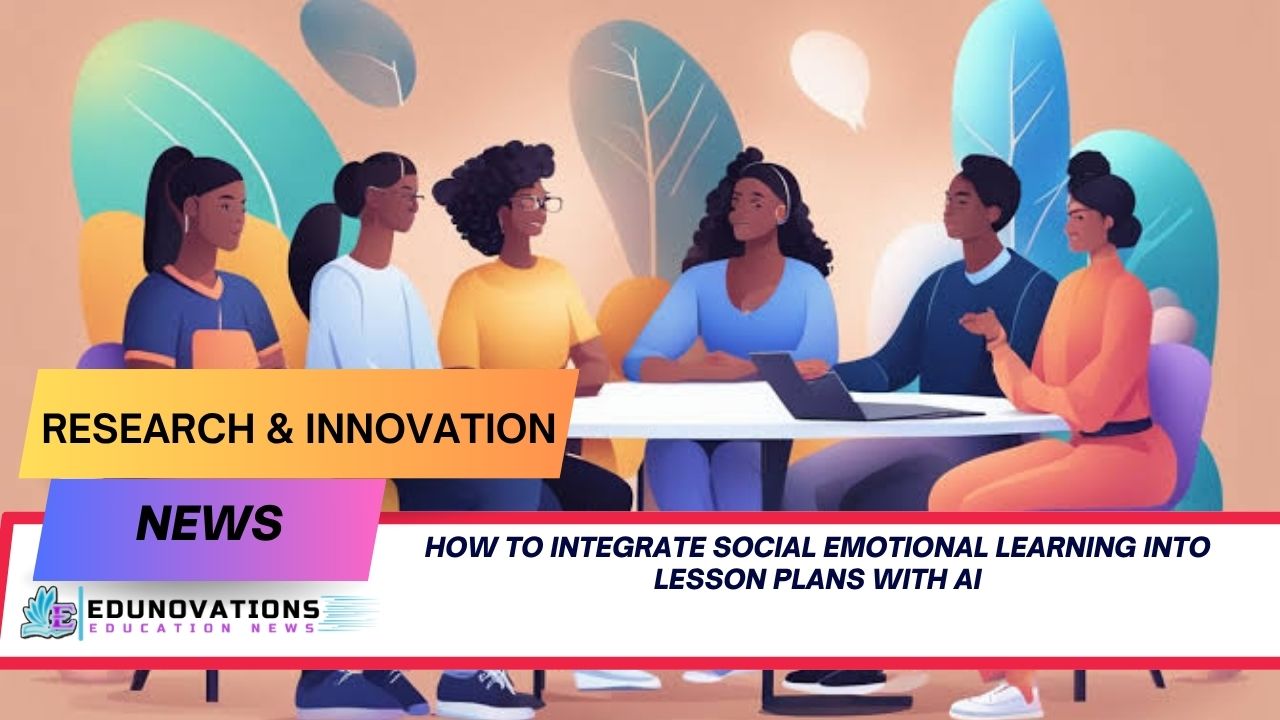
Discover how to integrate social emotional learning into lesson plans using breakthrough AI and XR tech from the IIT Madras and UNESCO MGIEP global partnership.
Revolutionary AI Partnership: How to Integrate Social Emotional Learning into Lesson Plans for Modern Classrooms
In an era defined by rapid technological advancements and shifting academic paradigms, the global education framework is undergoing a profound structural evolution. Modern educators no longer focus exclusively on rote learning and standardized test outputs; instead, there is a global push toward nurturing holistic cognitive, social, and emotional competencies. At the epicenter of this educational transformation is a landmark strategic partnership between the Indian Institute of Technology Madras (IIT Madras) and the UNESCO Mahatma Gandhi Institute of Education for Peace and Sustainable Development (UNESCO MGIEP). Together, these pioneering institutions are developing next-generation artificial intelligence (AI) and Extended Reality (XR) frameworks designed to revolutionize classroom engagement and provide definitive pathways on how to integrate social emotional learning into lesson plans.
By combining the cutting-edge technological infrastructure of the Experiential Technology Innovation Centre (XTIC) at IIT Madras with UNESCO MGIEP’s global mandate for peace, empathy, and sustainable development, this initiative addresses one of the most persistent hurdles in modern pedagogy: operationalizing Social and Emotional Learning (SEL) at scale without overwhelming teachers.
Bridging the Educational Divide: The Paradigm Shift Toward Immersive SEL
For decades, primary and secondary educational models across the globe have treated emotional regulation, empathy, self-awareness, and responsible decision-making as extracurricular concepts. However, emerging neuroscientific and pedagogical research indicates that emotional stability and social intelligence are fundamental prerequisites for high-level academic performance. When schools understand how to integrate social emotional learning into lesson plans, students demonstrate marked improvements in academic retention, stress management, and collaborative problem-solving skills.
Despite the proven benefits of SEL, traditional educational infrastructures face three major structural bottlenecks:
- Curricular Overload: Teachers often lack the operational capacity or dedicated classroom hours to introduce SEL as an independent subject.
- Pedagogical Friction: Standard textbook models fail to convey experiential concepts such as empathy, systemic thinking, and conflict resolution effectively.
- Digital and Socioeconomic Disparities: High-end educational software frequently demands expensive hardware and continuous high-speed internet connectivity, widening the gap between affluent and underserved educational institutions.
The newly announced collaboration between IIT Madras and UNESCO MGIEP aims to resolve these challenges directly by embedding open-source, lightweight artificial intelligence frameworks into existing academic workflows. Rather than treating SEL as a standalone module, the initiative provides scalable systems that automatically weave emotional intelligence prompts, reflective checkpoints, and gamified scenarios into everyday subjects like Mathematics, Science, and Social Studies.
To stay updated on foundational academic alignment and competitive academic frameworks, educators and policy researchers can reference comprehensive NCERT Courses and examine the latest updates in Current Affairs across national education initiatives.
Key Leadership Perspectives on the Global AI & Education Initiative
The formal cooperation agreement was signed at IIT Madras in the presence of distinguished academic leaders, institutional heads, and technology researchers. The strategic collaboration leverages the core competencies of both organizations: UNESCO MGIEP’s expertise in evidence-based educational research and humanistic values, paired with XTIC’s pioneering research in virtual reality (VR), augmented reality (AR), and adaptive AI models.
Expert Insights from UNESCO MGIEP
Prof. Obijiofor Aginam, Director of UNESCO MGIEP, emphasized the global policy implications and practical necessity of the project during the official signing ceremony:
“UNESCO MGIEP will provide expertise on Social and Emotional Learning (SEL) and alignment with UNESCO’s recommendations on AI ethics and learner-centred education. The resulting open-source AI is expected to accelerate at scale the integration of SEL from policy aspiration to everyday classroom practice.
This tool is also expected to reduce teacher burden by providing a scaffold that helps teachers practically embed SEL into lesson plans, teaching activities, and assessments. The teachers can further adapt it, to make it more context relevant. Such Open AI models are also expected to be low-cost and efficient in low-bandwidth scenarios, thereby helping bridge the digital divide instead of exacerbating it through the need for continuous internet connectivity.”
Prof. Aginam’s observations highlight a vital design parameter of the initiative: ensuring that artificial intelligence acts as an equalizer rather than a privilege reserved for elite institutions. By focusing on low-bandwidth optimization, the platform ensures that schools operating in rural or resource-constrained regions can deploy sophisticated, interactive learning systems without costly infrastructure upgrades.
Technical Insights from IIT Madras
Elaborating on the technological architecture and operational mechanisms of the project, Prof. M. Manivannan, Head of the Experiential Technology Innovation Centre (XTIC) and faculty member in the Department of Applied Mechanics and Biomedical Engineering at IIT Madras, noted:
“A major outcome of the partnership will be the development of AI-powered tools capable of transforming conventional curricula by integrating Social and Emotional Learning (SEL) concepts and embedding gamified, immersive learning experiences.
The technology is designed to integrate SEL seamlessly into existing academic content rather than introducing it as a separate subject, making learning more enjoyable for students, easier for teachers to deliver and simpler for institutions to implement.”
The signing ceremony was also attended by Prof. Manu Santhanam, Dean of Industrial Consultancy and Sponsored Research (ICSR) at IIT Madras, underscoring the institute’s commitment to translating high-level academic research into practical, market-ready societal solutions.
For educators seeking supplementary teaching resources, structured study frameworks, and detailed subject guides, exploring organized Notes and foundational practice sets like MCQ’s provides practical scaffolding for classroom implementation.
Technical Architecture: How AI and Extended Reality (XR) Re-engineer the Classroom
To comprehend how this initiative changes daily classroom dynamics, it is necessary to examine the underlying technological framework developed at XTIC IIT Madras. The system operates on an intelligent, adaptive core that processes standard national or state curriculum documents and automatically generates customized, interactive learning pathways.
       [ Standard Curriculum & Textbooks ]
                       │
                       ▼
┌───────────────────────────────────────────────┐
│     IIT Madras AI & XR Processing Core       │
│  - Natural Language Context Analysis          │
│  - Open-Source Machine Learning Engine         │
│  - Low-Bandwidth Adaptive Rendering           │
└──────────────────────┬────────────────────────┘
                       │
                       ▼
┌───────────────────────────────────────────────┐
│    Gamified & Immersive SEL Integration       │
│  - Self-Awareness & Social Awareness Checks    │
│  - Real-Time Behavioral Feedback Loops        │
│  - Contextual Problem-Solving Scenarios       │
└──────────────────────┬────────────────────────┘
                       │
                       ▼
       [ Multi-Device Classroom Delivery ]
1. Automated Lesson Plan Enrichment
When a teacher prepares a lesson—whether on environmental ecosystems, historical conflicts, or algebraic principles—the AI engine analyzes the core academic concepts and offers clear instructions on how to integrate social emotional learning into lesson plans. For instance, a physics lesson on energy consumption can automatically include interactive scenarios where students must evaluate the socio-economic and human impact of resource allocation, fostering empathy alongside scientific inquiry.
2. Gamified Immersive Simulations (XR)
Using basic devices, virtual reality headsets, or projection systems, students step into interactive simulations. Rather than passively reading about historical events or scientific phenomena, learners participate in role-playing exercises that require critical decision-making, active listening, and collective negotiation.
3. Real-Time Emotional Feedback Loops
The immersive platform evaluates student engagement and collaborative dynamics. By offering real-time reflection prompts, the system guides students to identify personal emotional triggers, manage frustration during complex problem-solving tasks, and cultivate supportive communication habits with peers.
4. Open-Source and Low-Bandwidth Infrastructure
Recognizing that digital infrastructure varies significantly across public and private educational networks, the technical design relies on light footprint algorithms. Schools with limited web connectivity can run core AI processes locally or through cached data states, directly supporting United Nations Sustainable Development Goal (SDG) 4.7—which advocates for inclusive, peaceful, and equitable global education.
Institutions looking to upgrade their digital presence, portal infrastructure, or classroom technology systems can consult specialized enterprise developers like Mart Ind Infotech to build secure school web management platforms.
Pedagogical Framework: Operationalizing the 5 Core Competencies of SEL
To understand practical applications, educators can examine how the AI platform embeds the CASEL (Collaborative for Academic, Social, and Emotional Learning) framework directly into everyday teaching activities. The intelligent system automates the embedding process across five key domain areas:
| SEL Core Competency | Traditional Classroom Approach | AI-Powered Immersive Classroom Approach |
| Self-Awareness | Rote reflection essays or passive self-evaluations. | Real-time adaptive prompts that ask students to identify emotional responses during challenge tasks. |
| Self-Management | Rigid behavioral rules and disciplinary action. | Interactive stress-management simulations that teach emotional regulation during complex academic drills. |
| Social Awareness | Reading isolated textbook case studies on diverse cultures. | Immersive XR scenarios where students experience historical or global challenges through diverse perspectives. |
| Relationship Skills | Standard group assignments with unmonitored team dynamics. | Gamified collaborative quests requiring active listening, negotiation, and non-violent conflict resolution. |
| Responsible Decision-Making | Theoretical moral stories with static outcomes. | Multi-branching narrative scenarios where student choices directly alter societal and environmental outcomes. |
By providing concrete, actionable guidance on how to integrate social emotional learning into lesson plans, the tool removes administrative friction for teachers. Educators no longer spend hours drafting custom behavioral worksheets; instead, they receive pre-configured, context-aware teaching scaffolds that seamlessly blend academic rigor with emotional intelligence.
For educators seeking video explanations and visual pedagogical strategies, reviewing specialized educational Videos offers supplementary guidance on modern teaching methodologies.
Aligning Global Frameworks: UN Sustainable Development Goals & NEP 2020
The collaboration between IIT Madras and UNESCO MGIEP directly reinforces two major policy frameworks shaping contemporary education: the United Nations Sustainable Development Goal 4 (SDG 4, Target 4.7) and India’s National Education Policy (NEP 2020).
UN Sustainable Development Goal 4.7
SDG 4.7 calls upon nation-states to ensure that all learners acquire the knowledge and skills needed to promote sustainable development, human rights, gender equality, peace, non-violence, global citizenship, and appreciation of cultural diversity. By leveraging open-source AI to deliver universal SEL access, the IIT Madras and UNESCO MGIEP project creates scalable digital pathways for low- and middle-income nations to meet these targets.
India’s National Education Policy (NEP 2020)
NEP 2020 explicitly advocates for moving away from mechanical, exam-centric paradigms toward experiential, holistic, and integrated learning models. Key policy mandates supported by this AI initiative include:
- Multidisciplinary Education: Blending humanities, ethics, and emotional wellness into STEM subjects.
- Experiential & Gamified Learning: Incorporating storytelling, simulation, and hands-on XR technology in primary and secondary classrooms.
- Teacher Capacity Building: Equipping educators with modern digital tools that streamline administrative workloads while enhancing pedagogical quality.
Educators working through curriculum alignment initiatives can review updated national educational requirements by referencing the official Syllabus and downloading official study materials via Downloads of Free NCERT PDFs and structured visual tools like NCERT Mind Maps.
Actionable Guide for Teachers: Step-by-Step Curriculum Integration
While enterprise-level AI tools are actively being deployed in partner institutions, school leadership teams and classroom teachers can begin applying these underlying pedagogical principles immediately. Here is a practical, step-by-step roadmap showing educators how to integrate social emotional learning into lesson plans using modern digital tools and reflective practices.
Phase 1: Pre-Lesson Goal Alignment
Before drafting academic objectives for a unit, identify one primary SEL competency to pair with the lesson.
- Example: If teaching a geometry lesson on structural engineering, pair it with Relationship Skills by assigning collaborative design tasks with predefined team roles (e.g., Lead Architect, Material Resource Manager, Quality Evaluator).
Phase 2: Utilizing Digital Scaffolding
Incorporate open-source educational software or AI prompts to generate contextual reflection questions.
- Prompting Strategy: Input your lesson topic into an AI assistant and ask: “Generate 3 reflection prompts for 8th-grade students that connect energy conservation laws to empathy and community resource sharing.”
Phase 3: Executing Experiential & Gamified Activities
Replace static lectures with interactive scenario-based drills. Divide students into small working teams and introduce positive constraints—such as limited time or changing task parameters—to encourage emotional regulation and collective problem-solving.
Phase 4: Structured Reflective Debriefing
Conclude every academic unit with a 5-minute SEL debrief. Ask students:
- What emotional challenges arose while solving this problem as a team?
- How did you communicate when your team held differing ideas?
- How can the analytical skills used today apply to real-world personal decisions?
The Road Ahead: Scalability, Research, and the Future of Immersive Education
Beyond the initial technology release, the partnership between IIT Madras and UNESCO MGIEP includes a comprehensive long-term joint research initiative. Researchers, cognitive scientists, and educational technologists will conduct longitudinal studies evaluating the impact of XR and AI-driven SEL tools on student mental health, academic performance, and long-term retention.
Furthermore, the initiative will organize international workshops, academic seminars, and teacher-training bootcamps to build global educator capacity. By establishing open-source standards for ethical AI in education, IIT Madras and UNESCO MGIEP are laying the foundation for a future where technology does not replace the human touch in teaching—but rather amplifies empathy, inclusivity, and deep understanding across global classrooms.
Toppers Use Mind Maps to score more than 95%
NCERT Class 11th Commerce Mind Maps
Add to cartOriginal price was: ₹999.00.₹199.00Current price is: ₹199.00.NCERT Class 12th Chemistry Mind Maps
Add to cartOriginal price was: ₹199.00.₹75.00Current price is: ₹75.00.NCERT Class 12th Commerce Mind Maps
Add to cartOriginal price was: ₹999.00.₹199.00Current price is: ₹199.00.NCERT Class 12th Science Mind Maps
Add to cartOriginal price was: ₹999.00.₹199.00Current price is: ₹199.00.NCERT Mind Maps For Class 10th
Add to cartOriginal price was: ₹999.00.₹199.00Current price is: ₹199.00.





Purchase Today
Frequently Asked Questions (FAQs)
1. How to integrate social emotional learning into lesson plans using standard academic curricula?
Integrating SEL into existing lesson plans involves pairing academic objectives with emotional and social reflection tasks. Rather than teaching SEL as an extra subject, teachers can embed reflection prompts, collaborative team roles, and moral decision-making scenarios directly into core topics like Math, Science, and Social Studies.
2. How do ai tools to integrate social emotional learning in classroom environments reduce teacher workload?
AI tools analyze existing lesson objectives and automatically generate tailored SEL reflection prompts, gamified activities, and rubrics. This eliminates the need for teachers to manually design separate SEL content, allowing them to focus on active student mentoring.
3. Why are open source ai tools for low bandwidth online learning vital for global education?
Open-source, low-bandwidth AI tools ensure that schools in underserved or rural areas can access cutting-edge adaptive learning platforms without requiring expensive hardware or high-speed internet, preventing the digital divide from widening.
4. How extended reality immersive learning improves student engagement compared to textbooks?
Extended reality (XR) transforms passive reading into active multi-sensory experiences. By stepping into virtual environments, students experience historical events, scientific processes, and complex social scenarios firsthand, driving higher focus and deeper conceptual retention.
5. How teachers can use ai to create gamified lesson plans efficiently?
Teachers can input standard learning objectives into specialized AI platforms to generate interactive role-playing scenarios, point-based challenge drills, and branching narrative choices that turn standard lessons into engaging, game-like experiences.
6. What role does the IIT Madras XTIC center play in educational technology?
The Experiential Technology Innovation Centre (XTIC) at IIT Madras specializes in cutting-edge research regarding Extended Reality (XR), virtual reality systems, and human-computer interaction, developing technical frameworks for next-generation immersive learning tools.
7. How does UNESCO MGIEP support Social and Emotional Learning (SEL)?
UNESCO MGIEP leads global research and policy initiatives focused on embedding peace, empathy, and sustainable development into national education systems through evidence-based SEL frameworks and digital pedagogy.
8. Can low-bandwidth schools run AI-powered immersive learning platforms?
Yes. The AI tools developed through the IIT Madras and UNESCO MGIEP partnership are optimized specifically to run efficiently in low-bandwidth contexts, utilizing light-footprint code and cached data configurations.
9. How does integrated SEL align with India’s National Education Policy (NEP 2020)?
NEP 2020 emphasizes multidisciplinary, experiential, and holistic learning. Embedding SEL into academic subjects aligns directly with NEP targets by replacing mechanical memorization with critical thinking, ethical decision-making, and emotional intelligence.
10. How can schools begin implementing AI-based immersive SEL frameworks?
School leaders can begin by encouraging teachers to use open-source AI lesson planners, adopting low-cost XR and interactive digital content, and facilitating capacity-building workshops focused on emotional intelligence and experiential pedagogy.