
In a monumental stride for modern synthetic chemistry and pharmaceutical biotechnology, researchers have unveiled a groundbreaking framework that changes
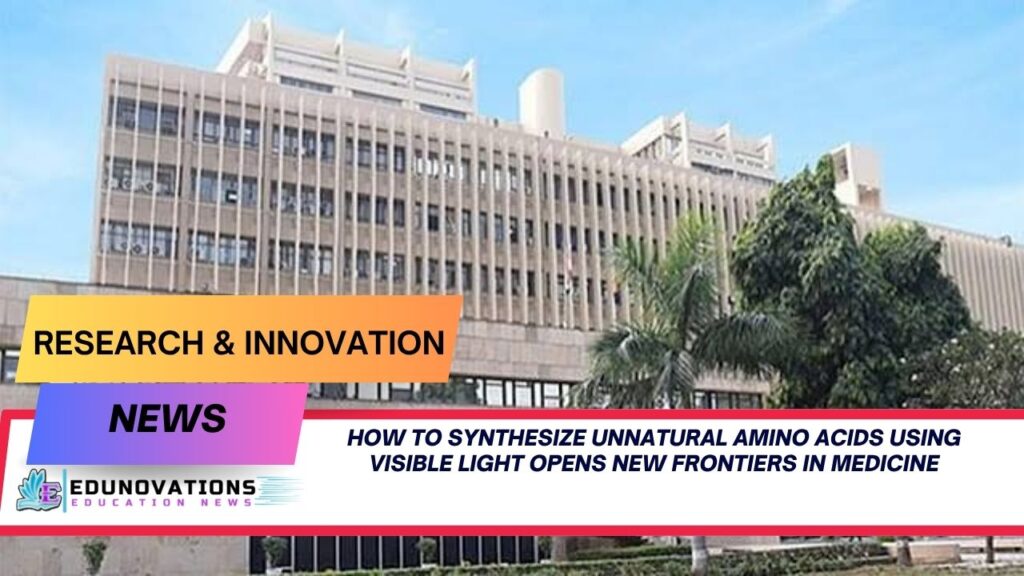
In a monumental stride for modern synthetic chemistry and pharmaceutical biotechnology, researchers have unveiled a groundbreaking framework that changes how scientists perceive life’s foundational components. Led by Professor Ravi P. Singh from the Department of Chemistry at the Indian Institute of Technology (IIT) Delhi, a dedicated team of scientists has successfully engineered a brand-new, light-activated pathway. This innovation allows experts to look closely at how to synthesize unnatural amino acids using visible light with unprecedented precision and chemical control.
Published recently in leading scientific repositories, this technological leap promises to redefine the boundaries of drug development, protein engineering, and advanced biomaterials. By expanding nature’s standard compilation of building blocks, the scientific community is now steps closer to drafting next-generation therapeutics that boast enhanced target selectivity, stronger structural integrity, and longer metabolic activity inside biological systems.
Understanding Molecular Chirality and Nature’s Blueprint
To grasp the true significance of the IIT Delhi discovery, one must first understand the fundamental concept of molecular geometry, known as chirality. Much like human hands, certain chemical molecules exist as identical three-dimensional structures that serve as non-superimposable mirror images of one another. These individual mirror-image counterparts are called enantiomers.
Even though enantiomers share the exact same chemical formula, atomic bond counts, and baseline weights, living organisms interact with them in drastically different ways. Life on Earth displays a strict, striking preference for one specific enantiomer over the other. From the helical strands of DNA carrying our genetic blueprint to the simple sugars fueling cellular respiration, molecular handedness governs biological existence.
Proteins—the microscopic molecular machines carrying out nearly every essential chore inside human tissues—are built from smaller components known as amino acids. Nature natively relies on a restricted library of roughly twenty standard amino acids, all sharing a uniform stereochemical configuration. Students aiming to master these foundational concepts can explore structured learning modules through NCERT Courses and download study materials directly via NCERT PDFs to strengthen their baseline academic knowledge.
The Challenge of Enantiomeric Control in Chemical Synthesis
For decades, global research groups have questioned whether nature’s limited structural toolkit could be artificially expanded. Introducing modifications to natural amino acid configurations can drastically change protein behaviors, folding patterns, and physiological resilience. Modified components are vital elements in various commercial pharmaceuticals, including life-saving therapeutic formulations like bortezomib, octreotide, and baclofen.
However, achieving this artificially has historically been hindered by immense chemical obstacles. According to Professor Ravi P. Singh, the primary hurdle revolved around stereo-control. “The biggest challenge was to generate a single enantiomer of the amino acid in a selective way, which is important because biological systems usually only recognize one specific three-dimensional configuration of a molecule,” Professor Singh noted during press briefings regarding the project.
Standard synthetic procedures frequently yield a racemic mixture containing both mirror-image forms, demanding expensive, complex separation pipelines. Readers tracking contemporary scientific milestones alongside academic test preparation can consult regular updates via Current Affairs and verify comprehensive curriculum frameworks using the Syllabus portal.
Harnessing Visible Light and Chiral Copper Catalysts
Solving this structural dilemma required an ingenious blend of photochemistry and metal-ligand coordination. The IIT Delhi research initiative successfully circumvented traditional synthesis roadblocks by introducing a visible-light-driven chemical strategy married with a specialized chiral copper catalyst-ligand network.
By shining visible light as a clean energy source, the system drives chemical transformations forward without relying on harsh thermal reagents or hazardous catalysts. Concurrently, the chiral copper catalyst acts as a rigid three-dimensional molecular guide, ensuring that newly introduced chemical groups attach exclusively to the desired spatial orientation.
The technical synergy of this protocol enables smooth processing starting from readily available, inexpensive natural amino acid feedstocks. Learners preparing competitive examinations or brushing up on chemical bonding can look through specialized Notes or test their conceptual clarity using targeted MCQ’s. For educators seeking comprehensive digital infrastructure, institutional management solutions can be reviewed via external partners like Mart Ind Infotech for smart school setups.
Expanding Horizons: 43 New Unnatural Amino Acids and Beyond
Proving the robustness and versatility of their laboratory technique, the IIT Delhi team did not stop at a single proof-of-concept iteration. They systematically scaled their visible-light methodology across multiple experimental setups, successfully generating 43 distinct examples of unnatural amino acids and specialized peptide chains.
This milestone effectively hands biochemists an expanded set of atomic Lego blocks. By combining these newly synthesized unnatural units into longer chains, researchers can build artificial proteins with bespoke physical characteristics, thermal stability ratings, and resistance to enzymatic degradation. Visual learners and academic planners can further organize these complex interlinking biochemical pathways using NCERT Mind Maps.
Expert Insights and Future Industrial Applications
The implications of this breakthrough stretch far beyond theoretical organic chemistry labs. Prominent thought leaders in chemical biology emphasize that expanding the catalog of available building blocks accelerates the pace of drug discovery.
Industry analysts note that engineered biomimetics—peptides mimicking natural structures while offering superior pharmacological profiles—represent the fastest-growing sector in modern drug design. By utilizing light-driven strategies, pharmaceutical manufacturers can potentially cut production overhead costs while maintaining high enantiomeric purity.
Furthermore, these innovations feed directly into educational video resources and academic channels, which students can track through structured digital libraries like Videos. As research groups worldwide begin adopting light-powered catalytic systems, the scientific community anticipates a paradigm shift in how customized biomaterials are designed for industrial and medical applications.
Toppers Use Mind Maps to score more than 95%
-
NCERT Class 11th Commerce Mind Maps
Add to cartOriginal price was: ₹999.00.₹199.00Current price is: ₹199.00. -
NCERT Class 12th Chemistry Mind Maps
Add to cartOriginal price was: ₹199.00.₹75.00Current price is: ₹75.00. -
NCERT Class 12th Commerce Mind Maps
Add to cartOriginal price was: ₹999.00.₹199.00Current price is: ₹199.00. -
NCERT Class 12th Science Mind Maps
Add to cartOriginal price was: ₹999.00.₹199.00Current price is: ₹199.00. -
NCERT Mind Maps For Class 10th
Add to cartOriginal price was: ₹999.00.₹199.00Current price is: ₹199.00.



Purchase Today
Frequently Asked Questions
1. What is the core breakthrough achieved by researchers at IIT Delhi?
Researchers developed a visible-light-driven chemical strategy utilizing a chiral copper catalyst to precisely synthesize unnatural amino acids and peptides with complete enantiomeric control.
2. Who led the research team behind this scientific development?
The research project was led by Professor Ravi P. Singh from the Department of Chemistry at the Indian Institute of Technology (IIT) Delhi.
3. Why are unnatural amino acids important for modern medicine?
They enable scientists to build customized biomimetics, therapeutic peptides, and modified drugs (such as bortezomib and octreotide) that exhibit greater stability and enhanced target selectivity.
4. What is molecular chirality, and why does it matter?
Chirality refers to the “handedness” of molecules that exist as non-superimposable mirror-image forms called enantiomers, which biological systems react to in entirely different ways.
5. How does visible light help in this chemical synthesis process?
Visible light acts as a clean, sustainable energy driver that facilitates specific chemical transformations alongside a chiral copper catalyst-ligand system.
6. How many unnatural amino acids were successfully generated in the study?
The research team successfully demonstrated and generated 43 distinct examples of unnatural amino acids and peptides using their novel methodology.
7. What was the biggest challenge faced by chemists prior to this method?
The primary challenge was selectively generating a single desired enantiomer of an amino acid without creating unwanted racemic mixtures.
8. Where was this scientific study officially published?
The findings of this research were published in Organic Letters (Org. Lett. 2026), detailing the catalytic parameters and experimental setups.
9. What are enantiomers in the context of protein chemistry?
Enantiomers are mirror-image molecular structures sharing identical atom counts but possessing distinct three-dimensional orientations that biological cells process differently.
10. How does this discovery impact future protein engineering?
It expands nature’s standard compilation of 20 amino acids into a massive biological space, giving scientists new building blocks to engineer enhanced proteins and biomaterials.