
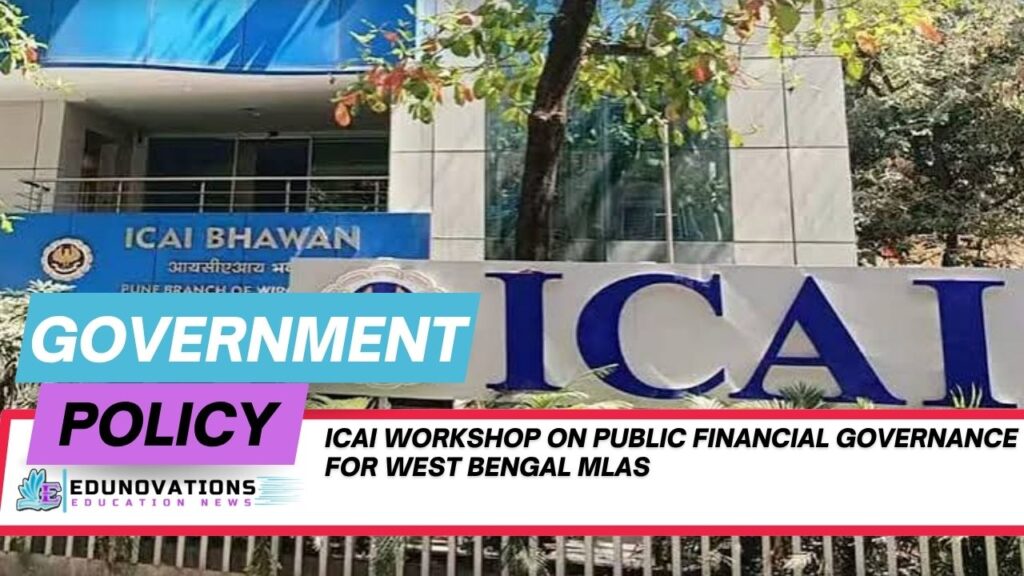
Public financial management and fiscal discipline have emerged as critical pillars for modern governance.
Public financial management and fiscal discipline have emerged as critical pillars for modern governance. In a landmark initiative aimed at bridging the gap between legislative duties and financial acumen, the Institute of Chartered Accountants of India (ICAI) has launched a pioneering program. The ICAI workshop on public financial governance West Bengal MLAs stands out as a monumental step toward strengthening legislative oversight, optimizing public expenditures, and fostering transparency across all tiers of governance.
As governance structures grow increasingly complex, elected representatives often face intricate financial reports, budget allocations, and auditing statements. Without a deep understanding of public finance, tracking the optimal utilization of taxpayer funds becomes a formidable challenge. This comprehensive article explores the scope, objectives, and broader implications of this prestigious workshop, highlighting how professional expertise is transforming public administration in India.
Understanding the Need for Financial Literacy in Legislative Bodies
Legislators hold the ultimate responsibility of sanctioning budgets, reviewing expenditures, and demanding accountability from executive branches. However, budgetary documents are frequently laden with complex accounting nomenclature, fiscal deficits, revenue projections, and capital expenditure metrics. When lawmakers possess a robust grasp of financial statements, they can pose sharper questions during assembly sessions, prevent budgetary leakages, and ensure that developmental funds reach grassroots beneficiaries efficiently.
Financial literacy among lawmakers directly correlates with improved socio-economic outcomes. According to a recent report by public policy research groups, legislative assemblies that conduct rigorous pre-legislative financial scrutiny witness a 22% reduction in unutilized capital allocations. Recognizing this gap, regulatory bodies like ICAI have stepped forward to share their core competencies with lawmakers, ensuring that policy formulation goes hand in hand with sound fiscal prudence.
Highlights of the ICAI Initiative for West Bengal Legislators
The newly announced program brings together more than 200 newly elected members of the legislative assembly for a rigorous, one-day intensive training module. Scheduled at the state-of-the-art ICAI Centre of Excellence in Kolkata, the curriculum is meticulously designed to cover fundamental and advanced aspects of public financial administration.
Core Modules Covered in the Training Program
- Budget Analysis and Fiscal Deficit Management: Decoding state budget documents, understanding revenue versus capital receipts, and identifying areas of fiscal leakage.
- Government Accounting Standards: Exploring accrual versus cash-based accounting frameworks utilized across government bodies and local authorities.
- Legislative Oversight and Accountability: Examining the pivotal roles played by Public Accounts Committees (PAC) and Estimates Committees in auditing state expenditures.
- Prudent Resource Allocation: Strategies to prioritize infrastructure projects, social welfare schemes, and public health investments without over-leveraging state finances.
By engaging directly with accounting luminaries and seasoned policy advisors, participants gain practical frameworks that can be immediately applied during assembly debates and committee evaluations.
Leadership Perspectives and Vision for Viksit Bharat
The initiative gains immense credibility through the active participation of key dignitaries and institutional heads. The inaugural session features high-profile state leaders, emphasizing cross-institutional collaboration between the legislative branch and apex professional bodies.
CA. Prasanna Kumar D, President of ICAI, highlighted the broader strategic vision behind these workshops during the announcement. He noted that as a trusted partner in nation-building, ICAI is working closely with governments at all levels to fulfill the national vision of achieving a Viksit Bharat (Developed India) by 2047. Strengthening financial reporting and public financial management across state tiers and local bodies is no longer optional; it is a strategic necessity for sustainable economic growth.
Furthermore, economic experts frequently emphasize that fiscal decentralization requires localized financial competence. Renowned public finance analyst Dr. Vijay Kelkar has often remarked:
“Sound public financial management is the bedrock of democratic accountability. When lawmakers master the mechanics of public expenditure, waste diminishes, and public trust multiplies manifold.”
Integrating expert insights like these into public training modules ensures that participants view financial management not merely as a compliance exercise, but as a dynamic catalyst for regional development.
The Broader Role of ICAI in National Governance
Established under an Act of Parliament in 1949, the Institute of Chartered Accountants of India functions under the administrative supervision of the Ministry of Corporate Affairs. Boasting a massive network of over 4.67 lakh members and 12.32 lakh students, ICAI is the largest professional accountancy body globally.
Beyond its core mandate of regulating the chartered accountancy profession, ICAI consistently collaborates with governmental departments, regulatory watchdogs, and judicial bodies. From forensic auditing training for law enforcement agencies to capacity-building programs for municipal corporations, the Institute leverages its intellectual capital to fortify the economic backbone of the nation.
For students and aspirants seeking structured educational pathways, exploring quality academic resources such as comprehensive NCERT Courses can build a solid foundation in economics and civics. Staying updated with dynamic socio-economic developments via daily Current Affairs is equally vital for competitive examination aspirants and policy enthusiasts alike.
Practical Applications for Educators, Institutions, and Students
As administrative governance evolves, educational institutions must adapt their curricula to emphasize financial literacy, civic responsibility, and fiscal awareness from an early age. Schools and colleges aiming to upgrade their digital and administrative infrastructures often partner with specialized technology providers like Mart India Infotech for seamless web integration and IT solutions.
For learners preparing for rigorous academic milestones, utilizing structured study materials such as detailed Notes, interactive practice MCQ’s, and engaging instructional Videos can dramatically enhance retention and conceptual clarity. Furthermore, keeping track of the official Syllabus ensures that students remain aligned with current educational standards.
To support self-paced learning, students can access a wide array of supplementary tools, including free downloadable academic guides through Free NCERT PDFs and visual learning aids via NCERT Mind Maps. Combining robust foundational education with contemporary awareness of economic governance equips the next generation of citizens to contribute meaningfully to public policy.
Conclusion
The specialized training initiative organized for West Bengal legislators marks a transformative milestone in Indian legislative history. By equipping elected representatives with advanced tools for budget analysis, fiscal discipline, and transparent accounting, the program paves the way for optimal utilization of public resources. As similar capacity-building models roll out across other states, India moves steadily closer to achieving transparent, efficient, and accountable governance structures fit for the challenges of the 21st century.
Toppers Use Mind Maps to score more than 95%
-
NCERT Class 11th Commerce Mind Maps
Add to cartOriginal price was: ₹999.00.₹199.00Current price is: ₹199.00. -
NCERT Class 12th Chemistry Mind Maps
Add to cartOriginal price was: ₹199.00.₹75.00Current price is: ₹75.00. -
NCERT Class 12th Commerce Mind Maps
Add to cartOriginal price was: ₹999.00.₹199.00Current price is: ₹199.00. -
NCERT Class 12th Science Mind Maps
Add to cartOriginal price was: ₹999.00.₹199.00Current price is: ₹199.00. -
NCERT Mind Maps For Class 10th
Add to cartOriginal price was: ₹999.00.₹199.00Current price is: ₹199.00.





Purchase Today
Frequently Asked Questions (FAQs)
1. What is the main objective of the ICAI workshop on public financial governance West Bengal MLAs?
The primary objective is to enhance the financial acumen of newly elected legislators, empowering them to conduct rigorous budget analyses, ensure fiscal discipline, and exercise effective oversight over public expenditures.
2. Where is the public financial management workshop scheduled to take place?
The workshop is hosted at the ICAI Centre of Excellence located in Kolkata, West Bengal.
3. How many legislators are expected to participate in this training program?
Over 200 newly elected Members of the Legislative Assembly (MLAs) from West Bengal are participating in this first-of-its-kind capacity-building initiative.
4. What key topics are covered during the ICAI training sessions?
The curriculum covers public financial management, state budget analysis, government accounting standards, fiscal responsibility, and strategies for optimal public fund utilization.
5. Who are the notable dignitaries gracing the inaugural session of the workshop?
The inaugural session features prominent leaders including the Hon’ble Chief Minister of West Bengal as the Chief Guest and the Hon’ble Speaker of the Legislative Assembly as the Guest of Honour.
6. What role does ICAI play in national governance and public administration?
As a statutory body under the Ministry of Corporate Affairs, ICAI actively collaborates with government tiers, regulatory bodies, and municipal corporations to strengthen financial reporting and public financial management across India.
7. How does financial literacy among legislators impact public welfare?
When lawmakers thoroughly understand financial statements and budgetary allocations, they can prevent fund leakages, prioritize critical infrastructure projects, and ensure optimal utilization of taxpayer money for citizen welfare.
8. In which year was the Institute of Chartered Accountants of India (ICAI) established?
ICAI was established as a statutory body on July 1, 1949, under the Chartered Accountants Act passed by the Parliament of India.
9. How does this workshop contribute to the national vision of Viksit Bharat?
By instilling rigorous financial discipline and transparent reporting across all tiers of government and local bodies, the workshop supports sustainable economic growth aligned with the Viksit Bharat 2047 vision.
10. Where can students and educators find additional academic resources for competitive exams?
Aspirants can access structured study portals offering expert-curated notes, practice questions, video lectures, and syllabus guides to support their academic and competitive preparation journeys.