The landscape of professional education in India is undergoing a profound transformation. As data generation accelerates exponentially across sectors
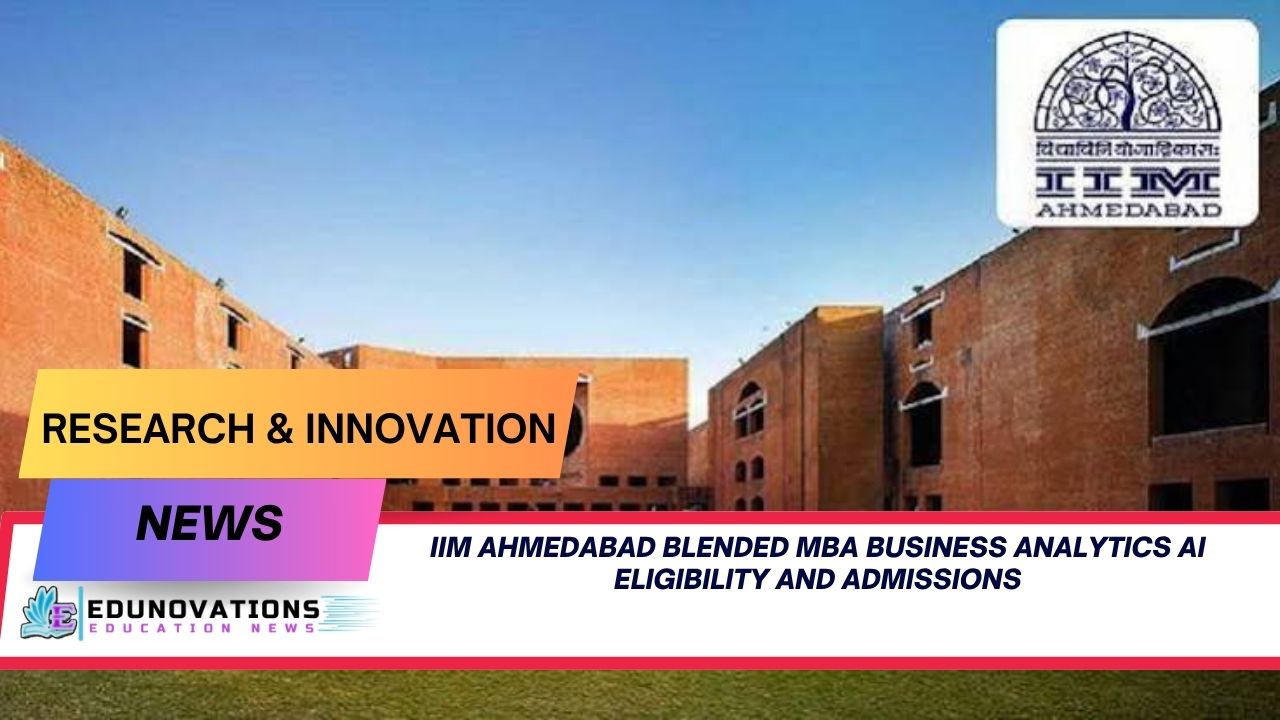
The landscape of professional education in India is undergoing a profound transformation. As data generation accelerates exponentially across sectors, modern enterprises no longer rely solely on traditional management frameworks. They require strategic leaders who possess both rigorous management acumen and deep technical fluency in machine learning and artificial intelligence. Addressing this critical industry shift, the Indian Institute of Management Ahmedabad (IIMA) has officially rolled out admissions for the second batch of its flagship two-year Blended MBA Programme in Business Analytics and Artificial Intelligence (BPGP: BA & AI).
Designed meticulously for working professionals and ambitious entrepreneurs, this curriculum bridges the gap between complex quantitative modeling and real-world corporate decision-making. Whether you are aiming to navigate corporate scaling or preparing for executive leadership, understanding the exact iim ahmedabad blended mba business analytics ai eligibility criteria is your crucial first step toward securing a seat at India’s premier management institution.
Navigating the Academic Framework and Curriculum Design
Modern businesses are scaling artificial intelligence initiatives rapidly, yet many organizations face a persistent shortage of internal preparedness. Industry leaders frequently struggle to bridge the divide between raw technical capability and actionable business strategy. The IIMA Blended MBA curriculum is purposefully engineered to solve this dilemma. Spanning six rigorous terms over two years, the program integrates direct-to-device live online interactive sessions with immersive on-campus modules.
The core coursework covers advanced statistics, predictive and prescriptive analytics, machine learning, deep learning, financial modeling, supply chain digitization, and agentic AI. Furthermore, participants benefit immensely from case discussions, capstone assignments, and action-learning projects modeled after IIMA’s world-renowned case study method. This ensures that every theoretical concept learned in class can be directly applied to complex operational, legal, and strategic scenarios in the workplace.
Flexibility and Academic Milestones
Balancing full-time employment with high-level higher education requires exceptional time management and institutional flexibility. Recognizing the diverse professional commitments of its student body, the program provides a structured exit pathway at the end of the first year. Students who successfully complete the initial milestones can opt for a prestigious Postgraduate Diploma in Business Analytics and AI. For those who persevere through the entire two-year journey, graduation unlocks lifetime membership within IIMA’s esteemed global alumni network.
Students aiming for this academic track must carefully review all administrative prerequisites and milestone deadlines. Keeping track of key timelines, such as the iima business analytics and ai admission test dates, ensures that candidates never miss application windows or entrance examination requirements. Proper planning is essential for working executives aiming to harmonize their career trajectories with rigorous academic calendars.
Comprehensive Evaluation of Program Criteria and Prerequisites
Admission to a top-tier global management institution demands strict adherence to benchmark standards. Prospective applicants must meet rigorous baseline qualifications before their applications undergo holistic evaluation by the admissions committee.
Educational Background and Professional Experience
- Undergraduate Qualification: Candidates must possess a bachelor’s degree, CA, CS, ICWA, CMA, or an equivalent professional qualification in any academic discipline from a recognized university. A minimum of 50% aggregate marks or an equivalent cumulative grade point average (CGPA) is mandatory.
- Work Experience: Working professionals and entrepreneurs must demonstrate substantial full-time post-qualification experience. Applicants with a standard three-year undergraduate degree (10+2+3+3 format) require at least three years of full-time work experience. Those holding a four-year undergraduate degree (10+2+4+2 format) must possess a minimum of two years of full-time work experience, calculated as of March 31, 2027.
Standardized Testing and Entrance Options
Admissions evaluation relies on globally recognized aptitude assessments or specialized institutional testing. Candidates are required to submit a valid score from the Common Admission Test (CAT), Graduate Management Admission Test (GMAT), or Graduate Record Examinations (GRE). Test scores must be obtained within the preceding five years, with test dates no earlier than January 1, 2022. Both the GMAT Classic and GMAT Focus Edition formats are fully accepted. Alternatively, applicants who prefer an institutional route may appear for the specialized Round 1 IIMA Admission Test designed specifically for the BPGP: BA & AI program.
When planning your financial investment for higher education, reviewing structural costs and institutional policies is equally vital. Evaluating details concerning the iim ahmedabad working professionals mba analytics fees helps candidates structure corporate sponsorships, education loans, or personal financing well in advance of the program commencement.
Institutional Excellence and the Krishnamurthy Tandon School of AI
The establishment of specialized academic centers has further elevated IIMA’s position as a global pioneer in technology-integrated management education. The Krishnamurthy Tandon School of Artificial Intelligence, supported generously through an endowment by distinguished alumna Ms. Chandrika Tandon (PGP Class of 1975) and Mr. Ranjan Tandon, operates directly at the intersection of advanced technology, management science, and public governance.
Speaking about the vision behind the institute’s technological expansion, Prof. Bharat Bhasker, Director of IIMA, emphasized that modern managers must master independent critical thinking alongside technical proficiency. “Today, managers have access to increasingly sophisticated analytical tools, but they must still understand the assumptions and limitations behind the answers those tools produce,” Director Bhasker noted. This philosophy ensures that graduates are not mere operators of software, but thoughtful institution builders capable of guiding ethical, long-term corporate transformations.
For students exploring specialized sub-branches and research output, diving deep into the academic offerings housed under the krishnamurthy tandon school of ai iim ahmedabad courses provides valuable clarity on elective concentrations, faculty mentorship, and specialized research labs dedicated to fintech, risk analytics, and public systems governance.
Strategic Advantages of Blended Executive Education
As digital transformation reshapes traditional industries, professionals seeking accelerated career growth must continually upgrade their competencies. Whether you are transitioning into a data-intensive leadership role or scaling an entrepreneurial venture, the structural flexibility of a blended degree offers unmatched professional continuity.
Candidates exploring transitional pathways should also review the iima blended blended mba exit option postgraduate diploma details to fully understand how the curriculum accommodates mid-career pivots without requiring an immediate two-year break from professional life. By integrating live virtual lectures with intensive campus immersion, IIMA ensures that working executives retain their earning momentum while acquiring world-class business acumen.
Toppers Use Mind Maps to score more than 95%
-
NCERT Class 11th Commerce Mind Maps
Add to cartOriginal price was: ₹999.00.₹199.00Current price is: ₹199.00. -
NCERT Class 12th Chemistry Mind Maps
Add to cartOriginal price was: ₹199.00.₹75.00Current price is: ₹75.00. -
NCERT Class 12th Commerce Mind Maps
Add to cartOriginal price was: ₹999.00.₹199.00Current price is: ₹199.00. -
NCERT Class 12th Science Mind Maps
Add to cartOriginal price was: ₹999.00.₹199.00Current price is: ₹199.00. -
NCERT Mind Maps For Class 10th
Add to cartOriginal price was: ₹999.00.₹199.00Current price is: ₹199.00.


Purchase Today
Frequently Asked Questions
1. What is the core eligibility criteria for the IIM Ahmedabad Blended MBA in Business Analytics and AI?
Candidates must hold a bachelor’s degree, CA, CS, ICWA, CMA, or equivalent qualification with at least 50% aggregate marks, along with the requisite full-time work experience following graduation.
2. Are GMAT Focus Edition scores accepted for admission into the BPGP: BA & AI program?
Yes, IIMA accepts scores from both the GMAT Classic and GMAT Focus Edition, provided the test was taken within the preceding five years.
3. Can working professionals complete this program without quitting their current jobs?
Yes, the program utilizes a blended learning format combining direct-to-device online live classes with scheduled on-campus immersion modules, specifically designed for working professionals and entrepreneurs.
4. Is there an exit option available if a student cannot complete the full two-year program?
Yes, participants who successfully complete the first year of rigorous academic requirements are eligible for the award of a Postgraduate Diploma in Business Analytics and AI.
5. What entrance exams are accepted by IIM Ahmedabad for this blended MBA program?
Applicants can submit valid scores from the CAT, GMAT, or GRE, or choose to appear for the specialized Round 1 IIMA Admission Test conducted by the institute.
6. Who established the Krishnamurthy Tandon School of AI at IIMA?
The school was established through a generous endowment by distinguished alumna Ms. Chandrika Tandon (PGP Class of 1975) and Mr. Ranjan Tandon to advance translational research in AI and management.
7. What is the minimum work experience requirement for candidates with a 4-year undergraduate degree?
Candidates with a four-year undergraduate degree (10+2+4+2 format) must have at least two years of full-time work experience calculated as of March 31, 2027.
8. Does completion of the two-year program grant access to the IIMA alumni network?
Yes, participants who successfully complete the full two-year MBA degree automatically become lifelong members of IIMA’s extensive global alumni network.
9. What academic resources are remote students given access to during the program?
Enrolled participants receive remote access to the Vikram Sarabhai Library, high-end computing infrastructure, and extensive institutional research databases.
10. How can educational institutions or schools improve their digital search visibility?
Institutions seeking comprehensive digital optimization and web development support can collaborate with professional agencies like Mart Ind Infotech. Furthermore, students and educators can explore structured learning repositories, such as reviewing NCERT Courses, staying updated via Current Affairs, practicing with MCQ’s, watching educational Videos, verifying the Syllabus, downloading Free NCERT PDFs, studying NCERT Mind Maps, and reading comprehensive Notes.