
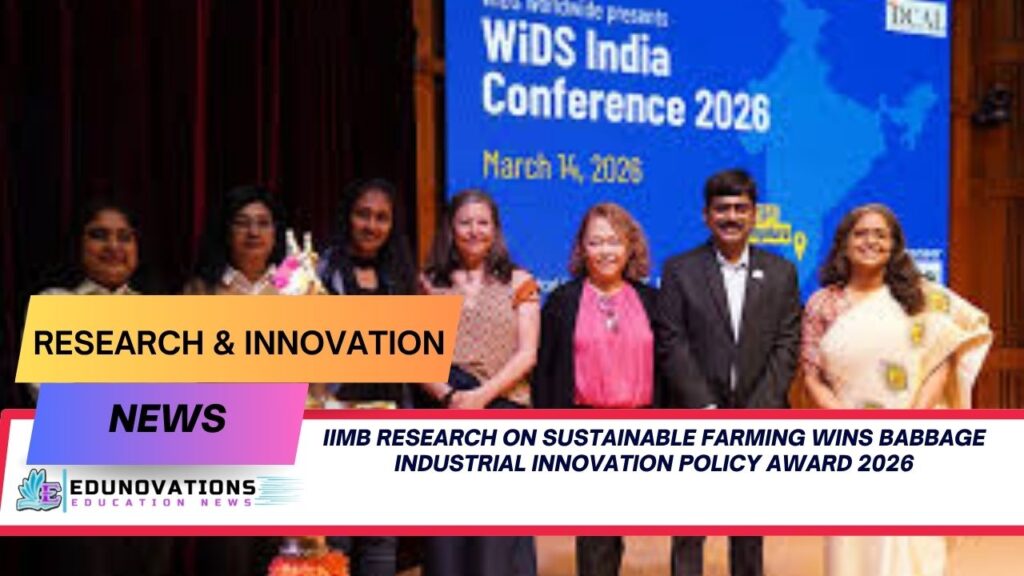
Discover how IIMB research on sustainable farming practices in India won the Babbage Industrial Innovation Policy Award 2026, promoting eco-friendly agriculture and economic benefits for farmers.
IIMB Research on Sustainable Farming Secures Prestigious Innovation Award
In a remarkable achievement for Indian academia, the Indian Institute of Management Bangalore (IIMB) has been recognized for its pioneering work on sustainable agriculture. The research study, co-authored by Dr. Subhankar Saha, an alumnus of the IIMB doctoral programme and current faculty at Ahmedabad University, alongside Prof. Haritha Saranga, Chairperson of the IIMB Sustainability Taskforce, received the Babbage Industrial Innovation Policy Award 2026 from the Industry Studies Association.
Titled ‘Implementing a Comprehensive Intervention to Promote Sustainable Agricultural Practices in India’, the study provides actionable insights into reducing crop residue burning in Punjab while improving both environmental and economic outcomes for farmers.
Understanding the Challenge of Crop Residue Burning in India
Crop residue burning has been a long-standing environmental challenge, particularly in the northern states of India. Farmers often resort to burning leftover straw after harvest due to economic, technological, and institutional constraints. These practices contribute significantly to air pollution and climate change, particularly during the post-harvest season.
The IIMB research highlights that addressing these challenges requires a multi-stakeholder intervention that combines policy measures, technological support, and community engagement. By analyzing satellite-based fire detection data, census demographics, and primary farmer surveys, the study demonstrates how coordinated action can reduce harmful practices and foster sustainable farming adoption.
Key Findings of the IIMB Sustainable Farming Study
The research offers several critical insights for policymakers and agricultural institutions aiming to promote sustainable farming practices:
- Economic Incentives Encourage Adoption: Providing financial benefits for farmers who adopt eco-friendly practices significantly increases participation rates.
- Technological Support is Crucial: Access to mechanized tools for managing crop residues helps farmers shift away from burning practices.
- Collaborative Policy Frameworks Work: Engagement among local authorities, industry stakeholders, and farmer groups ensures the effectiveness of interventions.
- Environmental Benefits are Measurable: Reduction in crop burning improves air quality and reduces greenhouse gas emissions.
- Scalable Solutions are Possible: The model developed in Punjab can be adapted to other Indian states facing similar agricultural challenges.
Prof. Haritha Saranga noted, “Our study demonstrates that with structured interventions, sustainable farming is not only environmentally necessary but also economically viable for farmers across India.”
Impact on Policymaking and Sustainable Agriculture
The study’s findings offer a roadmap for Indian policymakers seeking scalable strategies to promote sustainable agriculture. By integrating economic incentives, technological support, and institutional frameworks, governments can foster environmentally friendly practices while simultaneously boosting farmers’ income.
For educational resources and structured courses on sustainable farming and agricultural management, students can refer to NCERT Courses and Current Affairs. Detailed notes, video lectures, and downloadable NCERT PDFs provide additional context for researchers and academicians exploring sustainability policies in India.
Expert Insights: Dr. Subhankar Saha on Driving Agricultural Innovation
Dr. Subhankar Saha emphasized the importance of research-driven policy interventions. He stated, “The integration of satellite technology and grassroots surveys allows us to identify barriers and design targeted interventions. Sustainable farming is achievable when policy, technology, and community action converge effectively.”
The recognition by the Babbage Industrial Innovation Policy Award 2026 underscores the global relevance of such applied research. International experts have lauded the study for demonstrating a model that balances environmental conservation with farmers’ livelihoods.
For schools and institutions seeking practical applications of sustainable farming strategies, Mart India Infotech provides resources on innovative agricultural technology and industrial best practices.
How Multi-Stakeholder Interventions Transform Indian Agriculture
A central takeaway from the IIMB study is the power of collaboration. Multi-stakeholder interventions involve:
- Local and state governments implementing incentive policies.
- Agricultural extension services providing mechanized solutions for residue management.
- Community-based organizations educating farmers on sustainable practices.
- Private sector partners supporting technology adoption and market linkages.
Such coordinated interventions ensure that farmers transition to sustainable practices without facing economic setbacks, creating long-term environmental and financial benefits.
Lessons for Future Sustainable Farming Initiatives
The IIMB study serves as a blueprint for promoting eco-friendly agriculture across India:
- Policy Alignment: State governments need to align policies with environmental goals while ensuring farmers’ profitability.
- Data-Driven Insights: Satellite imaging and survey-based research allow targeted interventions.
- Economic Viability: Incentives and subsidies play a critical role in adoption.
- Scalability: Pilot programs can be scaled to cover multiple regions.
- Community Engagement: Educating farmers ensures awareness and compliance.
By applying these lessons, policymakers can effectively mitigate crop residue burning and enhance the overall sustainability of Indian agriculture.
Supporting Resources and Internal Links for Students
- For detailed syllabus information on agricultural management: NCERT Syllabus
- Access notes and research materials on sustainable practices: NCERT Notes
- Practice MCQs on environmental studies and agricultural policies: MCQs
- Explore mind maps for conceptual clarity on sustainability initiatives: NCERT Mind Maps
These resources ensure students and early researchers can understand the practical applications of sustainable farming interventions and policy innovations.
Toppers Use Mind Maps to score more than 95%
-
NCERT Class 11th Commerce Mind Maps
Add to cartOriginal price was: ₹999.00.₹199.00Current price is: ₹199.00. -
NCERT Class 12th Chemistry Mind Maps
Add to cartOriginal price was: ₹199.00.₹75.00Current price is: ₹75.00. -
NCERT Class 12th Commerce Mind Maps
Add to cartOriginal price was: ₹999.00.₹199.00Current price is: ₹199.00. -
NCERT Class 12th Science Mind Maps
Add to cartOriginal price was: ₹999.00.₹199.00Current price is: ₹199.00. -
NCERT Mind Maps For Class 10th
Add to cartOriginal price was: ₹999.00.₹199.00Current price is: ₹199.00.





Purchase Today
10 Frequently Asked Questions (FAQs)
- What is the Babbage Industrial Innovation Policy Award 2026?
It is a recognition by the Industry Studies Association for innovative research impacting industrial and policy practices. - Who co-authored the IIMB sustainable farming study?
Dr. Subhankar Saha and Prof. Haritha Saranga co-authored the research. - What is the focus of the study?
The study focuses on implementing multi-stakeholder interventions to reduce crop residue burning and promote sustainable farming practices in India. - Which Indian state was the study primarily conducted in?
Punjab, due to high levels of crop residue burning. - What methods were used in the study?
The research used satellite-based fire detection, census demographics, and primary farmer surveys. - How can farmers benefit economically from sustainable farming?
Through incentives, mechanized tools, and market access, farmers can improve profitability while reducing environmental impact. - Can this intervention model be applied to other states?
Yes, the study suggests that the model is scalable across regions with similar agricultural challenges. - Which internal resources support research on sustainable farming?
NCERT Courses, Notes, and Videos provide academic support. - How does technology aid sustainable farming adoption?
Mechanized tools and satellite monitoring help farmers manage crop residues efficiently. - Where can schools access additional sustainable farming resources?
Mart India Infotech offers industrial insights and practical resources for schools.