
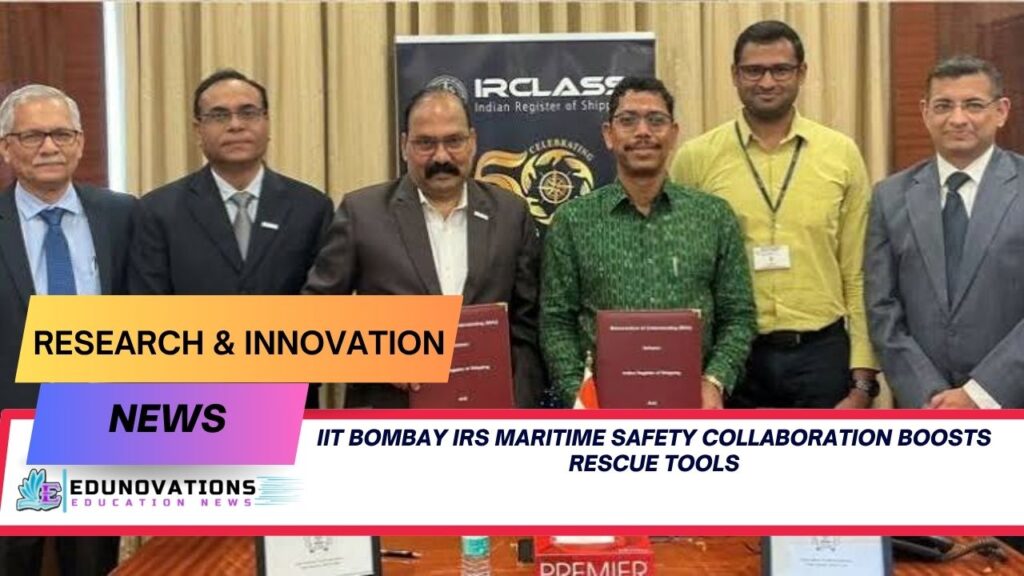
Discover how the IIT Bombay IRS maritime safety collaboration is developing advanced ship trajectory prediction tools to transform ocean rescue operations.
In an era where technological integration dictates the efficiency of critical national infrastructure, academic research and institutional governance are increasingly joining forces. A monumental development in this domain is the strategic partnership formed between the Indian Institute of Technology (IIT) Bombay and the Indian Register of Shipping (IRS). This collaboration represents a paradigm shift in how oceanic operations, maritime navigation safety, and emergency response management are approached in the region. By leveraging cutting-edge academic prowess and practical industrial application, the IIT Bombay IRS maritime safety collaboration aims to construct robust defense and rescue mechanisms that protect marine assets and human lives alike.
Maritime navigation has always inherent risks, ranging from sudden cyclonic storms and unpredictable oceanic currents to mechanical failures in deep waters. When a vessel becomes disabled in the open sea, every minute counts. Traditional rescue coordination methods often struggle with pinpointing the exact drift location of troubled vessels due to complex environmental variables. Recognizing this critical gap, the recent memorandum of understanding (MoU) between these two esteemed entities sets out to design, test, and deploy a state-of-the-art ship trajectory prediction tool. This initiative is not merely an engineering feat; it is a vital step toward creating a safer, more resilient maritime ecosystem.
The Genesis of the Partnership: Bridging Academia and Industry
The alliance between IIT Bombay and the Indian Register of Shipping formalizes a shared vision of national technological self-reliance. Signed by key institutional stakeholders—including Mr. P.K. Mishra, Joint Managing Director of the IRS, alongside senior academic representatives from IIT Bombay—the agreement bridges theoretical research and real-world implementation.
Institutes of Eminence like IIT Bombay carry the responsibility of translating academic research into tangible national solutions. This partnership operationalizes that mission. By focusing on localized environmental conditions, wind patterns, and hydrodynamic forces unique to regional waters, the collaboration ensures that safety solutions are tailor-made for specific geographic challenges.
For students and researchers tracking technological milestones in engineering and applied sciences, understanding these institutional frameworks is vital. Those preparing for competitive examinations can explore comprehensive academic resources via NCERT Courses and stay updated on daily milestones through Current Affairs. Additionally, aspirants looking for structured revision tools can access detailed Notes and test their understanding using practice MCQ’s. Visual learners can also benefit from curated educational Videos, verify curriculum frameworks through the official Syllabus, and download free study aids like NCERT PDFs and NCERT Mind Maps.
Mechanics of the Innovation: Understanding Ship Drift and Trajectory Prediction
At the heart of this collaborative initiative is the creation of a specialized computational system designed to forecast the movement of disabled ships and floating debris. When a vessel loses power or structural integrity in the open ocean, it does not remain stationary. Instead, it drifts in response to vector forces combining wind velocity, wave action, and subsurface oceanic currents.
The newly conceptualized ship trajectory prediction tool utilizes advanced algorithms to model these forces in real-time. Key technical objectives of the project include:
- High-Precision Drift Forecasting: Calculating precise drift coordinates based on historical meteorological data and live satellite feeds.
- Early Warning Integration: Providing maritime authorities with advanced alerts regarding vessel distress vectors before catastrophic failures occur.
- Optimized Search and Rescue (SAR) Planning: Directing Coast Guard vessels and nearby commercial shipping fleets along mathematically optimized interception routes.
According to maritime safety statistics compiled by international logistics bureaus, search and rescue operations that utilize predictive drift modeling reduce response times by up to 35 percent. In emergency scenarios, this reduction directly correlates with lower mortality rates and reduced environmental pollution from fuel spills.
Integrating Intelligence: The Indian Register of Shipping MoU Framework
The formalization of the Indian Register of Shipping IIT Bombay MoU establishes a clear roadmap for software development and operational deployment. Unlike generic modeling software available on the global market, this project focuses on creating indigenous solutions under the broader banner of ‘Made in India’ technological innovation.
Prof. Manas Behera and Prof. V.K. Srineash, prominent faculty members at IIT Bombay spearheading the initiative, have repeatedly emphasized the necessity of indigenous software systems. They note that relying on imported maritime software often introduces latency and fails to account for regional oceanographic nuances. By crafting custom code and simulation environments domestically, Indian maritime authorities retain complete sovereignty over critical safety infrastructure.
Furthermore, the project extends beyond standalone forecasting software. It involves engineering a specialized computer program featuring automated report generation capabilities. This program is designed to integrate smoothly into the existing emergency response system software maritime rescue protocols maintained by the IRS. Automated reporting eliminates manual data entry bottlenecks during high-stress rescue operations, ensuring that all coordinating stations share a single source of truth.
Expert Insights and Technological Self-Reliance
To understand the broader implications of this partnership, industry leaders and maritime experts have weighed in on the synergy between academic research and commercial application.
Dr. Arvind Sharma, a veteran naval architect and marine safety consultant, remarked:
“For decades, maritime rescue operations depended heavily on retrospective calculations and generalized drift tables. The integration of localized, AI-driven trajectory models developed through domestic academic-industrial partnerships marks a watershed moment. When institutions like IIT Bombay collaborate with regulatory bodies like the IRS, the resulting software is robust, field-tested, and perfectly attuned to regional marine hazards.”
This sentiment echoes the overarching national push toward technological autonomy. Developing specialized software assets ensures that India not only secures its own coastline—spanning over 7,500 kilometers—but also establishes itself as a regional net security provider.
Institutions and corporate entities looking to upgrade their digital infrastructure, secure remote communication networks, or build custom enterprise portals can partner with specialized technology developers such as Mart India Infotech. Their expertise in digital transformation mirrors the meticulous software engineering required for modern marine safety systems.
Toward a Safer Horizon: The Future of Ocean Governance
As the project progresses from the conceptual phase to active beta testing and deployment, several milestones remain on the horizon. The integration of the Made in India ship drift prediction software into national emergency frameworks will require rigorous stress-testing against simulated cyclonic conditions and high-sea anomalies.
The broader implications of this project extend to global benchmarks in maritime safety. By demonstrating how a premier research institute can successfully transfer intellectual property and software architecture to a national classification society, IIT Bombay and the IRS are setting a high standard for collaborative innovation. Future iterations of the software may also incorporate machine learning models that adapt dynamically to changing climate patterns, further future-proofing maritime supply chains.
Toppers Use Mind Maps to score more than 95%
-
NCERT Class 11th Commerce Mind Maps
Add to cartOriginal price was: ₹999.00.₹199.00Current price is: ₹199.00. -
NCERT Class 12th Chemistry Mind Maps
Add to cartOriginal price was: ₹199.00.₹75.00Current price is: ₹75.00. -
NCERT Class 12th Commerce Mind Maps
Add to cartOriginal price was: ₹999.00.₹199.00Current price is: ₹199.00. -
NCERT Class 12th Science Mind Maps
Add to cartOriginal price was: ₹999.00.₹199.00Current price is: ₹199.00. -
NCERT Mind Maps For Class 10th
Add to cartOriginal price was: ₹999.00.₹199.00Current price is: ₹199.00.





Purchase Today
Frequently Asked Questions (FAQs)
1. What is the primary objective of the IIT Bombay IRS maritime safety collaboration?
The collaboration aims to develop advanced ship trajectory prediction tools and automated reporting systems to enhance early warning systems and optimize rescue operations for disabled vessels in the open sea.
2. How does the new ship trajectory prediction tool work?
The tool uses advanced computational algorithms to analyze location-specific environmental conditions, wind patterns, and oceanic currents to forecast the precise drift movement of disabled ships and floating objects.
3. Who signed the MoU between IIT Bombay and the Indian Register of Shipping?
The agreement was formalized by Mr. P.K. Mishra, Joint Managing Director of the IRS, alongside designated academic representatives and faculty members from IIT Bombay.
4. What role do Prof. Manas Behera and Prof. V.K. Srineash play in this initiative?
As faculty members at IIT Bombay, they are leading the academic steering of the project, emphasizing the importance of industry-academia interaction and the development of indigenous ‘Made in India’ safety software.
5. How will this initiative improve existing maritime rescue operations?
By integrating automated report generation and trajectory forecasting into current IRS Emergency Response System (ERS) software, the project reduces response times and streamlines coordination between rescue teams.
6. Why is indigenous software development important for Indian maritime safety?
Indigenous software ensures that emergency systems are specifically calibrated to regional oceanographic nuances, eliminating the limitations and latency often associated with imported foreign software.
7. What types of vessels and objects will the prediction tool track?
The system is designed to track disabled ships, drifting marine structures, and floating objects in open waters to facilitate rapid location and rerouting of nearby commercial vessels.
8. How does this partnership align with national technological goals?
It supports the ‘Made in India’ initiative by fostering domestic technological self-reliance, ensuring that critical marine safety infrastructure is designed, built, and maintained locally.
9. Where can students find supplementary educational notes related to this topic?
Students and aspirants can explore comprehensive study materials, current affairs, and academic notes through dedicated educational platforms like Edunovations.
10. What are the long-term benefits of integrating AI and predictive modeling in maritime safety?
Long-term benefits include reduced search and rescue times, lower mortality rates during maritime mishaps, decreased environmental pollution risks, and higher global safety benchmarks for commercial shipping