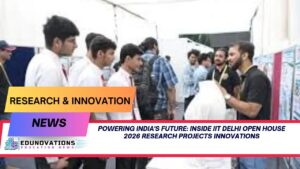
Discover how the IIT Delhi 2nd CSR Conclave emerging healthcare technologies are transforming indigenous medical innovation, AI diagnostics, and MedTech partnerships.
The landscape of Indian medical technology and public-private collaboration witnessed a monumental leap forward as the Indian Institute of Technology (IIT) Delhi hosted its landmark event. Bringing together over 150 visionaries, industry executives, policymakers, and academic researchers, the institution successfully spotlighted groundbreaking advancements designed to address national healthcare priorities. For students, aspirants, and researchers exploring academic milestones or preparing for competitive examinations through resources like NCERT Courses, understanding how institutional research transitions into real-world public utility is vital. The gathering served as a dynamic crucible where science met societal need, reinforcing India’s march toward self-reliance in medical engineering.
The Vision Behind the Conclave
Hosted by the Corporate Relations Office, the gathering was structured to bridge the persistent gap between laboratory innovation and commercial scalability. Academic institutions traditionally excel in theoretical research and early-stage prototyping. However, scaling those prototypes into affordable, accessible products for the masses requires robust financial backing, regulatory navigation, and strategic industry alignment.
This is precisely where the IIT Delhi 2nd CSR Conclave emerging healthcare technologies framework played a pivotal role. By channeling Corporate Social Responsibility (CSR) funds and Public Sector Undertaking (PSU) resources directly into high-impact medical research, the initiative aims to dismantle traditional funding bottlenecks. Experts noted that early-stage funding remains one of the most critical hurdles for Indian biotech and MedTech startups. Bridging this gap ensures that indigenous solutions—ranging from affordable cancer diagnostics to wearable mobility aids—reach tier-2 and tier-3 healthcare facilities without excessive delay.
For individuals tracking broader educational updates, competitive exam syllabi, and academic developments, keeping abreast of such national technological breakthroughs is increasingly emphasized across various study modules, including updated Current Affairs analyses.
Showcasing Cutting-Edge Medical Innovations
The technical sessions offered an immersive look into a wide array of disciplines, including biological sciences, artificial intelligence, and biomedical engineering. Researchers displayed working prototypes and advanced solutions designed to solve critical public health challenges.
Among the standout exhibits was advanced Raman spectroscopy tailored for rapid cancer detection. Traditional cancer screening techniques often involve lengthy turnaround times and expensive laboratory infrastructure. In contrast, spectroscopic innovations enable point-of-care screening with minimal invasiveness. Similarly, researchers introduced a miniaturized colposcope specifically optimized for cervical cancer screening in resource-limited rural settings.
Furthermore, artificial intelligence took center stage. AI-driven platforms capable of parsing complex neurological scans and oncology data with high precision were demonstrated to industry leaders. These tools are engineered to assist overburdened clinicians by flagging early anomalies that might escape the naked eye. Students and aspirants preparing analytical essays or general studies papers can utilize structured Notes to understand the societal impact of artificial intelligence in public governance and health infrastructure.
Fostering Strategic Partnerships and Collaborations
A major highlight of the summit was the active participation of public sector undertakings and global philanthropic foundations. The discussions emphasized that sustainable healthcare delivery requires multi-stakeholder ecosystems.
Key institutional agreements and Letters of Intent (LoIs) were exchanged during the event to formalize long-term joint ventures. For instance, collaborations focusing on biomedical research and regional capacity building were inked to ensure that technological advancements translate into grassroots benefits. Industry leaders from major healthcare and technology firms participated in high-level panel discussions, dissecting the regulatory frameworks, manufacturing compliance standards, and data governance policies required to scale medical devices nationally.
For educators and institutional administrators looking to upgrade digital infrastructure, streamline administrative workflows, or build advanced e-learning portals, partnering with specialized technology service providers such as Mart India Infotech can offer robust digital transformation solutions.
Expert Insights and Industry Perspectives
Analyzing the trajectory of Indian medical research, notable global health leaders have frequently emphasized the necessity of localized innovation. Bill Gates, co-chair of the Bill & Melinda Gates Foundation, has repeatedly highlighted that India’s unique combination of engineering talent, manufacturing capacity, and digital public infrastructure places it in a prime position to solve global health inequities. Speaking on technology-driven problem solving, Gates noted that innovations originating in Indian institutions often provide scalable, cost-effective models that can be successfully replicated across developing nations worldwide.
Echoing similar sentiments during the conclave panels, industry experts from diverse MedTech sectors underscored that automated diagnostics and biomanufacturing will define the next decade of healthcare delivery. As digital literacy and technological penetration expand, integrating interactive multimedia learning modules—such as specialized Videos—helps students and healthcare enthusiasts visualize complex biomedical engineering concepts effectively.
Integrating Technology with Academic Growth
As the academic curriculum evolves to incorporate interdisciplinary studies, students must align their preparation with modern technological paradigms. Whether reviewing the official Syllabus for technical entrances or practicing through targeted MCQ’s, understanding real-world applications of science creates a well-rounded educational foundation.
Moreover, complex scientific reports and institutional developments can be efficiently memorized and reviewed using structured study frameworks. Educators and candidates often rely on visual study aids and downloadable reference compilations. Accessing comprehensive Free NCERT PDFs alongside detailed NCERT Mind Maps allows learners to connect fundamental scientific principles taught in classrooms with monumental industrial achievements like those witnessed at the recent summit.
Conclusion
The successful execution of the recent technology conclave at IIT Delhi marks a significant milestone in India’s journey toward biomedical self-sufficiency. By uniting academic brilliance, philanthropic vision, and public sector backing, the institution has laid a sturdy blueprint for future healthcare innovations. As these technologies transition from laboratory benches to commercial hospitals and rural health clinics, they promise to democratize access to world-class medical diagnosis and treatment for millions across the nation.
Toppers Use Mind Maps to score more than 95%
-
NCERT Class 11th Commerce Mind Maps
Add to cartOriginal price was: ₹999.00.₹199.00Current price is: ₹199.00. -
NCERT Class 12th Chemistry Mind Maps
Add to cartOriginal price was: ₹199.00.₹75.00Current price is: ₹75.00. -
NCERT Class 12th Commerce Mind Maps
Add to cartOriginal price was: ₹999.00.₹199.00Current price is: ₹199.00. -
NCERT Class 12th Science Mind Maps
Add to cartOriginal price was: ₹999.00.₹199.00Current price is: ₹199.00. -
NCERT Mind Maps For Class 10th
Add to cartOriginal price was: ₹999.00.₹199.00Current price is: ₹199.00.


Purchase Today
Frequently Asked Questions (FAQs)
Q1. What was the main objective of the IIT Delhi 2nd CSR Conclave?
A1. The primary objective was to showcase emerging healthcare technologies, strengthen industry-academia partnerships, and leverage CSR and PSU support for indigenous research and innovation addressing national healthcare priorities.
Q2. Which technologies were highlighted during the IIT Delhi 2nd CSR Conclave emerging healthcare technologies sessions?
A2. Key technologies included advanced diagnostics, Raman spectroscopy for cancer detection, miniaturized colposcopes for cervical cancer screening, AI-enabled medical imaging, therapeutics, vaccines, and wearable robotic exoskeletons.
Q3. Who attended the PSU Summit held alongside the healthcare conclave?
A3. The summit was attended by senior leaders and executives from major public sector undertakings, government organizations, academic experts, and industry professionals, with Mr. Toko Tatung serving as the Chief Guest.
Q4. How do events like the IIT Delhi CSR Conclave help low-authority websites and students?
A4. They generate trending, authoritative academic news content that can be leveraged for educational analysis, current affairs tracking, and targeted SEO strategies using specialized long-tail keywords.
Q5. What role does artificial intelligence play in the innovations showcased at IIT Delhi?
A5. AI platforms presented at the event focused on enhancing diagnostic precision in oncology and neurology, assisting clinicians in early anomaly detection, and streamlining healthcare data processing.
Q6. What agreements were signed during the institutional summit?
A6. The event witnessed the exchange of Letters of Intent and Memorandums of Understanding between IIT Delhi and various mission plans, foundations, and bioscience companies for collaborative MedTech research.
Q7. Why is Corporate Social Responsibility (CSR) important for medical research in India?
A7. CSR funding provides critical early-stage financial support that helps researchers transition lab prototypes into scalable, affordable, and market-ready medical solutions for the public.
Q8. Where can students find supplementary educational resources related to science and current affairs?
A8. Students can access structured study materials, practice questions, and reference guides through dedicated educational portals like Edunovations.
Q9. How do indigenous medical devices impact India’s healthcare system?
A9. Indigenous medical devices significantly reduce dependence on imported equipment, lower healthcare costs, and improve accessibility across rural and urban medical facilities.
Q10. What future developments are expected following the recent IIT Delhi technology summit?
A10. Future developments include clinical validations, hospital trials, commercial manufacturing partnerships, and expanded deployment of affordable diagnostic tools developed by institute researchers.