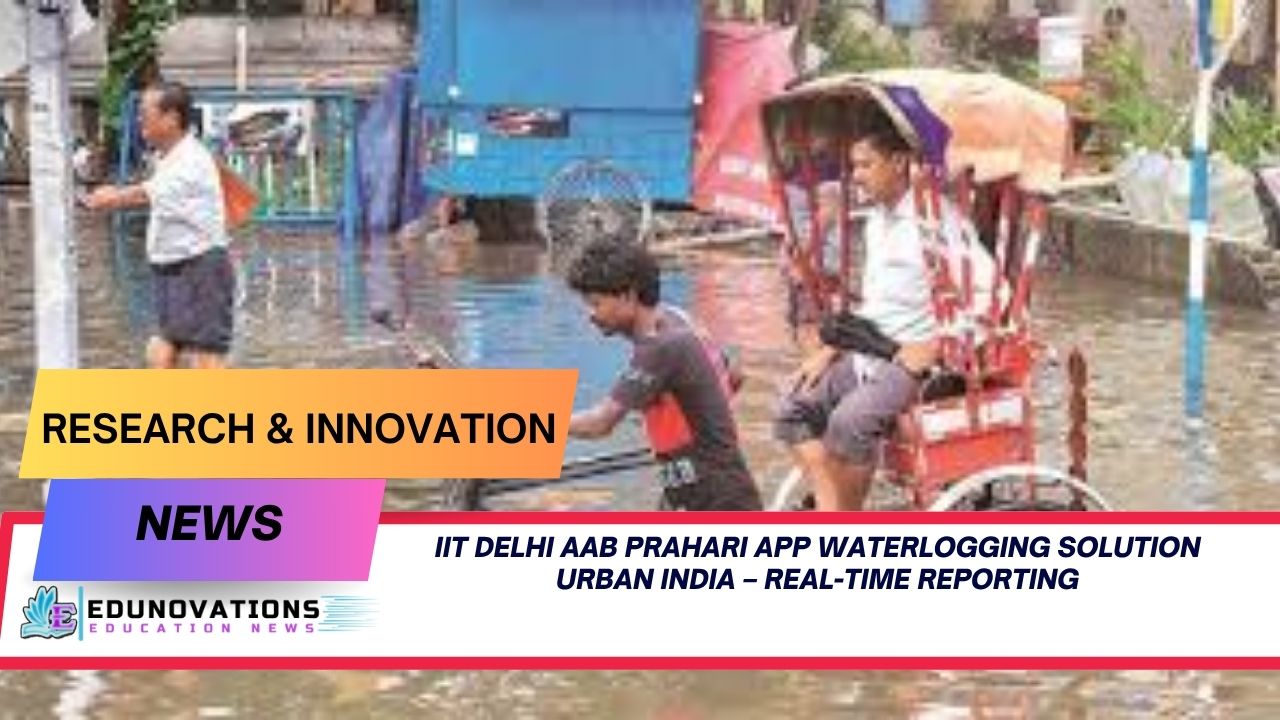
Discover how the IIT Delhi Aab Prahari app provides an innovative waterlogging solution in urban India, enabling real-time citizen reporting and flood management.
Urban flooding has long been a persistent challenge in Indian cities, disrupting daily life and causing significant damage to property and infrastructure. Recognizing the need for a technological intervention, Indian Institute of Technology Delhi (IIT Delhi) has developed the innovative Aab Prahari app, designed to empower citizens to report waterlogging incidents in real-time. This initiative represents a major step forward in smart city flood management, offering an effective waterlogging solution in urban India.
The app has garnered attention from government agencies, urban planners, and citizens alike, positioning IIT Delhi as a leader in developing practical, technology-driven solutions for urban challenges.
Addressing Urban Flooding Challenges with Technology
Urban flooding is a recurring problem in many Indian cities, exacerbated by heavy rainfall, inadequate drainage systems, and rapid urbanization. Flooded streets not only disrupt traffic but also pose health risks and cause economic losses. Traditional reporting methods often delay response times, making it difficult for municipal authorities to act swiftly.
By introducing the Aab Prahari app, IIT Delhi has created a bridge between citizens and local authorities. The app allows residents to report waterlogged areas instantly, attaching photos and location data, which helps authorities prioritize intervention. This citizen-centric approach ensures faster response times and more efficient resource allocation.
Features of the Aab Prahari App
The IIT Delhi Aab Prahari app waterlogging solution urban India initiative integrates several advanced features designed to enhance usability and effectiveness:
- Real-Time Reporting: Citizens can report waterlogged areas instantly using their smartphones.
- Geolocation Tagging: The app automatically records the exact location, enabling precise mapping of affected zones.
- Photo Uploads: Users can attach photos, providing authorities with visual evidence of the waterlogging situation.
- Priority Alerts: Critical flooding incidents are flagged for immediate action by municipal authorities.
- Data Analytics: Aggregated data helps urban planners identify recurring problem areas and plan long-term interventions.
These features make the app a practical tool for urban flood management, bridging the gap between residents and local government agencies.
Expert Insights on Urban Flood Management
Urban flooding experts have lauded IIT Delhi’s innovation. Dr. Ramesh Kumar, an urban planning consultant, notes:
“The Aab Prahari app represents a significant advancement in leveraging citizen participation for urban flood management. Real-time data allows municipal authorities to respond quickly, reducing the impact of waterlogging on urban infrastructure and public safety.”
The app’s data-driven approach aligns with global trends in smart city initiatives, where technology is increasingly used to solve urban challenges efficiently.
Citizen Participation: The Core of Aab Prahari’s Success
A key strength of the IIT Delhi Aab Prahari app lies in its focus on citizen participation. By enabling residents to report flooding incidents as they occur, the app fosters a sense of community responsibility and engagement.
Early user feedback highlights the app’s convenience and effectiveness:
- “Reporting waterlogging has never been easier. I just open the app, click a photo, and submit—it’s quick and efficient,” says Priya Sharma, a resident of Delhi.
- Municipal authorities have reported faster response times in areas where the app has been widely adopted, demonstrating the impact of citizen involvement on urban flood management.
Integrating Technology with Urban Planning
The app not only serves as a reporting tool but also provides valuable data for long-term urban planning. By analyzing patterns of waterlogging across different regions, city planners can identify vulnerable zones, plan better drainage systems, and implement preventive measures.
IIT Delhi’s research teams are continuously working to enhance the app’s capabilities, integrating predictive analytics and machine learning to forecast potential waterlogging scenarios based on rainfall patterns and historical data. This proactive approach allows cities to take preventive measures before floods occur.
Collaborative Efforts and Institutional Support
The development of the Aab Prahari app reflects IIT Delhi’s commitment to technology-driven social solutions. The project involves collaboration between multiple departments, including civil engineering, computer science, and urban studies, ensuring that the app is both technically robust and user-friendly.
Additionally, the app aligns with government initiatives aimed at improving urban resilience. Authorities are now exploring partnerships to integrate the app with municipal emergency response systems, enhancing its reach and effectiveness.
Expanding the Reach: Beyond Delhi
While initially focused on Delhi, IIT Delhi envisions scaling the Aab Prahari app to other urban centers in India. Cities like Mumbai, Chennai, and Kolkata, which frequently experience heavy flooding, stand to benefit immensely from real-time citizen reporting.
Plans are underway to customize the app for local conditions, including regional language support and integration with existing municipal reporting platforms. This will ensure that the app is accessible to a wider audience, including residents in semi-urban and smaller towns.
Statistical Insights: Waterlogging Trends in Indian Cities
According to a recent survey by the Ministry of Housing and Urban Affairs, over 60% of urban Indian cities face waterlogging issues during the monsoon season, affecting millions of residents annually. Delayed reporting and slow municipal response exacerbate the situation, highlighting the urgent need for tools like the Aab Prahari app.
By providing accurate, real-time data, the app enables authorities to address these issues more effectively, potentially reducing flood-related losses by a significant margin.
Educational and Awareness Initiatives
IIT Delhi is also conducting workshops and training sessions to educate citizens on how to use the Aab Prahari app effectively. These initiatives aim to increase adoption rates and ensure that residents are aware of the app’s capabilities.
For students and researchers interested in urban planning and smart city technologies, the app provides an excellent case study on how citizen participation and technology can be combined for practical solutions. NCERT students and teachers can explore related courses and notes to understand urban water management techniques.
Future Prospects and Technological Enhancements
The future roadmap for the Aab Prahari app includes:
- Predictive Flood Alerts: Using AI to forecast potential waterlogging based on weather data.
- Integration with Smart City Sensors: Linking with IoT-based sensors in drainage systems to provide real-time monitoring.
- Expanded Reporting Features: Enabling reporting of other urban issues like potholes, traffic congestion, and pollution.
These enhancements will further cement the app as a comprehensive urban management tool, reflecting IIT Delhi’s vision for technology-enabled citizen engagement.
Benefits to Urban Governance
Municipal authorities have noted multiple benefits from using the app:
- Faster response times to flooding incidents.
- Improved allocation of resources for flood management.
- Data-driven insights for infrastructure planning.
- Increased community engagement and awareness.
Experts believe that such citizen-driven initiatives are crucial for building resilient cities capable of handling the challenges posed by climate change and rapid urbanization.
Internal & External Links for Further Learning
For those seeking additional insights:
- Explore NCERT Courses for educational content related to technology and urban planning.
- Stay updated with Current Affairs for developments in smart city solutions.
- Access Notes and MCQs for academic preparation.
- Watch Videos covering citizen engagement in urban management.
- Download Free NCERT PDFs for comprehensive study materials.
- Refer to Mart India Infotech for official school and tech-related contacts.
Toppers Use Mind Maps to score more than 95%
NCERT Class 11th Commerce Mind Maps
Add to cartOriginal price was: ₹999.00.₹199.00Current price is: ₹199.00.NCERT Class 12th Chemistry Mind Maps
Add to cartOriginal price was: ₹199.00.₹75.00Current price is: ₹75.00.NCERT Class 12th Commerce Mind Maps
Add to cartOriginal price was: ₹999.00.₹199.00Current price is: ₹199.00.NCERT Class 12th Science Mind Maps
Add to cartOriginal price was: ₹999.00.₹199.00Current price is: ₹199.00.NCERT Mind Maps For Class 10th
Add to cartOriginal price was: ₹999.00.₹199.00Current price is: ₹199.00.





Purchase Today
10 FAQs on IIT Delhi Aab Prahari App
- What is the IIT Delhi Aab Prahari app?
The Aab Prahari app is a real-time reporting tool designed to help citizens report waterlogging incidents in urban India. - How does the Aab Prahari app help urban flooding management?
It enables immediate reporting, geolocation tagging, and photo uploads, helping authorities respond quickly. - Is the app available outside Delhi?
Currently, it’s focused on Delhi, but plans exist to expand it to other urban centers in India. - Can anyone use the Aab Prahari app?
Yes, any citizen with a smartphone can download and use the app to report flooding incidents. - Does the app provide predictive flood alerts?
Future versions aim to integrate AI for forecasting potential waterlogging based on weather patterns. - How do municipal authorities benefit from the app?
Authorities gain faster response times, data-driven insights, and improved resource allocation. - Is the app free to use?
Yes, the app is free for all citizens to download and report waterlogging incidents. - Can the app report other urban issues?
Currently, it focuses on flooding, but future updates may include reporting for potholes, pollution, and traffic. - Does IIT Delhi offer training to use the app?
Yes, workshops and training sessions are conducted to increase adoption and effective usage. - Where can students learn more about urban flood management technologies?
Students can explore NCERT Courses and related notes for educational content on urban planning and water management.