Education is undergoing a monumental paradigm shift across India, driven by inter-institutional synergies and collaborative frameworks.
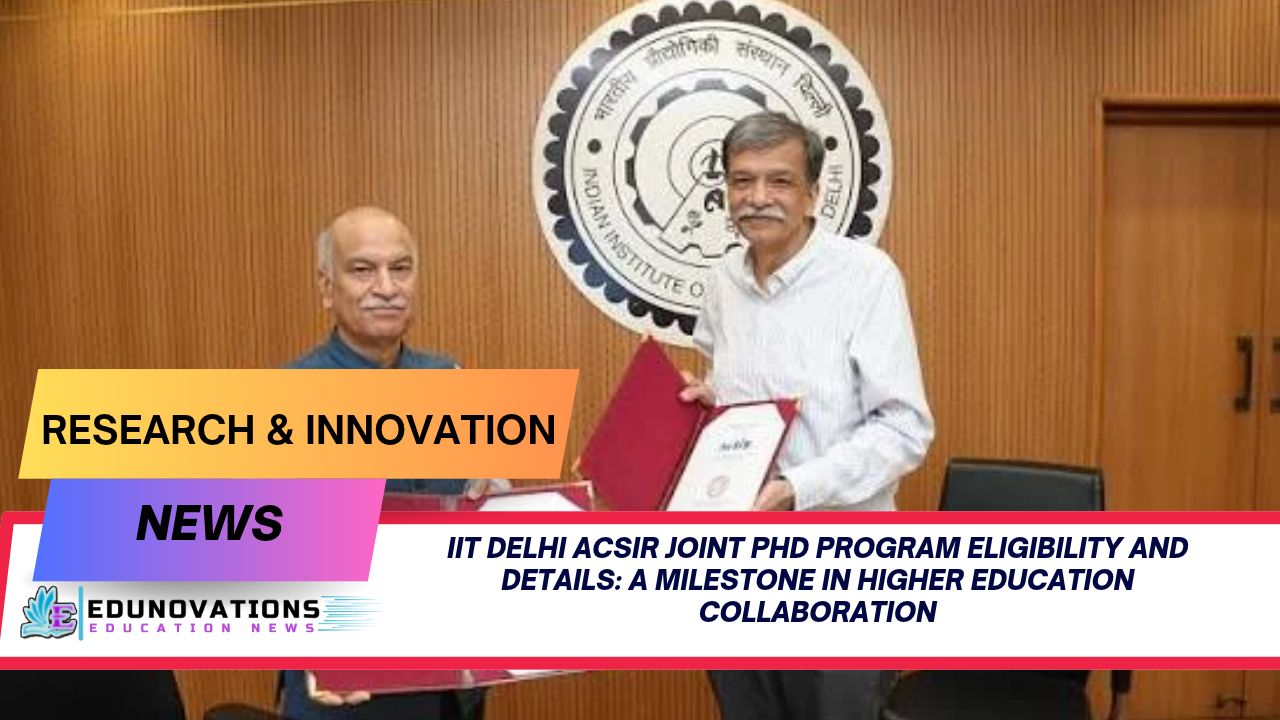
Education is undergoing a monumental paradigm shift across India, driven by inter-institutional synergies and collaborative frameworks. In a landmark development, the Indian Institute of Technology Delhi (IIT Delhi) and the Academy of Scientific and Innovative Research (AcSIR) have formally joined hands to redefine the contours of postgraduate education and research. By signing a comprehensive Memorandum of Understanding (MoU), both premier institutions have opened unprecedented doors for scholars, research enthusiasts, and academicians. This strategic alliance is designed to pool state-of-the-art research infrastructure, bridge traditional academic silos, and foster a dynamic environment for collaborative problem-solving. Whether you are an aspiring researcher looking to explore the IIT Delhi AcSIR joint PhD program eligibility and details, or an educator tracking modern pedagogical trends, this collaboration represents a transformative leap forward for the Indian scientific ecosystem.
Fostering Synergy Between Elite Institutions
The modern academic landscape demands dynamic solutions to complex societal and technological challenges. Historically, premier technological institutes and specialized national research laboratories operated within distinct administrative and academic boundaries. The partnership between IIT Delhi and AcSIR systematically dismantles these barriers.
Under the newly established framework, students and faculty members can seamlessly cross institutional boundaries, utilizing world-class laboratories, high-performance computing centers, and specialized research facilities. This initiative aligns closely with national educational reforms aimed at promoting multidisciplinary learning and holistic growth. For students striving to excel in competitive examinations or seeking structured study pathways—much like those utilizing resources for NCERT Courses or staying updated via Current Affairs—understanding these structural shifts is vital for career planning.
Furthermore, academic institutions seeking to expand their digital reach and modernize their institutional frameworks often collaborate with specialized digital partners like Mart Ind Infotech, ensuring that academic advancements are effectively communicated to the wider public.
Core Pillars of the Memorandum of Understanding
The collaboration is built upon several robust pillars designed to maximize academic rigor and research output. Key structural elements of the MoU include:
- Joint Supervision Framework: Postgraduate scholars pursuing Ph.D., M.Tech., and MS(R) degrees will benefit from dual mentorship, having at least one supervisor from IIT Delhi and another from an AcSIR-associated research institute.
- Streamlined Mobility: Postgraduate students, research scholars, and faculty can undertake academic visits, coursework, and research stints at partner institutions without facing bureaucratic hurdles.
- Fee Waivers: Enrolled scholars can complete coursework at host institutions without requiring separate admission processes or paying additional tuition fees.
- Industry Alignment: By integrating the expansive research infrastructure of CSIR laboratories with IIT Delhi’s technological prowess, research projects will directly address real-world industrial and societal problems.
For students organizing their study materials, utilizing structured Notes and practicing through targeted MCQ’s can significantly enhance foundational knowledge before embarking on advanced postgraduate research.
Perspectives from Academic Leadership
The signing ceremony brought together distinguished leaders who emphasized the long-term vision of this partnership. Prof. Rangan Banerjee, Director of IIT Delhi, highlighted that the collaboration transcends conventional student and faculty exchange programs. He noted that by combining institutional strengths, students and faculty can share ideas freely and tackle challenging research problems with real-world impact.
Echoing this sentiment, Prof. Manoj K. Dhar, Director of AcSIR, pointed out that the partnership opens up vast research infrastructure to a broader pool of emerging scholars. He stressed that working on research problems with strong industrial relevance prepares students for future leadership roles in science and technology.
To support rigorous academic preparation, educators and aspirants frequently rely on comprehensive visual aids and multimedia tools, including curated Videos and structured Syllabus breakdowns.
Broadening Horizons for STEM Scholars
The integration of IIT Delhi and AcSIR creates a formidable network involving premier laboratories under the Council of Scientific and Industrial Research (CSIR) and other premier scientific bodies. This scale of collaboration ensures that scholars do not have to compromise due to resource limitations at a single institution.
For students preparing for advanced academic pursuits, having access to foundational learning materials is crucial. Resources such as Downloads of Free NCERT PDFs and conceptual NCERT Mind Maps provide the strong conceptual foundation needed to succeed in entrance tests and subsequent doctoral research.
Toppers Use Mind Maps to score more than 95%
-
NCERT Class 11th Commerce Mind Maps
Add to cartOriginal price was: ₹999.00.₹199.00Current price is: ₹199.00. -
NCERT Class 12th Chemistry Mind Maps
Add to cartOriginal price was: ₹199.00.₹75.00Current price is: ₹75.00. -
NCERT Class 12th Commerce Mind Maps
Add to cartOriginal price was: ₹999.00.₹199.00Current price is: ₹199.00. -
NCERT Class 12th Science Mind Maps
Add to cartOriginal price was: ₹999.00.₹199.00Current price is: ₹199.00. -
NCERT Mind Maps For Class 10th
Add to cartOriginal price was: ₹999.00.₹199.00Current price is: ₹199.00.


Purchase Today
Frequently Asked Questions
1. What is the primary objective of the IIT Delhi and AcSIR collaboration?
The partnership aims to strengthen academic and research collaboration through joint supervision of postgraduate students, resource sharing, and student-faculty exchanges between IIT Delhi and AcSIR-associated institutes.
2. Who are the key signatories of the MoU?
The MoU was signed by Prof. Rangan Banerjee, Director of IIT Delhi, and Prof. Manoj K. Dhar, Director of AcSIR, alongside other senior academic officials.
3. Are students required to pay additional tuition fees at the host institution?
No, students enrolled under this collaborative framework can undertake coursework and research at either institution without paying separate tuition fees at the host institution.
4. Which degree programs are covered under this joint framework?
The collaboration primarily facilitates joint supervision and research for Ph.D., M.Tech., and MS(R) postgraduate students.
5. How does the joint supervision model work for doctoral candidates?
Scholars enrolled in the program will have at least one designated supervisor from IIT Delhi and another from an AcSIR-associated research institute.
6. What role do CSIR laboratories play in this partnership?
CSIR-associated research institutes provide an extensive network of specialized laboratories and domain expertise that complement IIT Delhi’s technological infrastructure.
7. Can faculty members also participate in collaborative projects?
Yes, faculty members from both IIT Delhi and AcSIR-associated institutes are encouraged to collaborate on research in areas of mutual interest and pursue joint projects.
8. Does the MoU allow students to skip regular admission processes for host institutions?
Students admitted under the collaborative framework can undertake coursework and research across institutions without needing separate admissions at the host organization.
9. How does this partnership impact industrial research relevance?
By combining academic excellence with industrial-grade laboratory facilities, researchers can focus on solving practical problems with direct commercial and societal applications.
10. Where can students find official announcements regarding these collaborative programs?
Interested candidates can check the official academic portals of IIT Delhi and AcSIR for detailed guidelines, application timelines, and eligibility criteria.