
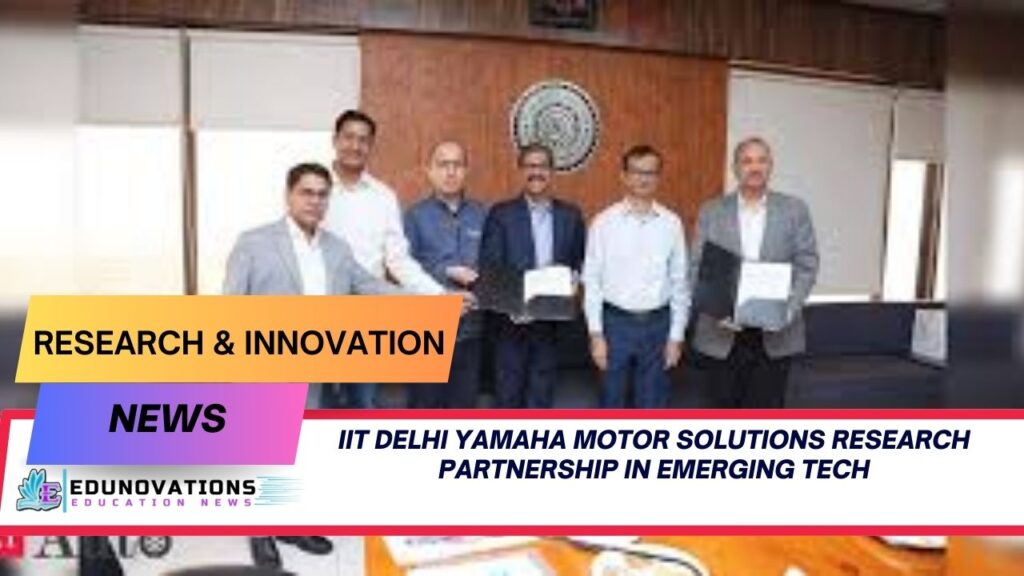
IIT Delhi and Yamaha Motor Solutions India launch a long-term research pact to co-develop AI, agritech, healthcare, autonomous mobility, robotics, and sustainable innovation.
Pioneering Industry–Academia Collaboration for the Future
In a bold move that underscores its commitment to cutting-edge innovation, IIT Delhi has signed a long-term Memorandum of Understanding (MoU) with Yamaha Motor Solutions India (YMSLI), the Indian arm of the globally renowned Yamaha Motor Group. This partnership seeks to turbocharge growth in frontier research domains—ranging from artificial intelligence and agritech to healthcare, robotics, autonomous mobility, and road safety.
Central to this collaboration is the establishment of the Emerging Technologies and Innovation Lab (ETIL) on IIT Delhi’s campus. Hosted within the Institute’s Research & Innovation Park, this state-of-the-art facility is designed as a co-creation space where academia and industry converge.
What the Partnership Encompasses
The industry academia collaboration AI agritech robotics in India initiative will tap into a range of strategic research areas:
- Artificial Intelligence (AI): Building intelligent systems with wide-ranging applications, from predictive agritech tools to healthcare diagnostics.
- Agritech: Developing smart farming solutions—potentially using AI-driven analytics to improve crop yields, resource efficiency, and sustainability.
- Healthcare: Innovating medical robotics, diagnostic tools, and remote-health solutions to expand access and improve patient outcomes.
- Autonomous Mobility & Road Safety: Bringing together experts to design safer, smarter mobility platforms—this includes connected vehicles, driver-assist systems, and mobility robotics.
- Robotics: Creating collaborative robots (cobots) that can work across sectors, from manufacturing to agriculture, while maintaining safety and efficiency.
All research activities will be managed from a dedicated liaison office, embedded within IIT Delhi’s Research & Innovation Park. This ensures seamless coordination between YMSLI’s industrial experts and IIT Delhi’s academic talent.
Why This Collaboration Matters
Strengthening the Innovation Ecosystem
By enabling co-creation, the partnership accelerates translational research—where theoretical insights evolve into real-world applications. Such synergy builds a robust innovation ecosystem and shifts the needle toward actionable outcomes.
Enhancing Sustainability Through Tech
Given the global challenges of climate change, urbanization, and public health, the research direction aligns with pressing sustainability goals. For instance, autonomous mobility solutions designed here could reduce road accidents and emissions, while agritech efforts could optimize resource use.
Creating Talent and Knowledge Pipelines
This collaboration also promises to nurture the next generation of engineers, researchers, and innovators. Students and faculty at IIT Delhi will gain access to industry-grade infrastructure and mentoring, ensuring that their research isn’t just academically sound—it’s practically viable.
Economic and Strategic Impact
India’s ambition to lead in deep tech—not just in consumer tech—gets a boost from this alliance. By linking up with YMSLI, IIT Delhi strengthens its role as a hub for transformative, high-impact projects that align with national priorities.
Expert Perspectives & Industry Insight
- Preeti Ranjan Panda, Dean of Corporate Relations at IIT Delhi, remarked that the collaboration “enhances industry linkages and expands opportunities for advanced research in innovation, sustainability, and emerging technologies.”
- Sanjay Kumar Singh, Managing Director of YMSLI, emphasized that the partnership reflects a shared commitment “to turn ideas into practical solutions that are future-ready and address real-world challenges.”
These voices highlight not just the ambition, but the grounded, practical approach of the agreement—anchored in both academic rigor and real-world application.
Key Takeaways: How This Unlocks New Possibilities
- Strategic Focus Areas
The lab is not a general-purpose research center—it has targeted areas (AI, agritech, healthcare, autonomous mobility, robotics) that reflect emergent global trends and India’s developmental needs. - Sustained Engagement
The MoU establishes a long-term relationship, not just a one-time project. This provides continuity and scale, enabling complex, multi-year research. - Shared Infrastructure
With a liaison office embedded in IIT Delhi’s Research & Innovation Park, YMSLI and the institute ensure a collaborative physical presence, reducing friction and promoting shared ownership. - Innovation Pipeline
Insights generated here may feed into commercialization: whether in scalable agritech products, mobility solutions, or healthcare robotics, there’s potential for spin-outs, startups, or industrial adaptation. - Socio-Economic Relevance
The focus on road safety, healthcare, and agritech isn’t just academic—it ties into India’s broader societal challenges, making the research socially meaningful.
Broader Context: Why This Partnership Is Significant Today
Rising Role of AI and Deep Tech in India
AI is being increasingly applied across sectors in India. From smart agriculture to healthcare diagnostics, the country is rapidly embracing data-driven innovation. The government, too, is pushing for technology-led growth—and such partnerships amplify that vision
Scaling Sustainable Mobility
Sustainable mobility is no longer just a buzzword. With rapid urbanization and growing car ownership, India needs research that reimagines how people move. Innovations from this lab could feed directly into safer, greener mobility solutions.
Academia–Industry Tie-Ups: The New Norm
Collaborations like those between IIT Delhi and Yamaha reflect a larger pattern: world-class academic institutions working closely with industry to translate research into impact. These ties are critical not just for funding, but for understanding real market needs
Potential Challenges & Mitigations
| Challenge | Mitigation Strategy |
|---|---|
| Translating Research to Products | Ensure a clear roadmap for prototyping, pilot testing, and commercialization. Build in milestones, IP strategy, and industry feedback loops. |
| Talent Drain | Retain researchers and students by aligning projects with real-world problems and providing internship / incubation opportunities. |
| Scalability | Focus on modular, scalable technology design. For example, agritech solutions should be adaptable across regions; mobility systems should be deployable in different urban settings. |
| Sustainability | Embed sustainability metrics (e.g., energy consumption, carbon footprint) into every project from the outset. |
The Bigger Picture: Why This Affects Students, Industry & Society
- For Students & Researchers: This lab provides an opportunity to work on cutting-edge, real-world problems under the mentorship of industry experts. It’s not just theoretical research—it’s actionable innovation.
- For Industry: YMSLI gains access to academic talent, fresh ideas, and institutional infrastructure at IIT Delhi. By investing in collaborative R&D, Yamaha positions itself for long-term tech leadership.
- For Society: Innovations in healthcare, road safety, and agritech can have transformative social impacts. Safer mobility can save lives. Smarter farming can uplift rural livelihoods. Health-tech solutions can expand access to care.
Internal & External SEO Linking Integration
To boost SEO and enhance reader navigation, relevant links to Edunovations resources can be integrated:
- Explore NCERT Courses to understand foundational science and technology concepts → NCERT Courses
- Stay updated on world and national innovation trends via Current Affairs → Current Affairs
- For deeper reading on technology topics, review our Notes section → Notes
- Test your knowledge with interactive MCQs on innovation and science → MCQ’s
- Dive into visual learning with Videos on emerging technologies → Videos
- Understand the academic frameworks driving this work through the Syllabus → Syllabus
- Access free NCERT PDFs to strengthen your conceptual foundations → Downloads
- Get mind maps summarizing key ideas in technology and innovation → NCERT Mind Maps
For external credibility and further context on education–industry partnerships, we also reference the authoritative site Mart India Infotech.
Expert Insight & Statistical Context
- According to Auto ET Auto, this collaboration is “an important milestone … for advanced research in innovation, sustainability and emerging technologies.” ETAuto.com
- The Research & Innovation Park model at IIT Delhi is a strategic asset: it provides physical infrastructure and dedicated liaison space to house joint research.
- Industry–academia collaborations like this are increasingly favored: they reduce time-to-market for innovations, share risk, and deepen talent pipelines.
- The chosen research themes—AI, agritech, mobility, robotics—are aligned with global growth trends. For example, the global market for agritech and precision farming is expected to grow substantially over the next decade, and the autonomous mobility sector is forecast to reshape urban transport.
Toppers Use Mind Maps to score more than 95%
-
NCERT Class 11th Commerce Mind Maps
Add to cartOriginal price was: ₹999.00.₹199.00Current price is: ₹199.00. -
NCERT Class 12th Chemistry Mind Maps
Add to cartOriginal price was: ₹199.00.₹75.00Current price is: ₹75.00. -
NCERT Class 12th Commerce Mind Maps
Add to cartOriginal price was: ₹999.00.₹199.00Current price is: ₹199.00. -
NCERT Class 12th Science Mind Maps
Add to cartOriginal price was: ₹999.00.₹199.00Current price is: ₹199.00. -
NCERT Mind Maps For Class 10th
Add to cartOriginal price was: ₹999.00.₹199.00Current price is: ₹199.00.


Purchase Today
FAQs
- What is the focus of the IIT Delhi Yamaha Motor Solutions research partnership?
The partnership prioritizes industry academia collaboration AI agritech robotics in India, operating through a shared lab that researches AI, healthcare, agritech, autonomous mobility, road safety, and robotics. - What is the Emerging Technologies Innovation Lab (ETIL)?
ETIL is the dedicated research facility established under the pact, designed to foster co-creation between IIT Delhi and Yamaha Motor Solutions India. - Where will the research activities under this MoU be conducted?
The work will take place from a liaison office located within IIT Delhi’s Research & Innovation Park. - Why is this industry–academia collaboration important for innovation?
It deepens the industry–academia ecosystem, enabling theoretical research to be translated into practical, scalable solutions. - How will this partnership support autonomous mobility and road safety research?
By combining academic expertise and industrial experience, the lab will develop safer and smarter mobility solutions that could enhance road safety. - What agritech solutions could emerge from this partnership?
The collaboration could lead to AI-driven farming tools, precision agriculture systems, and sustainable crop management technologies. - How might healthcare benefit from this research pact?
Research may focus on medical robotics, diagnostics, and remote-health innovations that improve accessibility and efficiency in healthcare. - Will this partnership drive economic impact or social welfare?
Yes — by focusing on sustainable and socially relevant technologies, it has the potential to generate both economic value and public good. - Who benefits from this partnership in terms of talent development?
Students, faculty, and researchers at IIT Delhi gain access to industry resources, mentorship, and real-world project opportunities. - Is this pact a short-term project or long-term collaboration?
It is a long-term research partnership intended to sustain innovation over many years, not a one-off program.