
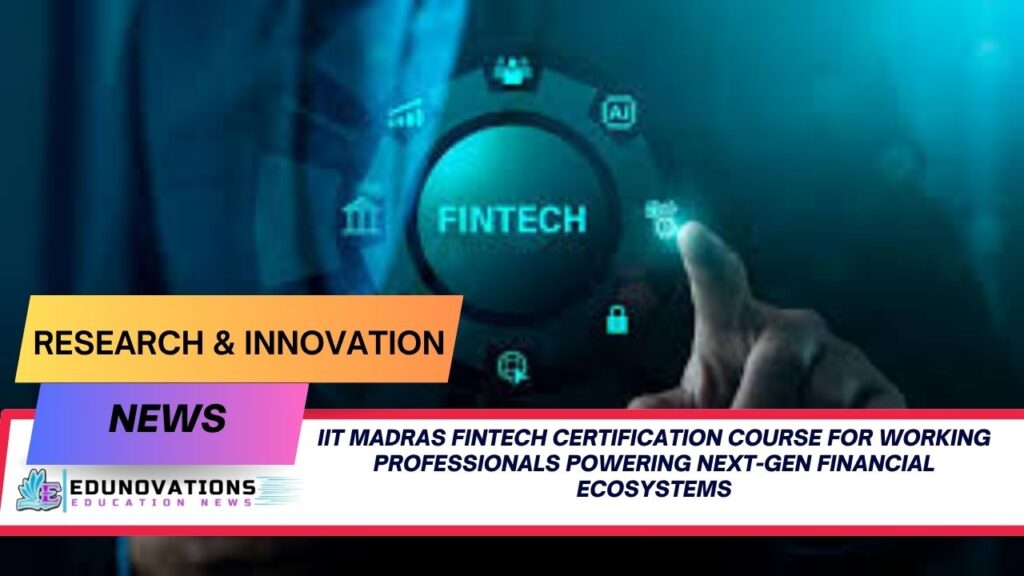
In the fast-evolving landscape of global finance, the synergy between elite academic prowess and deep corporate expertise has become the ultimate catalyst for disruptive innovation.
In the fast-evolving landscape of global finance, the synergy between elite academic prowess and deep corporate expertise has become the ultimate catalyst for disruptive innovation. Recently, a monumental development has taken center stage as the Indian Institute of Technology Madras (IIT Madras) and Computer Age Management Services (CAMS) announced an aggressive expansion of their joint venture. Through the renewed charter of the CAMS IIT Madras FinTech Innovation Lab (CIFIL), this strategic partnership aims to redefine the contours of digital finance, startup acceleration, and specialized workforce training. For fresh aspirants, students, and tech professionals tracking modern economic shifts, mastering these domains is no longer optional—it is a mandatory career accelerator. To support your continuous learning journey, you can explore structured NCERT Courses or download essential Notes to build strong foundational knowledge.
The Evolution of Industry-Academia Synergies in Modern Finance
The contemporary financial services sector is undergoing an unprecedented technological revolution. From automated algorithmic trading to decentralized trust architectures, traditional banking parameters are being rewritten daily. Recognizing this paradigm shift, institutions are actively bridging the gap between theoretical research and commercial deployment.
The collaboration between IIT Madras and CAMS, initially seeded under corporate social responsibility frameworks, has matured into a powerhouse of applied research. By merging the academic rigor of premier research clusters with market-tested strategies from financial infrastructure leaders, the ecosystem creates a fertile breeding ground for high-impact technologies. Professionals seeking to stay ahead of these macroeconomic shifts can keep track of regular market developments through Current Affairs portals or test their comprehension via specialized MCQ’s.
Expanding Horizons: Key Technological Verticals Under CIFIL
The expanded roadmap of CIFIL targets critical technological frontiers that are shaping the future of global commerce. Rather than restricting itself to generic software developments, the initiative zeroes in on precise, high-utility sectors:
- Artificial Intelligence and Machine Learning: Deploying smart algorithms for predictive risk analysis, automated customer onboarding, and fraud detection.
- Blockchain and Tokenization: Building immutable digital ledgers to secure asset transfer and streamline cross-border remittances.
- Regulatory Technology (RegTech) and Cybersecurity: Developing robust defense mechanisms against digital fraud while ensuring seamless compliance with shifting regulatory frameworks.
- WealthTech and InsurTech: Reinventing asset management paradigms and micro-insurance delivery models through user-friendly digital portals.
For educators and institutional administrators looking to build digital infrastructure for modern tech campuses, scaling up technological integration requires expert guidance. Educational setups seeking specialized technology implementation can reach out to Mart Ind Infotech for reliable web and IT solutions. Furthermore, students can visualize complex financial workflows and study frameworks by accessing comprehensive Videos and detailed Syllabus breakdowns.
Addressing the Skills Gap: Upskilling for the Future Economy
As digital transactions scale up exponentially across emerging economies, a critical bottleneck has emerged: the severe shortage of industry-ready talent equipped with cross-disciplinary expertise in finance and software engineering. Addressing this deficit requires targeted academic interventions that go beyond traditional textbook learning.
This is precisely where structured professional pathways make a monumental difference. Programs designed for career advancement offer deep dives into core banking technologies, neo-banking structures, and digital ledger mechanisms. Learners can also access a vast repository of foundational resources, including free Downloads of Free NCERT PDFs and conceptual NCERT Mind Maps to sharpen core analytical competencies before transitioning into advanced financial engineering.
Leadership Insights on the Future of Financial Technology
Industry veterans have consistently emphasized that true disruption happens when experienced minds collaborate with youthful innovators. Reflecting on the trajectory of this expanded collaboration, Mr. Anuj Kumar, Managing Director of CAMS, shared profound insights during the official memorandum signing:
“Organisations that have spent decades serving an industry develop deep expertise, but some of the most transformative ideas often emerge from outside conventional boundaries. They come from researchers questioning accepted models, students bringing fresh perspectives and innovators experimenting with new technologies.”
Echoing this sentiment, Prof. V. Kamakoti, Director of IIT Madras, emphasized the tangible societal impact of the venture:
“The CAMS FinTech Innovation Lab is a significant step forward in IIT Madras’ commitment to drive innovation in the rapidly evolving field of financial technology. By combining IIT Madras’ research excellence and CAMS’ deep industry expertise, this partnership has the potential to strengthen and accelerate growth to build cutting edge fintech solutions for Bharat’s financial ecosystem.”
These leadership perspectives underline a core economic truth: the future belongs to ecosystems that prioritize collaborative, inclusive, and multi-disciplinary problem-solving.
Catalyzing Entrepreneurship and Startup Incubation
Beyond academic upskilling and corporate research, the renewed CIFIL mandate places a heavy emphasis on nurturing early-stage startups. In a competitive market where capital is selective, early-stage founders need more than just financial backing; they require technical validation, mentorship, and sandbox environments to test their products.
The innovation lab provides promising entrepreneurs with direct access to institutional faculty, elite technical networks, and venture scaling opportunities. By bridging the gap between raw ideas and market reality, initiatives like these ensure that local innovations can scale globally, addressing real-world friction points in digital lending, wealth accumulation, and asset tracking.
Toppers Use Mind Maps to score more than 95%
-
NCERT Class 11th Commerce Mind Maps
Add to cartOriginal price was: ₹999.00.₹199.00Current price is: ₹199.00. -
NCERT Class 12th Chemistry Mind Maps
Add to cartOriginal price was: ₹199.00.₹75.00Current price is: ₹75.00. -
NCERT Class 12th Commerce Mind Maps
Add to cartOriginal price was: ₹999.00.₹199.00Current price is: ₹199.00. -
NCERT Class 12th Science Mind Maps
Add to cartOriginal price was: ₹999.00.₹199.00Current price is: ₹199.00. -
NCERT Mind Maps For Class 10th
Add to cartOriginal price was: ₹999.00.₹199.00Current price is: ₹199.00.


Purchase Today
Frequently Asked Questions (FAQs)
1. What is the main objective of the expanded CAMS and IIT Madras partnership?
The partnership aims to drive the next phase of innovation in financial technologies, startup incubation, industry-driven research, and specialized professional education within India’s digital financial ecosystem.
2. Who can benefit from a specialized iit madras fintech certification course for working professionals?
Working professionals, software engineers, banking executives, and entrepreneurs seeking career acceleration and deep technical mastery in digital finance benefit immensely from these structured programs.
3. What core technologies are prioritized under the renewed CIFIL mandate?
The lab focuses heavily on artificial intelligence in financial services, blockchain and tokenization, regulatory technology (RegTech), cybersecurity, digital lending, and data analytics.
4. How does CIFIL support early-stage entrepreneurs?
CIFIL offers tech startups access to faculty expertise, incubation support, innovation challenges, mentorship networks, and validation frameworks to test real-world financial solutions.
5. What role does CAMS play in this collaborative laboratory?
As a market infrastructure leader, CAMS brings profound domain expertise in capital markets, mutual fund services, transaction processing, and financial technology applications.
6. Are there student-centric engagement opportunities integrated into this initiative?
Yes, students gain practical exposure through structured research projects, technical hackathons, industry internships, and direct mentoring interactions with corporate leaders.
7. When was the initial framework of the CAMS IIT Madras FinTech Innovation Lab established?
The lab was originally established in December 2022 through a collaborative CSR initiative between IIT Madras and CAMS to foster BFSI sector innovation.
8. How does industry-academia collaboration impact financial inclusion?
By combining academic research models with market data, these partnerships help engineer affordable, scalable financial products tailored for underserved segments of the population.
9. Where can candidates find additional learning resources for competitive technical exams?
Learners can utilize dedicated portals offering curated notes, syllabus breakdowns, practice MCQs, and interactive digital video modules to strengthen their core competencies.
10. What is the significance of integrating AI and blockchain in modern banking curriculum?
These technologies form the backbone of next-gen financial security, risk management, and decentralized asset tracking, making proficiency in them vital for modern financial engineering roles.