
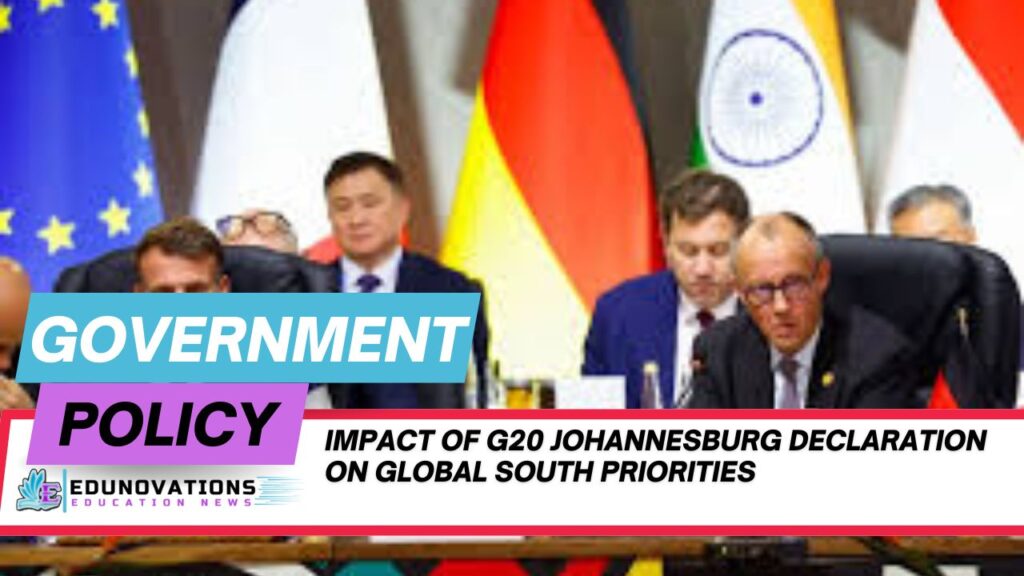
Dive into the impact of the G20 Johannesburg declaration on Global South priorities, and how the ACITI partnership and COP30 Belém Political Package are shaping climate action and innovation.
The impact of G20 Johannesburg declaration on Global South priorities is emerging as a defining theme of the 2025 summit. Held for the first time on African soil, the G20 summit underscored a growing shift in global governance — spotlighting multilateralism, sustainable development, and equity. For many developing nations, this declaration serves not just as symbolic solidarity but as a concrete alignment of the G20 agenda with their core concerns.
G20 Johannesburg: A New Emphasis on the Global South
At the G20 conclave in Johannesburg, leaders adopted a 122-point declaration that places the Global South firmly at the center of the conversation. Wikipedia+2IOL+2
Key Dimensions of the Declaration
- Sovereignty and Peace
The declaration reaffirmed respect for territorial integrity and political independence. It called on all states to refrain from acquiring territory through force, implicitly referencing conflicts in Ukraine and the Indo-Pacific. - UN Security Council Reform
Critically, the G20 leaders called for reinventing the UN Security Council’s structure — advocating for a more representative body that better includes regions such as Africa, Asia-Pacific, Latin America, and the Caribbean. - Counter-Drug Terror Nexus
Prime Minister Narendra Modi brought attention to the link between illicit drug trafficking and global terrorism. He proposed a “G20 Initiative on Countering the Drug–Terror Nexus,” aimed at dismantling financial networks that give terror groups their resources - Ubuntu & Multilateralism
The summit’s spirit was framed through the lens of Ubuntu — the African philosophy of interconnectedness. Leaders emphasized that “I am because we are,” underscoring that global challenges demand collective responses.
The Role of the ACITI Partnership: Innovation Meets Equity
One of the most watched announcements from the G20 was the ACITI (Australia-Canada-India Technology & Innovation) partnership. This trilateral initiative aims to bridge technology gaps while advancing sustainable development goals.
- Emerging Technologies & Green Innovation: ACITI is set to drive cooperation in critical and emerging technologies, especially in green energy innovation.
- Critical Minerals & Resilient Supply Chains: It prioritizes building resilient supply chains, particularly for critical minerals that are vital for clean energy transitions.
- Artificial Intelligence (AI): The partnership envisions mass adoption of AI tools for social good, tapping into each country’s strengths — from India’s talent pool to Australia’s research base.
- Implementation Timeline: Officials have agreed to convene in early 2026 to operationalize this initiative. India is also gearing up to host an AI Impact Summit in February 2026.
By aligning technological collaboration with social development, ACITI signals a shift in how innovation can be leveraged for equity — especially for developing nations.
COP30 and the Belém Political Package: Climate Finance in Focus
Parallel to the G20 outcomes, COP30 in Belém, Brazil, produced what’s being called the Belém Political Package, which addressed core demands of the Global South.
What Went Down at COP30
- Article 9.1 of the Paris Agreement: Developing countries, led by India, pushed for concrete commitment under Article 9.1. This provision mandates that developed nations offer financial resources to support climate adaptation.
- Two-Year Work Programme: As part of the deal, COP30 established a two-year working group to discuss all aspects of climate finance — including the operationalization of Article 9.1.
- Trade Measures & Carbon Border Adjustment Mechanism (CBAM): The package also acknowledged concerns around unilateral trade measures like the EU’s CBAM, which can penalize developing economies.
These outcomes give developing countries a stronger platform to demand climate justice. Rather than just symbolic pledges, COP30 offered a mechanism to follow up and operationalize finance commitments — a win for nations that have long called for fairness in climate negotiations.
The Broader Picture: Why This Matters for India and Other Developing Nations
India’s Strategic Wins:
- Through ACITI, India not only forges a powerful tech alliance but also positions itself as a bridge between developed and developing nations in innovation.
- By pushing for UN Security Council reform, the country underscores its vision for a more balanced international order — one that better represents Asia and Africa.
Global South Empowerment:
- The G20 declaration’s language reflects a shift: from token mentions of developing countries to concrete policy outcomes.
- The alignment between G20 and COP30 paves the way for more coherent advocacy — meaning demands made at climate summits can now be backed by the political muscle of major economies.
Financing as Leverage:
- The establishment of a working group for climate finance shows a recognition that money isn’t just a tool — it’s bargaining power.
- By combining innovation (via ACITI) and finance (via COP30), Global South nations may gain leverage to influence future negotiations on debt, climate, and development.
Expert Insight
Diplomatic analysts suggest that this G20 summit could mark a turning point in global governance:
- According to the G20 Secretariat, multilateralism must now match ambition with implementation, especially when it comes to climate.
- Civil society voices, like those from Global Citizen, argue that the declaration’s support for renewable energy and development finance could translate into real-world impact — for instance, powering millions of African homes by 2030.
- Think tanks, too, see the ACITI partnership not just as a technology pact, but as a model for “inclusive innovation”: clean energy, AI, and skills training tailored toward countries that are often left behind in global tech races.
Challenges & Criticisms
No major diplomatic event is without its critics. Some of the key concerns include:
- Lack of Hard References to Conflict: The G20 declaration’s cautious wording on Ukraine and other geopolitical flashpoints has drawn criticism from those who expected stronger stances.
- Fossil Fuel Phase-Out: While COP30 made progress on finance, fossil fuel phase-out did not feature as strongly in official negotiations — raising questions about commitment to a just energy transition.
- Operational Challenges: Setting up an ambitious two-year work programme on climate finance is one thing; ensuring its delivery is another. Implementation risks remain high, especially with divergent economic interests.
Why This Matters for UPSC Aspirants & Policy Scholars
For UPSC students and policy analysts, understanding these developments is crucial:
- International Relations (IR): The declaration shows how G20 dynamics are shifting — away from unilateralism and toward a more Global South-centric multilateralism.
- Climate Policy: The COP30 package is a live example of how climate finance mechanisms are evolving, with important implications for future Paris Agreement negotiations.
- Technology Diplomacy: ACITI illustrates how emerging economies can leverage technological collaboration to assert leadership, not just as recipients but as co-creators of innovation.
Looking Ahead: What’s Next
- ACITI Implementation: Countries will meet in early 2026 to operationalize ACITI; India’s AI Impact Summit, also slated for Feb 2026, could set the tone.
- Work Programme on Climate Finance: The upcoming two-year programme on Article 9.1 and other climate finance issues will be closely watched by developing nations.
- Continued G20-COP Synergy: The alignment between G20 and COP processes suggests that future negotiations could benefit from greater coherence — especially on technology, finance, and sustainable development.
Toppers Use Mind Maps to score more than 95%
-
NCERT Class 11th Commerce Mind Maps
Add to cartOriginal price was: ₹999.00.₹199.00Current price is: ₹199.00. -
NCERT Class 12th Chemistry Mind Maps
Add to cartOriginal price was: ₹199.00.₹75.00Current price is: ₹75.00. -
NCERT Class 12th Commerce Mind Maps
Add to cartOriginal price was: ₹999.00.₹199.00Current price is: ₹199.00. -
NCERT Class 12th Science Mind Maps
Add to cartOriginal price was: ₹999.00.₹199.00Current price is: ₹199.00. -
NCERT Mind Maps For Class 10th
Add to cartOriginal price was: ₹999.00.₹199.00Current price is: ₹199.00.





Purchase Today
FAQs
Q1: What is the impact of G20 Johannesburg declaration on Global South priorities?
The G20 Johannesburg declaration strongly centers Global South priorities by pushing for institutional reform, climate finance, and innovation partnerships tailored to developing nations.
Q2: What is the ACITI technology-innovation partnership g20?
ACITI (Australia-Canada-India Technology & Innovation) is a trilateral initiative focusing on green energy innovation, AI, and resilient supply chains of critical minerals, aiming to support sustainable development.
Q3: What are the key outcomes of COP30 climate finance agreement article 9.1?
COP30 secured a two-year work programme to operationalize Article 9.1 of the Paris Agreement, which mandates developed countries to provide financial resources to developing nations for climate adaptation and mitigation.
Q4: How does the G20 drug-terror nexus initiative explained for current affairs?
The G20 counter-drug-terror nexus initiative, proposed by PM Modi, targets financial and governance networks used by terrorists, especially those funded by illicit synthetic drug trafficking like fentanyl.
Q5: What is the Belém Political Package and fossil fuel phase-out debate?
The Belém Political Package is the COP30 outcome that strengthens climate finance mechanisms but stops short of mandating a fossil fuel phase-out, reflecting ongoing debate among developing and developed nations.
Q6: Why did the G20 declaration lack strong language on Ukraine or Gaza?
Diplomatic caution influenced the declaration: leaders used more general terms on conflict and refrained from explicitly naming Ukraine or Gaza, focusing instead on broader norms like territorial integrity.
Q7: How will ACITI help developing countries?
ACITI will enable developing countries to access advanced technologies, bolster their critical minerals supply chains, and use AI for social development — giving them a seat at the innovation table.
Q8: What role does the UN Security Council reform play in G20 declaration?
The G20 declaration supports “transformative reform” of the UN Security Council to include underrepresented regions like Africa, Latin America, and Asia-Pacific, aligning with Global South demands.
Q9: How credible is the COP30 finance commitment?
While COP30’s commitment via Article 9.1 is a positive step, its credibility will depend on how the two-year work programme is executed and whether developed countries meet their pledges.
Q10: What are the risks in implementing the G20 and COP30 outcomes?
Risks include geopolitical backlash, non-compliance by developed countries, financial shortfalls, and diverging national interests that could undermine both ACITI and climate finance mechanisms.