Explore the Indo‑German AgriPV pilot project at ICAR IARI, promoting renewable energy integration, sustainable farming, and climate-resilient agriculture.
Introduction
In a landmark initiative strengthening bilateral collaboration, the Indo‑German AgriPV pilot project at ICAR IARI highlights the integration of renewable energy with agriculture to foster climate-resilient farming systems in India. The project emphasizes sustainable energy adoption, improved land-use efficiency, and enhanced farmers’ income through innovative agrivoltaic (AgriPV) solutions.
German Delegation Visit: Promoting Indo-German Collaboration
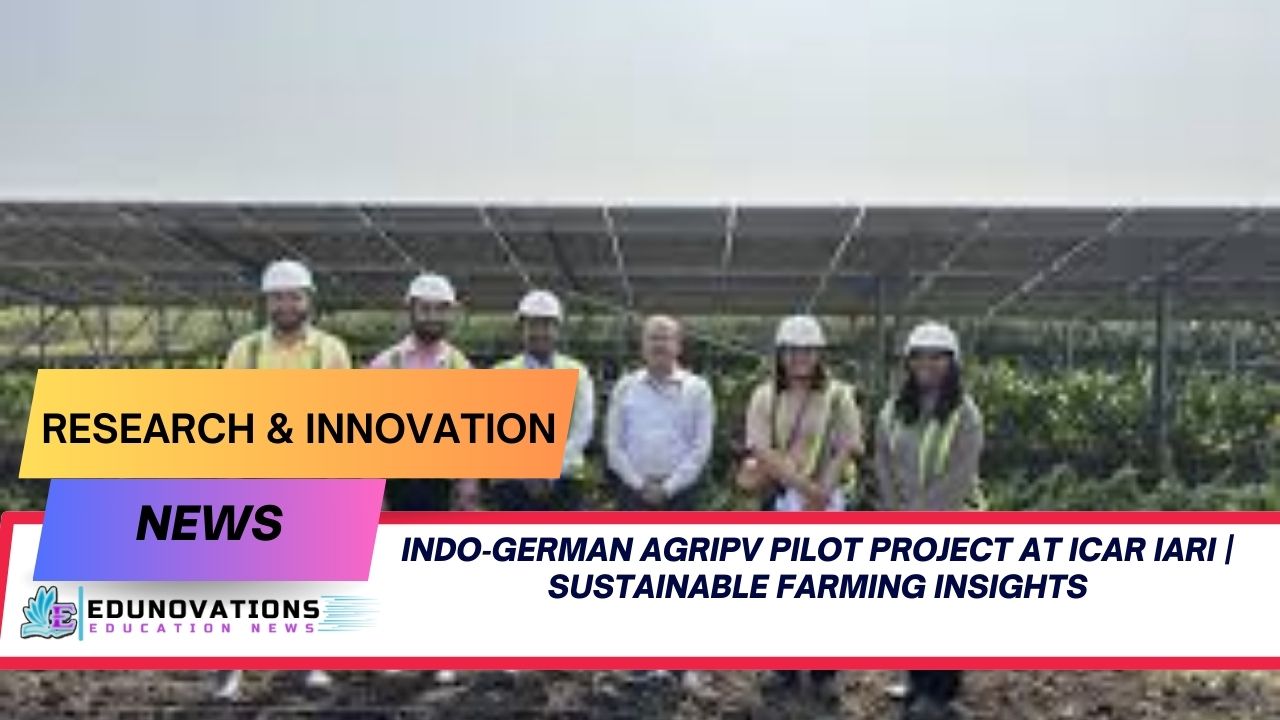
On 1st November 2025, a distinguished German delegation led by Mr. Johann Saathoff, Parliamentary State Secretary, Federal Ministry for Economic Cooperation and Development (BMZ), Germany, visited the 100 kW AgriPV pilot site at ICAR IARI, New Delhi. The delegation aimed to strengthen collaboration in sustainable agriculture and renewable energy integration.
Dr. Ch. Srinivasa Rao, Director, ICAR IARI, provided an in-depth overview of ongoing research initiatives, highlighting the Centre of Excellence on AgriPV established jointly with the National Institute of Solar Energy (NISE) and supported by GIZ India. This center focuses on scaling up AgriPV systems across India’s diverse agro-climatic zones.
Objectives of the AgriPV Pilot Project
The Indo‑German AgriPV pilot project at ICAR IARI has several strategic goals:
- Integrating solar energy with crop cultivation to improve land-use efficiency.
- Enhancing farmers’ income through climate-smart agrivoltaic technologies.
- Promoting clean energy adoption and net-zero farming practices.
- Facilitating research-driven solutions for renewable energy implementation in agriculture.
Key Highlights of the Visit
- Interactive Sessions: Delegation members engaged with ICAR scientists, NISE representatives, and students, gaining insights into the operational framework and research priorities of the AgriPV system.
- Technology Demonstration: The 100 kW AgriPV pilot site showcased solar panels installed above crop fields, generating clean energy while supporting crop growth.
- Data-Driven Research: Discussions focused on decision support systems, climate-smart farming technologies, and the potential for nationwide scaling.
- Institutional Collaboration: Key participants included Dr. Mohammad Rehan (Director General, NISE), Dr. D.K. Yadava (DDG Crop Science, ICAR), and Dr. C. Viswanathan (Joint Director Research, IARI), emphasizing a multidisciplinary approach.
Role of GIZ India and Renewable Energy Integration
The pilot project receives significant support from GIZ India, focusing on sustainable farming practices and renewable energy solutions. By integrating solar energy with agriculture, the 100 kW AgriPV solar-agriculture integration at IARI demonstrates a practical model for climate-resilient farming and increased farm productivity.
Scaling AgriPV Across India
With the success of the pilot, experts aim to expand the model to other regions. Key benefits of scaling AgriPV include:
- Optimized land-use and dual production (crops + solar energy).
- Reduced greenhouse gas emissions and lower dependency on conventional energy.
- Enhanced income security for farmers and improved energy access in rural areas.
Expert Insights
According to Dr. Ch. Srinivasa Rao, Director, ICAR IARI, “The Indo‑German AgriPV pilot project at ICAR IARI sets a benchmark for integrating renewable energy into agriculture. Collaboration with Germany and support from GIZ India ensures research-backed strategies for climate-smart farming.”
Renewable energy specialists suggest that agrivoltaic systems can increase land-use efficiency by 30–40% while maintaining crop yield, indicating a promising future for climate-resilient farming through solar agrivoltaics in India.
Future Prospects of AgriPV in India
The Indo-German initiative serves as a model for sustainable agriculture:
- Development of smart farming technologies for diverse climatic zones.
- Implementation of large-scale AgriPV projects with government and private partnerships.
- Enhanced research collaboration between Indian and German agricultural institutions.
Benefits for Farmers and Society
The project ensures:
- Diversified income sources for farmers.
- Access to renewable energy for rural communities.
- Contribution to India’s net-zero emission targets.
- Promotion of sustainable farming practices for environmental conservation.
Conclusion
The Indo‑German AgriPV pilot project at ICAR IARI exemplifies the fusion of technology, international cooperation, and sustainable agriculture. Through joint research, expert collaboration, and renewable energy integration, this initiative sets a strong precedent for climate-smart and profitable farming in India.
For those interested in educational resources related to agricultural studies, NCERT Courses, Current Affairs, Notes, MCQ’s, and Videos can provide valuable insights.
Toppers Use Mind Maps to score more than 95%
NCERT Class 11th Commerce Mind Maps
Add to cartOriginal price was: ₹999.00.₹199.00Current price is: ₹199.00.NCERT Class 12th Chemistry Mind Maps
Add to cartOriginal price was: ₹199.00.₹75.00Current price is: ₹75.00.NCERT Class 12th Commerce Mind Maps
Add to cartOriginal price was: ₹999.00.₹199.00Current price is: ₹199.00.NCERT Class 12th Science Mind Maps
Add to cartOriginal price was: ₹999.00.₹199.00Current price is: ₹199.00.NCERT Mind Maps For Class 10th
Add to cartOriginal price was: ₹999.00.₹199.00Current price is: ₹199.00.





Purchase Today
10 FAQs on the Indo‑German AgriPV Pilot Project at ICAR IARI
- What is the Indo‑German AgriPV pilot project at ICAR IARI?
It is a collaborative initiative integrating solar energy with agriculture to promote sustainable farming and renewable energy. - Who led the German delegation to ICAR IARI?
Mr. Johann Saathoff, Parliamentary State Secretary, BMZ, Germany, led the delegation. - What is the capacity of the AgriPV pilot site?
The pilot site has a 100 kW AgriPV solar-agriculture integration system. - Which Indian institute collaborated in the AgriPV project?
The Indian Agricultural Research Institute (ICAR IARI) partnered with the National Institute of Solar Energy (NISE). - Which organization supports the AgriPV project in India?
GIZ India provides technical and financial support for the project. - What are the benefits of climate-resilient farming through solar agrivoltaics in India?
Benefits include optimized land-use, increased farmers’ income, and reduced carbon footprint. - How does the AgriPV system improve land-use efficiency?
By combining crop cultivation and solar energy production on the same land, maximizing output per hectare. - Can the AgriPV model be scaled across India?
Yes, with government support and institutional collaboration, the model is scalable across diverse agro-climatic zones. - Who are the key participants from ICAR and NISE in this project?
Dr. Ch. Srinivasa Rao, Dr. D.K. Yadava, Dr. Mohammad Rehan, and Dr. C. Viswanathan played key roles. - Where can I find more educational resources related to sustainable agriculture and renewable energy?
Visit NCERT Courses, Notes, and Videos for comprehensive learning materials.