
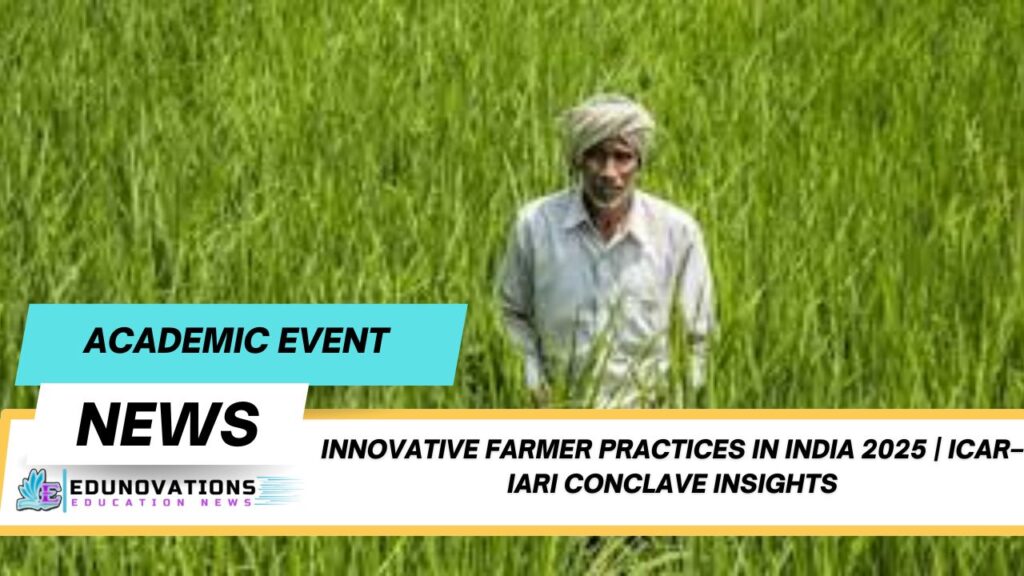
Discover innovative farmer practices in India 2025 at ICAR–IARI conclave, showcasing sustainable farming, digital tools, and farmer-scientist partnerships for agriculture growth.
The Innovative Farmers Conclave 2025, organized by ICAR–Indian Agricultural Research Institute (ICAR–IARI), New Delhi, successfully concluded on 24 December 2025, celebrating the birth anniversary of Chaudhary Charan Singh, revered as Kisanon ke Masiha. The two-day event, held from 23–24 December, focused on documenting, celebrating, and mainstreaming innovative farmer practices in India 2025, aiming to empower farmers for sustainable and inclusive agricultural development.
Celebrating Farmers on Kisan Diwas
The inaugural session coincided with Kisan Diwas, graced by Shivraj Singh Chouhan, Hon’ble Union Minister for Agriculture & Farmers Welfare. Emphasizing the pivotal role of farmers in nation-building, he highlighted India’s strides towards self-reliance in food grains, fruits, vegetables, and milk through scientific farming and ICAR-led innovations. Central themes included integrated farming systems, natural farming, balanced input use, and achieving self-reliance in pulses and oilseeds.
Bhagirath Choudhary, Hon’ble Minister of State for Agriculture & Farmers Welfare, paid tributes to Chaudhary Charan Singh and reinforced the vision that national prosperity is rooted in farmer empowerment. He stressed the integration of smart agriculture, digital tools, drones, and modern technologies into farming systems, celebrating Indian farmers as continual innovators despite climate challenges.
Farmers as “Professors of Practice”
Addressing the gathering, Dr. M.L. Jat, Secretary, DARE & Director General, ICAR, described farmers as the “real jewels of the nation.” He highlighted that Kisan Diwas is not merely ceremonial but serves as a reminder of farmers’ essential role in shaping India’s future. Farmers, he said, are “professors of practice,” whose feedback will guide ICAR’s research policies. Dr. Jat emphasized Viksit Bharat @2047, noting that a developed India requires empowered and prosperous farmers actively involved in research and innovation.
Showcasing Farmer Innovations Across India
Dr. D.K. Yadava, Deputy Director General (Crop Science), ICAR, lauded ICAR–IARI’s efforts in mainstreaming farmer-led innovation, particularly in areas of natural resource management, crop and horticultural sciences, women empowerment, and rural entrepreneurship. The conclave offered farmers a platform to share their experiences and showcase grassroots innovations.
Ch. Srinivasa Rao, Director, ICAR–IARI, highlighted the event as a critical platform for documenting and disseminating indigenous technologies and successful farming models. Farmers from 25 states participated, demonstrating innovative practices, addressing climate variability, weather uncertainties, and market challenges. Publications released during the conclave served as reference materials for wider adoption of these innovative farmer practices in India 2025.
Technical Sessions and Knowledge Exchange
Technical sessions during the conclave encouraged farmer-scientist partnerships, facilitating peer learning and farmer-to-farmer knowledge dissemination. Emphasis was placed on reducing chemical pesticide reliance, promoting bio-pesticides, and leveraging digital tools for modern agriculture. Experts discussed strategies to integrate digital tools and smart agriculture trends in India into daily farming operations, ensuring sustainable and profitable practices.
Inclusive Growth and Collective Action
The valedictory session featured Raj S. Paroda, Founder Chairman, Trust for Advancement of Agricultural Sciences (TAAS), as Chief Guest. He emphasized inclusive agricultural growth, underscoring collective action among farmers, scientists, and institutions. He noted that farmer-to-farmer knowledge exchange accelerates the adoption of innovative methods, contributing to the vision of Viksit Bharat.
R.N. Padaria, Joint Director (Extension), ICAR–IARI, extended a vote of thanks, acknowledging the contributions of farmers, scientists, and organizers, reaffirming ICAR–IARI’s commitment to strengthening farmer-scientist partnerships nationwide.
Key Highlights of the Conclave
- Participation from farmers representing 25 Indian states.
- Showcasing indigenous technologies and climate-resilient farming models.
- Focus on digital tools, drones, and smart agriculture.
- Emphasis on sustainable farming practices and reduced chemical use.
- Release of publications documenting innovative farmer practices in India 2025.
- Sessions promoting farmer-to-farmer knowledge dissemination.
Expert Insights
- Dr. M.L. Jat emphasized the importance of empowering farmers as central to India’s agricultural development.
- Bhagirath Choudhary highlighted how digital tools and smart agriculture can boost productivity and climate resilience.
- Raj S. Paroda encouraged collaborative approaches, reducing reliance on chemicals, and promoting inclusive growth.
Benefits of Farmer-Led Innovations
- Encourages sustainable farming practices.
- Strengthens local economies via entrepreneurship.
- Enhances resilience against climate change.
- Facilitates knowledge sharing through farmer-scientist partnerships.
- Promotes digital adoption in agriculture.
Toppers Use Mind Maps to score more than 95%
-
NCERT Class 11th Commerce Mind Maps
Add to cartOriginal price was: ₹999.00.₹199.00Current price is: ₹199.00. -
NCERT Class 12th Chemistry Mind Maps
Add to cartOriginal price was: ₹199.00.₹75.00Current price is: ₹75.00. -
NCERT Class 12th Commerce Mind Maps
Add to cartOriginal price was: ₹999.00.₹199.00Current price is: ₹199.00. -
NCERT Class 12th Science Mind Maps
Add to cartOriginal price was: ₹999.00.₹199.00Current price is: ₹199.00. -
NCERT Mind Maps For Class 10th
Add to cartOriginal price was: ₹999.00.₹199.00Current price is: ₹199.00.




Purchase Today
FAQs
1. What was the main aim of the Innovative Farmers Conclave 2025?
The conclave focused on documenting, celebrating, and mainstreaming innovative farmer practices in India 2025 for sustainable agriculture.
2. Who were the key dignitaries present at the conclave?
Key speakers included Shivraj Singh Chouhan, Bhagirath Choudhary, Dr. M.L. Jat, Dr. D.K. Yadava, and Raj S. Paroda.
3. How did the conclave promote farmer-scientist partnerships?
Through technical sessions and peer learning workshops, farmers shared insights directly with scientists to refine agricultural research.
4. Which modern tools were highlighted for smart agriculture?
Digital tools, drones, bio-pesticides, and other technology-driven practices were emphasized to modernize Indian farming.
5. How were women farmers supported during the conclave?
Sessions addressed women empowerment in agriculture, highlighting entrepreneurship and leadership roles.
6. How did the conclave address climate challenges?
Farmers showcased climate-resilient practices and shared indigenous techniques to manage weather variability and water scarcity.
7. What publications were released during the conclave?
ICAR–IARI released publications documenting innovative farmer practices in India 2025 for wider adoption.
8. How does the conclave contribute to Viksit Bharat 2047?
By empowering farmers, promoting sustainable agriculture, and encouraging innovation, it aligns with national development goals.
9. Which states participated in the conclave?
Farmers from 25 states across India participated, presenting local innovations and indigenous farming methods.
10. How can farmers access knowledge shared at the conclave?
Through technical publications, peer interactions, and workshops promoting farmer-scientist partnerships and digital adoption.