
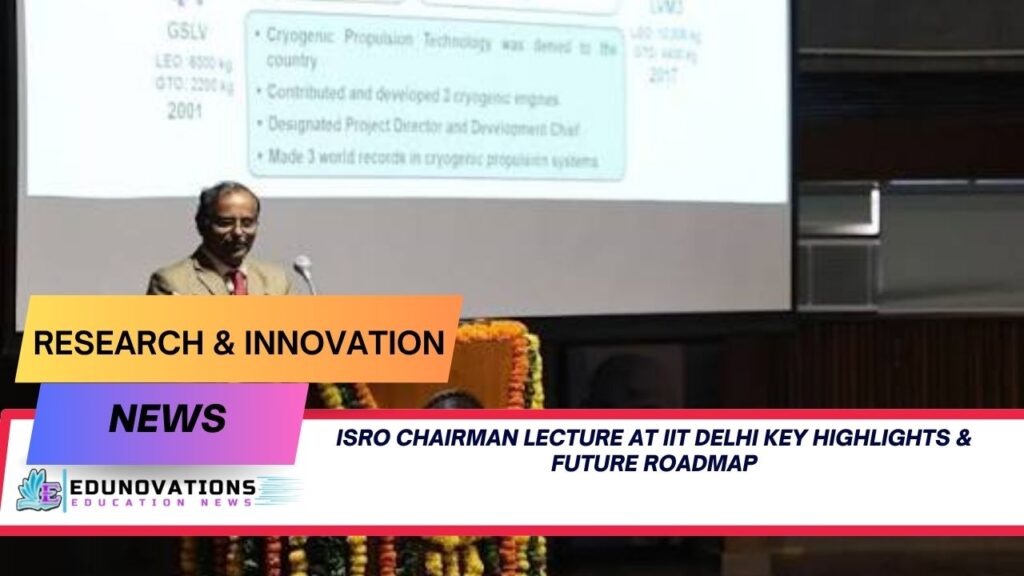
Discover the ISRO chairman lecture at IIT Delhi key highlights, exploring India’s space journey, upcoming Gaganyaan missions, and Viksit Bharat 2047 goals.
Executive Summary of the Historic Address
India’s space sector stands at a monumental crossroads, transitioning from basic satellite launches to ambitious interplanetary exploration, crewed spaceflight, and cutting-edge academic collaborations. Delivering an inspiring Institute Lecture at the prestigious Indian Institute of Technology Delhi (IIT Delhi), Dr. V. Narayanan, Director of the Liquid Propulsion Systems Centre (LPSC) and senior leader representing the Indian Space Research Organisation (ISRO), outlined the visionary roadmap that will define the nation’s space endeavors over the coming decades.
The lecture, held before a packed audience of esteemed researchers, academic faculty, engineering scholars, and space enthusiasts, focused broadly on the critical theme: “India’s Space Programme: The Challenges and Way Forward.” Throughout his address, Dr. Narayanan reflected on ISRO’s humble beginnings, celebrated historic accomplishments such as the Chandrayaan-3 lunar landing, and laid out an exhaustive blueprint for upcoming missions, including the Gaganyaan human spaceflight programme and the long-term vision for Viksit Bharat 2047.
This detailed report provides a comprehensive analysis of the landmark address, shedding light on how strategic partnerships between premier technical institutions and national research facilities are accelerating India’s technological self-reliance.
Historical Evolution: From Humble Origins to Global Aerospace Leadership
To fully appreciate the modern advances highlighted in the address, one must understand the remarkably modest beginnings of India’s space enterprise. Initiated in the early 1960s under the pioneering vision of Dr. Vikram Sarabhai and Dr. Homi Bhabha, the Indian space initiative began operating out of a small church in Thumba, Kerala. In those early years, rocket components were transported on bicycles and bullock carts—a stark contrast to the state-of-the-art launch complexes operated by ISRO today.
Over six decades, ISRO transformed from a modest research team into one of the world’s most efficient, reliable, and cost-effective space agencies. The evolution of India’s indigenous launch vehicle capability underscores this extraordinary journey:
- SLV-3 (Satellite Launch Vehicle): India’s first experimental satellite launch vehicle, led by former President Dr. A.P.J. Abdul Kalam, which successfully injected the Rohini satellite into orbit in 1980.
- ASLV (Augmented Satellite Launch Vehicle): An intermediate step developed to evaluate critical technologies needed for payload payloads in low Earth orbit.
- PSLV (Polar Satellite Launch Vehicle): Widely acclaimed as ISRO’s ultimate “workhorse,” boasting dozens of successful consecutive launches and carrying national as well as international payloads.
- GSLV and LVM3 (Launch Vehicle Mark-III): Heavy-lift launch vehicles capable of carrying heavy communication satellites into Geosynchronous Transfer Orbit (GTO) and executing complex interplanetary missions.
During the lecture, it was highlighted that ISRO’s success rests on indigenous technology development, robust failure analysis systems, and an unyielding commitment to serving societal needs—ranging from agricultural monitoring and disaster management to tele-education and national defense.
Key Takeaways from the ISRO Address at IIT Delhi
The core focus of the address was to analyze the primary technological hurdles facing modern space exploration and to detail how strategic engineering solutions are being developed in India.
1. Celebrated Milestones: Chandrayaan-3 and Beyond
The success of Chandrayaan-3 marked a momentous epoch in international space history. By becoming the very first nation to accomplish a soft landing near the lunar south pole, India demonstrated advanced autonomous landing algorithms, precision hazard avoidance systems, and robust cryogenic propulsion technology. The insights gained from the Pragyan rover continue to enrich global scientific understanding of lunar geology and ice deposits.
2. The Next Frontier: The Gaganyaan Mission
India is actively preparing for its first human spaceflight mission, Gaganyaan. This ambitious project aims to launch a crew of three astronauts into a 400 km low Earth orbit for a three-day mission before bringing them safely back to Earth with a splashdown in Indian ocean waters. The address detailed the exhaustive qualification tests currently underway:
- Development of human-rated launch vehicles (HLVM3).
- High-altitude escape motor tests and Crew Escape System (CES) validation.
- Integrated air-drop tests and environmental control system testing.
- Specialized training of Indian astronauts (Gaganyatris) in India and abroad.
3. Deepening Academic and Research Collaborations
A primary message directed at the faculty and students of IIT Delhi was the critical need for joint research between academia and ISRO. Modern space exploration requires breakthroughs across multiple scientific disciplines that extend far beyond traditional aerospace engineering.
Key collaborative domains discussed during the session include:
- Advanced biomechanics and life support systems for human spaceflight.
- Next-generation solar cell technologies and high-density energy storage.
- Additive manufacturing (3D printing) of rocket engine components.
- Artificial intelligence and machine learning for autonomous satellite navigation and imagery analysis.
Students preparing for competitive examinations or pursuing research careers in space systems can access structured study resources through NCERT Courses and review updated subject documentation in Notes.
Technical Innovations and Engineering Challenges
Space remains an exceptionally unforgiving environment. Rockets operate under extreme mechanical stress, intense acoustic vibration, and thermal environments ranging from cryogenic temperatures below -200°C to combustion chamber temperatures exceeding 3,000°C.
       ISRO'S STRATEGIC EVOLUTION & EXPANSION ROADMAP

  +-------------------------------------------------------+
  |  FOUNDATIONAL ERA (1960s - 1980s)                     |
  |  - Sounding Rockets, SLV-3, Rohini Satellite           |
  +-------------------------------------------------------+
                              |
                              v
  +-------------------------------------------------------+
  |  OPERATIONAL CAPABILITY (1990s - 2010s)               |
  |  - PSLV Workhorse, GSLV, IRS & INSAT Constellations   |
  +-------------------------------------------------------+
                              |
                              v
  +-------------------------------------------------------+
  |  EXPLORATION & HEAVY LIFT (2010s - PRESENT)           |
  |  - Chandrayaan Series, Mangalyaan, LVM3, Aditya-L1    |
  +-------------------------------------------------------+
                              |
                              v
  +-------------------------------------------------------+
  |  HUMAN SPACEFLIGHT & FUTURE VISION (2025 - 2047)      |
  |  - Gaganyaan Crewed Mission, Bharatiya Antariksh      |
  |    Station (BAS), Next-Gen Launch Vehicles (NGLV)     |
  +-------------------------------------------------------+
Cryogenic and Liquid Propulsion Breakthroughs
Liquid and cryogenic propulsion engines represent the pinnacle of rocket engineering. Developing indigenous cryogenic upper stages required ISRO to master complex metallurgy, turbopump design, and ignition techniques at sub-zero temperatures. The lecture detailed how continuous refinement of liquid propulsion systems ensures higher payload efficiency, enabling heavier satellites to be put into orbit without exponentially increasing launch costs.
Satellite Navigation and Remote Sensing
India maintains one of the world’s largest fleets of remote sensing and communication satellites. The NavIC (Navigation with Indian Constellation) system provides independent, accurate positioning services across India and surrounding regions. Expanding NavIC’s reach to civilian applications, smart devices, and commercial aviation remains a national priority.
Aspirants studying political science, defense, and science policy can keep track of these technological developments in Current Affairs and verify their examination preparation using MCQ’s.
Aligning Space Technology with Viksit Bharat 2047
The overarching vision presented during the lecture directly aligns ISRO’s strategic goals with the national objective of transforming India into a fully developed nation by 2047 (Viksit Bharat 2047).
| Strategic Pillar | Target Objective | Expected Impact on India |
| Bharatiya Antariksh Station (BAS) | Operational modular space station by 2035 | Establishes permanent Indian presence in Low Earth Orbit for scientific research. |
| Next-Gen Launch Vehicle (NGLV) | Development of reusable heavy-lift launchers | Drastically lowers launch costs per kilogram, enabling commercial competitiveness. |
| Lunar & Interplanetary Base | Crewed lunar landing by 2040 | Positions India among top spacefaring nations capable of deep-space exploration. |
| Commercial Space Economy | Increasing global space market share from 2% to 10%+ | Drives private sector investment, startup creation, and high-tech job creation. |
By opening the space sector to private enterprises, non-governmental entities, and space tech startups through IN-SPACe (Indian National Space Promotion and Authorization Centre), the government has created an ecosystem where innovation can thrive rapidly. Educational institutions are encouraged to establish satellite design labs and aerospace incubation centers to prepare young engineers for this booming economy.
Institutions planning to build digital infrastructure and educational portals to support space tech curricula can consult custom web development specialists via Mart Ind Infotech for tailored digital solutions.
Academic Synergy: How IITs and Universities Drive Space Science
The choice of IIT Delhi as the venue for this landmark lecture highlights the crucial dependence of space research on academic institutions. Advanced research conducted at university centers feeds directly into national technology pipelines.
Key Fields of Academic Engagement:
- Material Science: Formulating ultra-lightweight alloys, thermal barrier coatings, and carbon composite materials capable of surviving re-entry conditions.
- Robotics and Automation: Developing planetary rovers, robotic arms for space station assembly, and autonomous docking mechanisms.
- Space Weather and Astrophysics: Studying solar storms, space debris tracking, and orbital mechanics to safeguard critical satellite constellations.
- Bio-astronautics: Analyzing human physiology under microgravity, radiation shielding, and closed-loop ecological life support systems.
For students eager to explore aerospace fundamentals, interactive visual lectures are accessible via Videos, while standard academic guidelines and entrance test patterns can be reviewed under Syllabus. Additionally, candidates preparing for foundational examinations can access free study material via Downloads of Free NCERT PDFs and simplify complex concepts using NCERT Mind Maps.
Strategic Analysis: Overcoming Future Space Challenges
While celebrating past accomplishments, the address candidly analyzed significant challenges that demand immediate attention from scientists, engineers, and policymakers:
1. Space Debris Mitigation
With thousands of active and inactive satellites orbiting Earth, space debris poses a growing threat to space assets. ISRO’s Project NETRA (Network for space object Tracking and Analysis) plays a vital role in protecting Indian satellites from space collisions. Future research must focus on active debris removal technologies and sustainable satellite disposal mechanisms.
2. Transition to Reusable Launch Systems
To maintain economic competitiveness against global commercial space operators, developing fully or partially reusable launch vehicles is mandatory. ISRO’s successful Reusable Launch Vehicle Autonomous Landing Experiment (RLV-LEX) demonstrates solid progress toward this goal.
3. Supply Chain and Material Independence
Achieving absolute self-reliance (Atmanirbhar Bharat) requires building local supply chains for specialized electronics, space-grade sensors, and raw materials. Collaborative ventures between technical universities, public sector enterprises, and private industry are essential to eliminate import dependencies.
Quotes and Expert Perspectives
Highlighting the transformative nature of Indian space research, senior aerospace authorities have consistently emphasized academic integration:
“Space technology is no longer an isolated domain restricted to rocket scientists. It is an interdisciplinary field requiring computer scientists, biomedical engineers, material researchers, and fundamental physicists. Our partnership with premier institutes like IIT Delhi guarantees that the brightest young minds contribute directly to national space missions.”
— Dr. V. Narayanan, Director, Liquid Propulsion Systems Centre (LPSC/ISRO)
Echoing this vision during discussions on space policy, former ISRO Chairman and eminent scientist Dr. K. Sivan previously noted:
“The success of complex space missions relies heavily on continuous innovation coming out of our academic institutions. Opening up our space sector ensures that youthful energy and institutional research combine to drive India’s futuristic space goals.”
Educational Implications for Students and Civil Service Aspirants
The rapid expansion of India’s space program carries immense relevance for students, engineering candidates, and civil services aspirants. Topics concerning space technology, satellite applications, and national science policies form a vital part of competitive examinations like UPSC Civil Services, GATE, and state public service commissions.
Important Concepts Every Aspirant Should Master:
- Types of Orbits: Low Earth Orbit (LEO), Medium Earth Orbit (MEO), Geostationary Earth Orbit (GEO), and Sun-Synchronous Orbit (SSO).
- Propulsion Systems: Solid, liquid, cryogenic, semi-cryogenic, and electric propulsion technologies.
- National Policy Initiatives: Indian Space Policy 2023, IN-SPACe guidelines, and NewSpace India Limited (NSIL) commercial mandates.
- Key Interplanetary Missions: Aditya-L1 (solar observation), XPoSat (X-ray polarimetry), Chandrayaan series, and Mars Orbiter Mission (MOM).
By keeping track of regular updates and structured research papers, students can build a solid conceptual foundation required for competitive career growth.
Toppers Use Mind Maps to score more than 95%
-
NCERT Class 11th Commerce Mind Maps
Add to cartOriginal price was: ₹999.00.₹199.00Current price is: ₹199.00. -
NCERT Class 12th Chemistry Mind Maps
Add to cartOriginal price was: ₹199.00.₹75.00Current price is: ₹75.00. -
NCERT Class 12th Commerce Mind Maps
Add to cartOriginal price was: ₹999.00.₹199.00Current price is: ₹199.00. -
NCERT Class 12th Science Mind Maps
Add to cartOriginal price was: ₹999.00.₹199.00Current price is: ₹199.00. -
NCERT Mind Maps For Class 10th
Add to cartOriginal price was: ₹999.00.₹199.00Current price is: ₹199.00.


Purchase Today
Frequently Asked Questions (FAQs)
Q1: What were the main topics covered during the ISRO address at IIT Delhi?
The address focused primarily on India’s space journey, major technological challenges in rocketry and satellite systems, details of upcoming human spaceflight endeavors, and collaborative opportunities between ISRO and academic institutions for Viksit Bharat 2047.
Q2: What is the significance of the Gaganyaan mission for India?
Gaganyaan is India’s flagship human spaceflight program designed to demonstrate indigenous capabilities in sending a human crew to Low Earth Orbit and returning them safely to Earth. Success in this mission will place India among an elite group of nations with independent human spaceflight capabilities.
Q3: How are ISRO and academic institutions like IIT Delhi working together?
ISRO partners with academic institutions on advanced joint research, focusing on areas such as biomechanics, high-efficiency solar cells, advanced propulsion materials, additive manufacturing, and artificial intelligence for autonomous satellite operations.
Q4: What is the long-term vision of ISRO for Viksit Bharat 2047?
By 2047, ISRO aims to establish the Bharatiya Antariksh Station (BAS), achieve crewed lunar landings, operationalize Next-Generation Launch Vehicles (NGLV), and significantly increase India’s share in the global commercial space economy.
Q5: Why are cryogenic engines so crucial for heavy satellite launches?
Cryogenic engines utilize liquid hydrogen and liquid oxygen at extremely low temperatures to provide significantly higher thrust per unit of propellant compared to solid or conventional liquid stages, making them essential for heavy-lift vehicles like LVM3.
Q6: What is NavIC and how does it benefit India?
NavIC (Navigation with Indian Constellation) is an independent regional satellite navigation system developed by ISRO. It provides precise positioning services across India and surrounding areas, supporting terrestrial, aerial, and marine navigation.
Q7: How does opening the space sector to private companies help India?
Allowing private companies and startups into the space sector fosters innovation, accelerates technological development, attracts private capital, and frees up ISRO to focus on core research and deep-space exploration.
Q8: What role does Project NETRA play in space safety?
Project NETRA is an automated tracking system designed to monitor space debris and potential collision threats to Indian operational satellites, ensuring orbital safety and sustainable space activities.
Q9: How can students pursue research careers with ISRO?
Students can pursue aerospace, mechanical, electronics, or computer science engineering, participate in ISRO-sponsored university research programs, apply for internships through ISRO centers, or clear the ISRO Centralised Recruitment Board (ICRB) examination.
Q10: Where can aspirants find updated study notes on space technology for exams?
Aspirants can access curated study modules through structured learning platforms offering updated current affairs, NCERT courses, and subject notes tailored for competitive exam preparation.