
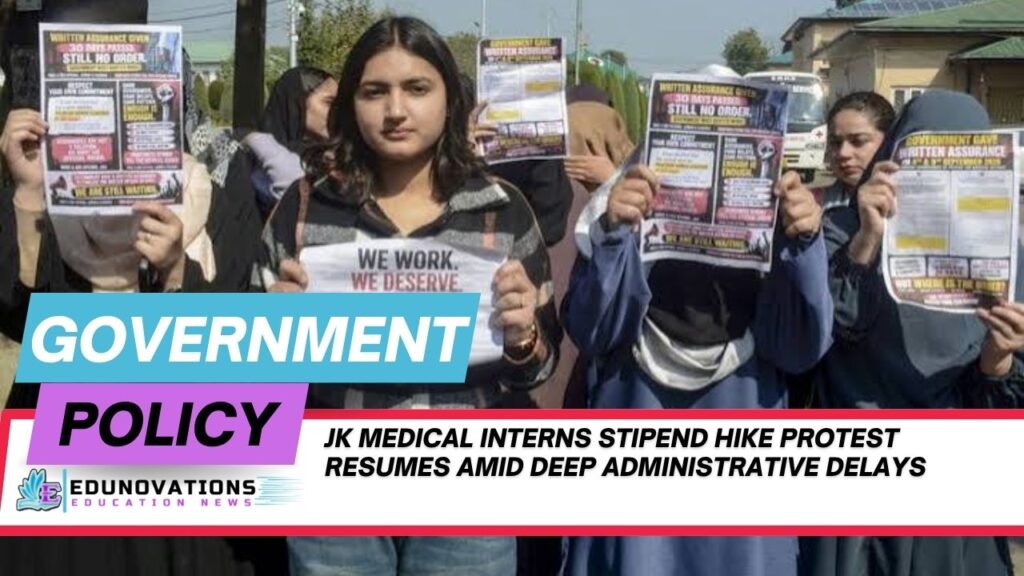
The healthcare landscape in the Union Territory of Jammu and Kashmir has once again been thrown into turmoil as young healthcare professionals step back onto the streets.
The healthcare landscape in the Union Territory of Jammu and Kashmir has once again been thrown into turmoil as young healthcare professionals step back onto the streets. The JK medical interns stipend hike protest details have rapidly evolved into a major flashpoint between medical trainees and administrative authorities. Across various prominent medical institutions, including Government Medical College (GMC) Srinagar, GMC Jammu, and SKIMS Medical College Bemina, MBBS and BDS intern doctors have resumed their intense agitation. This renewed phase of demonstrations stems directly from what protesting interns describe as a chronic and unacceptable delay in issuing a formal administrative government order approving their much-needed financial revision.
For months, thousands of young medical graduates who form the absolute backbone of emergency wards, outpatient departments (OPDs), and intensive care units have shouldered grueling shifts under immense physical and mental pressure. Yet, their monthly compensation has remained stagnant at a meager ₹12,300 per month—a rate that has stayed unchanged since 2019 despite soaring inflation, high living costs, and the strenuous demands of modern medical training. While the administration, led by key leaders such as Chief Minister Omar Abdullah, has verbally acknowledged the urgency of revising trainee remunerations—with proposals discussed to double the monthly payout—the lack of a binding, written government notification has shattered the patience of the student community, pushing them to restart their statewide agitation.
The Anatomy of a Stalled Promise: Understanding the Grievances
The roots of the current crisis extend far beyond a simple disagreement over numbers; they touch upon administrative credibility, transparency, and the fundamental welfare of frontline medical practitioners. When medical interns first initiated their coordinated protests earlier in the academic and clinical calendar, their voices echoed through hospital corridors from Jammu to Kashmir. At that time, student representatives under organizations such as the All India Medical Students’ Association (AIMSA) and local resident doctor bodies engaged in extensive dialogues with top-tier health ministry officials and bureaucratic heads.
During those crucial negotiations, administrative representatives requested a cooling-off period—typically cited as a 30-day window—to process files, evaluate budgetary allocations, and formally sanction the stipend enhancement. Trusting these administrative assurances, the student leadership made the conscious decision to temporarily suspend their agitations, ensuring that patient care across major tertiary care hospitals did not suffer further disruptions. However, as the stipulated grace period lapsed and weeks turned into months without a single gazetted notification or formal treasury order, frustration boiled over.
According to student representatives participating in the renewed demonstrations, verbal commitments carry no weight in financial matters when rent, food, medical literature, and basic daily survival expenses continue to mount. Trainees working continuous 24-to-36-hour shifts find themselves struggling to maintain basic financial independence. This economic strain directly impacts their focus, well-being, and overall quality of life during a critical developmental phase of their medical careers. For students seeking foundational learning materials or tracking academic updates alongside their clinical duties, accessing organized resources like NCERT Courses and staying informed through structured Current Affairs portals remains vital for their holistic professional growth.
Institutional Impact and the Strain on Healthcare Delivery
The resumption of the stipend agitation has sent ripples across major healthcare facilities in the region. GMC Srinagar, GMC Jammu, and SKIMS Bemina handle thousands of daily emergency and trauma cases, serving as primary healthcare lifelines for the entire Union Territory. When medical interns—who act as the immediate first responders and executioners of vital hospital protocols—participate in demonstrations or partial boycotts of non-essential duties, the burden shifts heavily onto senior resident doctors and faculty members.
While student unions have repeatedly emphasized their commitment to maintaining emergency services and safeguarding critical patient care, the administrative friction poses systemic risks. Medical experts and healthcare administrators have frequently warned that unresolved welfare issues among resident doctors and interns can lead to widespread burnout, lower morale, and a brain drain toward states offering far more competitive trainee remunerations. In neighboring states and central institutions, medical stipends have seen progressive revisions to match the rising cost of living, leaving Jammu and Kashmir significantly behind the national average.
For students and aspirants planning their academic journeys in medicine or looking into structured curricula, utilizing verified study aids, comprehensive Notes, and practice-oriented MCQ’s can build a strong conceptual foundation before entering rigorous clinical environments. Furthermore, institutions aiming to streamline their administrative communications, digital infrastructure, and internal connectivity often collaborate with technical solution providers such as Mart Ind Infotech to build robust digital frameworks.
Administrative Responses and Political Accountability
The political and bureaucratic machinery in Jammu and Kashmir faces mounting pressure to resolve the crisis permanently. Chief Minister Omar Abdullah and health ministry officials have previously signaled positive intent toward revising financial frameworks for young professionals. Public statements from political leadership have often highlighted the necessity of creating an enabling, supportive ecosystem that retains medical talent within the Union Territory.
However, policy analysts and student leaders argue that administrative goodwill must translate into concrete bureaucratic action. A promise to examine or approve a proposal in principle does not alter bank balances or alleviate financial distress until the finance department formally issues the requisite treasury sanction. The gap between executive announcements and on-ground execution remains the single largest driver of recurring protests in the public sector.
To bridge this communication divide, transparent administrative timelines, automated policy updates, and regular consultative forums between student representatives and health secretaries are essential. Trainees must also have access to reliable institutional guidelines, structured Syllabus frameworks for professional exams, and visual learning aids such as NCERT Mind Maps to maintain academic continuity amidst professional uncertainties. For those looking to download comprehensive reference materials, exploring dedicated portals for Downloads of Free NCERT PDFs provides accessible educational support.
The Road Ahead: Dialogue vs. Escalation
As the agitation enters its critical phase, the onus lies squarely on the government to expedite the formal issuance of the revised stipend order. Student bodies have maintained that while they remain open to constructive dialogue, they will not settle for recurring verbal assurances or indefinite extensions. If formal notification is further delayed, unions have threatened to escalate their protests, potentially impacting routine hospital functioning across multiple districts.
For the healthcare sector in Jammu and Kashmir, resolving this impasse is not merely a budgetary decision; it is a vital investment in the morale, mental health, and dedication of the next generation of physicians. Ensuring fair compensation empowers medical interns to focus entirely on patient care, clinical excellence, and professional mastery without the constant distraction of financial insecurity.
Toppers Use Mind Maps to score more than 95%
-
NCERT Class 11th Commerce Mind Maps
Add to cartOriginal price was: ₹999.00.₹199.00Current price is: ₹199.00. -
NCERT Class 12th Chemistry Mind Maps
Add to cartOriginal price was: ₹199.00.₹75.00Current price is: ₹75.00. -
NCERT Class 12th Commerce Mind Maps
Add to cartOriginal price was: ₹999.00.₹199.00Current price is: ₹199.00. -
NCERT Class 12th Science Mind Maps
Add to cartOriginal price was: ₹999.00.₹199.00Current price is: ₹199.00. -
NCERT Mind Maps For Class 10th
Add to cartOriginal price was: ₹999.00.₹199.00Current price is: ₹199.00.





Purchase Today
Frequently Asked Questions
Q1: Why did medical interns in Jammu and Kashmir resume their protests?
A1: Medical interns resumed their protests because the administration failed to issue a formal government order implementing the promised stipend increase after the expiration of the agreed 30-day assurance period.
Q2: What is the current monthly stipend received by medical interns in J&K?
A2: Protesting medical interns currently receive a monthly stipend of ₹12,300, a rate that has remained unchanged since 2019 despite significant inflation and rising living costs.
Q3: Which medical institutions are primarily affected by the ongoing agitation?
A3: The agitation spans multiple major medical institutions across the Union Territory, prominently including Government Medical College (GMC) Srinagar, GMC Jammu, and SKIMS Medical College, Bemina.
Q4: What specific demands are being raised by the protesting MBBS and BDS interns?
A4: Interns are demanding an immediate, formal revision and enhancement of their monthly stipend from ₹12,300 to ₹30,000, backed by a written and legally binding government order.
Q5: What role does AIMSA play in the Jammu and Kashmir medical protests?
A5: The All India Medical Students’ Association (AIMSA) and local resident doctor committees have been actively representing the grievances of trainees, organizing peaceful demonstrations, and negotiating with health authorities.
Q6: How does the delay in stipend revision impact day-to-day hospital operations?
A6: Prolonged dissatisfaction and strikes by interns can strain hospital emergency wards and OPDs, shifting heavy workloads onto senior resident doctors and creating potential bottlenecks in patient care services.
Q7: Have political leaders in Jammu and Kashmir commented on the stipend hike?
A7: Yes, key political figures, including Chief Minister Omar Abdullah, have previously expressed intent to support stipend enhancements, but delays in official administrative paperwork have frustrated the student community.
Q8: Why are verbal assurances no longer accepted by the protesting medical interns?
A8: Interns argue that past verbal promises failed to materialize into actual bank disbursements, making a formal, gazetted government notification mandatory before any suspension of protests.
Q9: Where can students access reliable educational resources and current affairs updates?
A9: Students can explore dedicated academic platforms offering structured courses, current affairs summaries, and revision notes to support their continuous professional and academic development.
Q10: What immediate steps are required from the government to resolve the crisis?
A10: The government must immediately issue the formal finance department order sanctioning the approved stipend hike to restore administrative trust and ensure uninterrupted healthcare services.