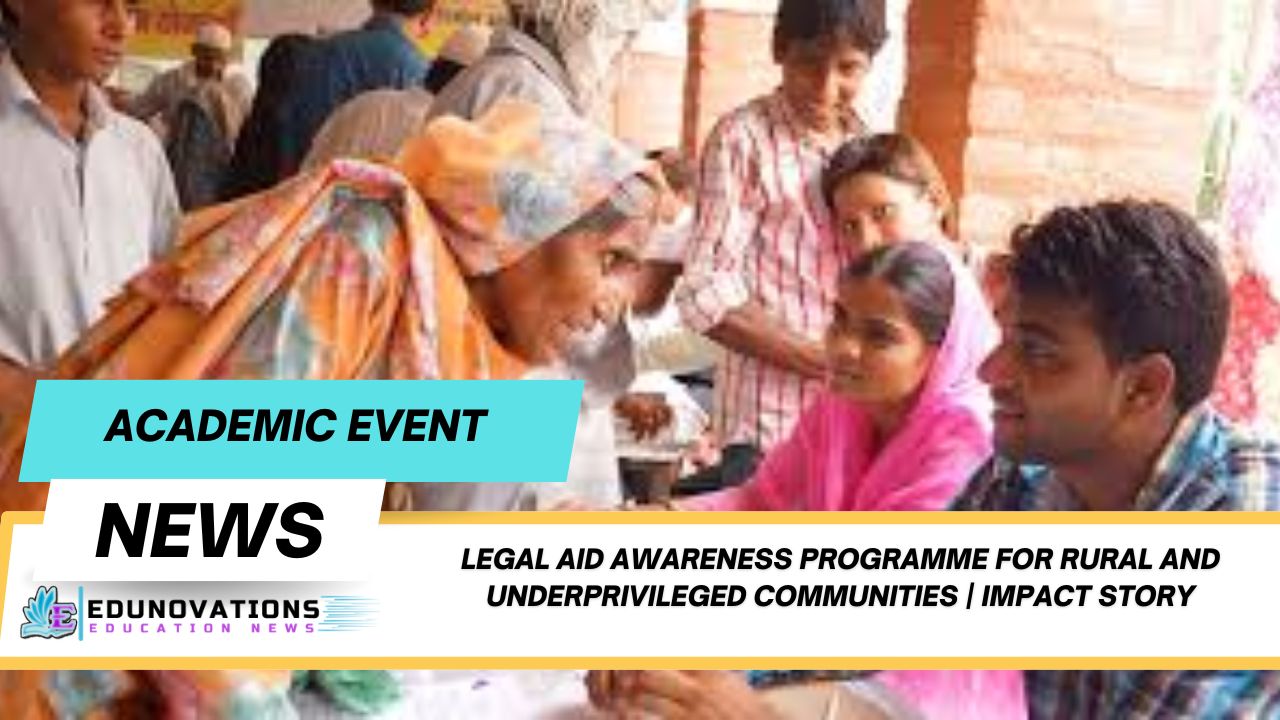
Discover how a legal aid awareness programme for rural and underprivileged communities is bridging justice gaps, empowering citizens, and transforming access to legal rights in India.
Access to justice remains a central pillar of a democratic society, yet millions of people across India’s hinterlands still lack clear avenues to understand their rights or exercise them. In recent years, legal aid initiatives undertaken by student bodies and law schools have taken centre stage in bridging the justice gap. One such notable effort is the comprehensive legal aid awareness programme for rural and underprivileged communities, led by the National Law Institute University (NLIU) in Bhopal under its Legal Aid Clinic (LAC). This initiative has not only educated local residents about their fundamental legal rights, but also connected them with legal assistance mechanisms that were previously unknown to many.
The programme is part of a larger commitment to bring legal knowledge out of the courtroom and into everyday life — especially among groups who face systemic barriers to justice.
Understanding the Need: Why Legal Literacy Matters
The Justice Gap in India
Despite the constitutional promise of equality before the law, there remains a significant divide between legal rights in theory and their accessibility in reality. Many residents in remote villages lack awareness about basic civil liberties, labour laws, property rights, and avenues for legal redress. According to the National Legal Services Authority (NALSA), millions are unaware of the free or subsidised legal support available under Indian law — a gap that perpetuates exploitation and injustice.
In this context, a legal aid awareness programme for rural and underprivileged communities serves as a vital instrument for public empowerment and justice dissemination.
How the Programme Works: From Classroom to Community
Student‑Led Legal Outreach
The Legal Aid Clinic at NLIU is a student‑run initiative supervised by faculty experts. Driven by principles similar to Article 39A of the Constitution, which mandates equality of opportunity in matters of justice, the Clinic has organised an array of outreach activities aimed at enhancing legal literacy.
These include:
- Legal Literacy Workshops
Sessions conducted in village schools, community centres, and public spaces where students explain citizens’ rights under various statutes such as consumer protection and domestic violence laws. - Pro Bono Legal Guidance
Students work alongside empanelled advocates to offer pro bono consultations, helping villagers understand complaint procedures, legal documentation, and court processes. - Interactive Awareness Drives
Street plays, infographic campaigns, and role‑play sessions are used to simplify complex legal concepts and encourage community participation. - Rights Education Camps
On‑site camps have been held in rural clusters, where local residents can meet legal professionals face‑to‑face — strengthening trust and dispelling fears about legal systems.
Voices From the Field: Real Impact Stories
Breaking Barriers to Justice
At several locations where the programme was conducted, villagers shared how they had never before consulted a lawyer or even knew that legal help could be free or subsidised. Many women reported newfound awareness about domestic violence protections, while senior citizens learned about schemes designed to safeguard elder rights.
Legal literacy in these contexts is not just abstract instruction — it’s practical empowerment that affects livelihoods, family security, and social justice.
Expert Insight: Why Grassroots Legal Literacy Is Critical
Dr. Ritu Sharma, a practising human rights lawyer based in Delhi, notes that “access to justice is not merely about lawyers and courts — it’s about enabling every citizen to recognise when their rights are violated and to seek appropriate support.” Her comments underscore the need for community justice awareness and legal literacy outreach programme India efforts that demystify the law for everyday people.
Collaboration With Government & Non‑Profits
The NLIU initiative aligns with broader national efforts to strengthen access to legal services and awareness. For instance, similar Legal Aid and Awareness Camps under the Department of Justice aim to reach underserved populations with targeted legal education campaigns.
In collaboration with local legal services authorities, non‑governmental organisations, and grassroots volunteers, the programme enhances both legal knowledge and civic confidence among participants.
Challenges and Solutions in Legal Outreach
Overcoming Accessibility Barriers
Despite growing awareness, challenges remain:
- Geographic Isolation: Remote villages often lack easy access to courts or legal aid offices.
- Language Barriers: Legal terminology can be intimidating without translation into local dialects.
- Cultural Stigma: In some areas, there is hesitation to approach legal authorities due to social norms.
To tackle these, the programme adopts:
- Mobile legal literacy units
- Community legal ambassadors
- Local language resource materials
This strategic approach ensures that even the most marginalised segments benefit from the justice system.
Why This Matters for India’s Future
Empowering citizens with legal knowledge creates a multiplier effect: individuals who were once unaware of their rights are now able to advocate for themselves and others. As India’s democratic fabric continues to evolve, efforts like this legal aid awareness programme for rural and underprivileged communities establish a foundation of informed citizenship and equitable access to justice.
Such initiatives are not limited to one region alone. Across the country, law schools and legal aid cells are undertaking similar community outreach efforts — helping bridge the justice divide one village at a time.
How You Can Support Legal Awareness Initiatives
If you’re passionate about legal empowerment and justice literacy, here are some ways you can contribute:
- Volunteer at legal literacy camps in your area.
- Support NGOs focused on access to justice programmes.
- Advocate for integration of legal education within community development frameworks.
For educators and learners, resources such as internal links to NCERT Courses, Current Affairs, and MCQ’s can reinforce legal studies and civic education. Whether it’s using https://courses.edunovations.com/ for foundational course material or https://edunovations.com/currentaffairs/ for contextual updates, integrating legal literacy into broader education curricula strengthens long‑term outcomes.
You may also explore free NCERT PDF downloads and mind maps to build legal awareness among students and emerging professionals.
For community partners or schools looking to organise legal rights workshops, contacting entities like Mart Ind Infotech can help coordinate logistics and technical support for outreach campaigns.
Toppers Use Mind Maps to score more than 95%
NCERT Class 11th Commerce Mind Maps
Add to cartOriginal price was: ₹999.00.₹199.00Current price is: ₹199.00.NCERT Class 12th Chemistry Mind Maps
Add to cartOriginal price was: ₹199.00.₹75.00Current price is: ₹75.00.NCERT Class 12th Commerce Mind Maps
Add to cartOriginal price was: ₹999.00.₹199.00Current price is: ₹199.00.NCERT Class 12th Science Mind Maps
Add to cartOriginal price was: ₹999.00.₹199.00Current price is: ₹199.00.NCERT Mind Maps For Class 10th
Add to cartOriginal price was: ₹999.00.₹199.00Current price is: ₹199.00.





Purchase Today
10 FAQs on Legal Aid Awareness Initiatives
- What is a legal aid awareness programme for rural and underprivileged communities?
A community outreach initiative that educates citizens about their legal rights and helps them access justice systems. - Who can benefit from a legal aid awareness programme for rural and underprivileged communities?
Citizens living in remote or underserved areas, especially those with limited access to legal resources. - How do community justice awareness and legal literacy outreach programme India activities function?
Through workshops, camps, consultations, and interactive drives aimed at simplifying legal information. - Can a legal aid awareness programme for rural and underprivileged communities provide free assistance?
Yes — many programmes collaborate with pro bono lawyers to offer free legal guidance. - What topics are covered in legal literacy outreach programmes?
Rights under domestic law, consumer rights, protections against abuse, and procedures for legal redressal. - Why are community justice awareness efforts important in India?
They bridge gaps in legal knowledge and empower citizens to exercise their constitutional rights. - Are law students involved in community justice awareness and legal literacy outreach programme India initiatives?
Yes — student‑run Legal Aid Clinics often play a key role in organising and delivering programmes. - How do legal camps support underprivileged communities?
By providing on‑site consultations, referral services, and educational materials. - Can educational organisations partner to spread legal awareness?
Educational institutions and civil society groups can collaborate to expand the reach of legal literacy programmes. - What role does pro bono legal services and justice awareness initiatives India play?
They ensure access to justice for those who cannot afford traditional legal services.