
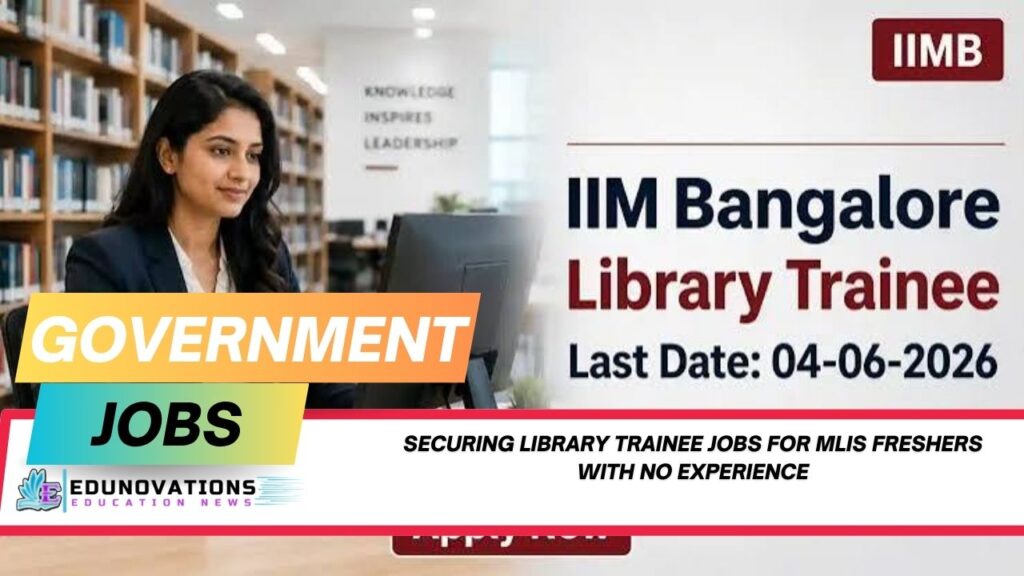
Finding a strong professional foothold right after completing a Master’s degree in Library and Information Science (MLIS) can often feel challenging for recent graduates.
Finding a strong professional foothold right after completing a Master’s degree in Library and Information Science (MLIS) can often feel challenging for recent graduates. Many aspiring information professionals spend months looking for entry-level opportunities that do not demand years of prior work history. For fresh post-graduates seeking practical exposure, university libraries offer some of the most dynamic environments to master modern digital repository tools, cataloguing standards, and institutional database management.
Securing library trainee jobs for mlis freshers with no experience serves as the definitive stepping stone into the broader landscape of academic librarianship, knowledge management, and archival science. This comprehensive guide explores what these roles entail, the critical skill sets required to excel, expert tips for building a stellar application, and how comprehensive preparation resources can accelerate your career trajectory.
The Evolving Landscape of Library and Information Science
Modern academic and research libraries have transformed dramatically over the last decade. Gone are the days when a library was merely a quiet repository of physical books, ledgers, and manual card catalogs. Today, state-of-the-art university libraries function as complex digital knowledge hubs, managing terabytes of scholarly research data, electronic resource management systems (ERMS), institutional repositories, and advanced metadata schemas.
For fresh graduates entering the job market, this technological shift presents both an opportunity and a learning curve. Major institutions increasingly look for entry-level candidates who possess foundational theoretical knowledge combined with a willingness to learn specialized library management software. Engaging with library trainee jobs for mlis freshers with no experience allows candidates to bridge the gap between classroom theory and real-world operational workflows.
“Libraries store the energy that fuels the imagination. They open up windows to the world and inspire us to explore and achieve, and contribute to improving our quality of life.” — Sidney Sheldon, celebrated author and library advocate, often emphasized how institutional information hubs empower community learning and intellectual growth.
To stay ahead in academic preparations, competitive exams, or general knowledge enhancement, candidates can explore structured learning modules such as NCERT Courses to build strong foundational teaching and study habits.
Anatomy of a University Library Trainee Role
When premier institutions—such as top-ranked national universities—announce professional training vacancies, they typically design these programs to offer holistic exposure across various library sections. A standard traineeship encompasses three primary operational pillars:
1. Catalogue Management and Bibliographic Control
Cataloguing forms the backbone of any well-organized library system. Trainees often work extensively with integrated library systems like KOHA alongside manual legacy records. Key responsibilities in this domain include:
- Copy Cataloguing: Utilizing protocols such as Z39.50 (Library of Congress) to retrieve and adapt established bibliographic records.
- Standardization: Editing records according to modern descriptive frameworks like MARC21 and RDA/AACR2.
- Data Verification: Correcting critical fields such as author names, uniform titles, edition statements, pagination, and classification numbers.
2. Digitised Collections and Institutional Repositories
With universities shifting toward open-access models, managing digital assets has become paramount. Trainees frequently handle tools like Calibre and DSpace to:
- Review scanned scholarly articles, dissertations, and manuscripts for visual completeness and text clarity.
- Standardize metadata tags, accession numbers, and call numbers to maximize search discoverability.
- Correct repository URLs, update author abstracts, and refine institutional indices.
If you are tracking evolving academic requirements, keeping up with Current Affairs is essential for understanding broader educational policy shifts across India. Furthermore, utilizing structured Notes can streamline your preparation for various professional screening rounds.
Essential Skills Required for MLIS Graduates
While formal professional experience is rarely mandatory for trainee positions, academic institutions look for specific hard and soft competencies during the recruitment screening process. Cultivating these skills will significantly enhance your employment prospects:
- Technical Proficiency: Familiarity with open-source Integrated Library Systems (ILS) like KOHA, digital repository software like DSpace, and metadata standards (MARC21, AACR2, RDA).
- Office Automation: Strong working knowledge of Microsoft Office Suite (Excel, Word) for inventory tracking, report generation, and data sorting.
- Attention to Detail: Precision in handling bibliographic metadata, spelling consistency, and classification codes.
- Adaptability: Willingness to work in rotational shifts, manage high-volume user traffic, and adapt to changing institutional schedules.
For candidates preparing for competitive library science recruitment examinations (such as UGC-NET or state-level librarian tests), practicing regular MCQ’s helps reinforce theoretical concepts in classification, cataloguing, and reference service management.
Crafting a Winning Application Portfolio
When applying for competitive institutional traineeships, your application package serves as your primary introduction to the selection committee. Because freshers lack professional tenure, every element of the application must highlight academic rigor and enthusiasm:
1. The Curriculum Vitae (CV)
Your CV should be clean, professional, and structured chronologically or functionally. Highlight your MLIS coursework, major research projects, internship stints during your master’s program, and technical proficiencies (mentioning specific software like KOHA or DSpace). For institutional setups, professional technology infrastructure can also be referenced; institutions looking to digitize internal workflows often consult expert technology providers like Mart Ind Infotech for tailored digital transformation solutions.
2. The Statement of Purpose (SOP)
An effective SOP (typically within 500 words) should articulate:
- Why you chose Library and Information Science as a career.
- What specific areas of library science (e.g., cataloguing standards, digital archiving, metadata curation) fascinate you.
- How a six-month or one-year traineeship aligns with your long-term career goals in academic librarianship.
3. Academic References
Since freshers do not possess prior employer references, securing two strong recommendation letters from university professors or dissertation guides who can vouch for your analytical capability, work ethic, and academic dedication is critical.
To support broader study schedules and academic research, candidates can access comprehensive Videos and reference the official Syllabus guidelines to align their preparation with institutional expectations.
Expert Insights: The Future of Academic Librarianship
Library and information science is no longer confined to book circulation desks. Experts in information science emphasize that data curation, digital preservation, and institutional repository management represent the fastest-growing sub-sectors within the profession.
Dr. S. R. Ranganathan, the father of library science in India, famously formulated the Five Laws of Library Science:
- Books are for use.
- Every reader his/her book.
- Every book its reader.
- Save the time of the reader.
- The library is a growing organism.
In the 21st century, the fifth law—”The library is a growing organism”—manifests through digital expansion, cloud repositories, and automated metadata curation. Trainees who immerse themselves in these modern workflows position themselves at the cutting edge of information science.
For self-paced learners and students looking for foundational study aids, downloading Free NCERT PDFs and reviewing visual NCERT Mind Maps can help build a robust interdisciplinary knowledge base necessary for competitive examinations and academic success.
Conclusion
Embarking on a career in library and information science requires dedication, technical adaptability, and continuous learning. Pursuing structured entry-level opportunities provides fresh post-graduates with the invaluable hands-on experience needed to thrive in modern academic environments. By mastering essential cataloguing standards, understanding digital repository architecture, and presenting a polished application portfolio, aspiring professionals can unlock rewarding career pathways in premier educational institutions across the country.
Toppers Use Mind Maps to score more than 95%
-
NCERT Class 11th Commerce Mind Maps
Add to cartOriginal price was: ₹999.00.₹199.00Current price is: ₹199.00. -
NCERT Class 12th Chemistry Mind Maps
Add to cartOriginal price was: ₹199.00.₹75.00Current price is: ₹75.00. -
NCERT Class 12th Commerce Mind Maps
Add to cartOriginal price was: ₹999.00.₹199.00Current price is: ₹199.00. -
NCERT Class 12th Science Mind Maps
Add to cartOriginal price was: ₹999.00.₹199.00Current price is: ₹199.00. -
NCERT Mind Maps For Class 10th
Add to cartOriginal price was: ₹999.00.₹199.00Current price is: ₹199.00.


Purchase Today
Frequently Asked Questions (FAQs)
1. What qualifications are required for library trainee jobs for mlis freshers with no experience?
Candidates typically need a Master’s degree in Library and Information Science (MLIS) or an equivalent degree from a recognized university or institute, along with basic IT proficiency.
2. Is prior work experience mandatory for university library trainee positions?
No, most library trainee positions are specifically designed for fresh graduates. Prior work experience is generally not required, and freshers are actively preferred.
3. What technical skills are most valued in library trainee interviews?
Familiarity with Integrated Library Systems like KOHA, digital repository platforms like DSpace, and bibliographic standards such as MARC21 and AACR2/RDA are highly valued.
4. What is the typical duration of a library traineeship program?
Most academic library traineeships are contractual positions lasting for a period of six months to one year, with potential extensions based on institutional requirements and performance.
5. Do library trainee roles involve working on weekends or shifts?
Yes, because university libraries often operate extended hours (ranging from morning until late night), trainees may be required to work in rotational shifts, including weekends and holidays.
6. How can freshers write a strong Statement of Purpose (SOP) for library jobs?
An effective SOP should clearly explain your motivation for entering the library science field, highlight your academic projects, and state how the traineeship will help your career goals.
7. What documents are generally required when applying for library trainee vacancies?
Applicants typically need to submit an updated Curriculum Vitae (CV), a Statement of Purpose (SOP), academic transcripts, and professional or faculty reference letters.
8. Are stipends or honorariums provided during library traineeship programs?
Yes, most premier educational and research institutions offer a monthly honorarium or stipend to support trainees during their training period.
9. How do digital repositories like DSpace benefit modern university libraries?
DSpace allows universities to securely store, manage, and provide open access to digital research outputs, dissertations, theses, and institutional publications.
10. Why are cataloguing standards like MARC21 important for library trainees?
MARC21 provides a standardized formatting structure for bibliographic data, enabling libraries worldwide to share catalog records seamlessly across networks.