
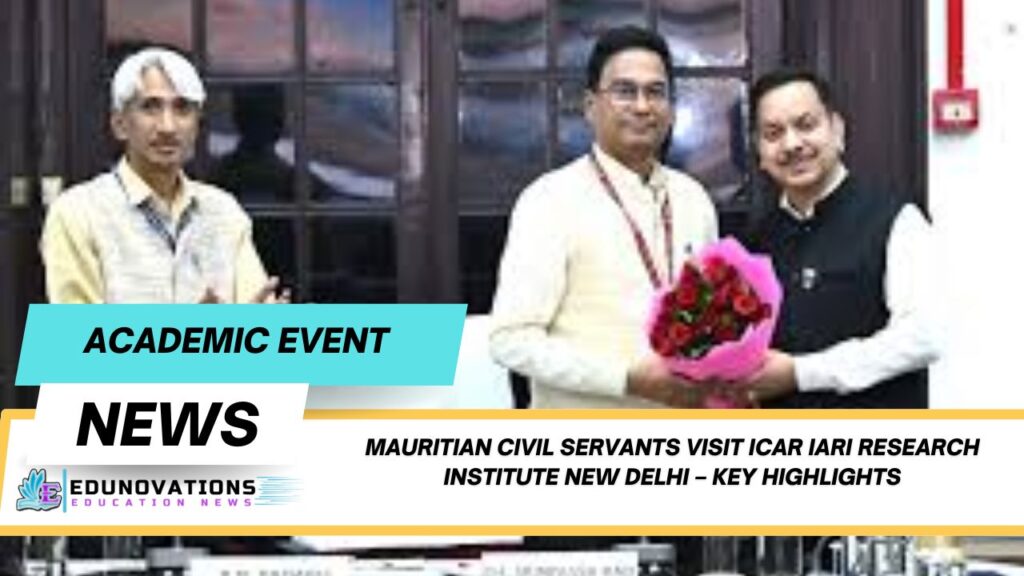
Explore the Mauritian civil servants visit to ICAR IARI research institute New Delhi, focusing on agricultural research, capacity building, and India-Mauritius cooperation.
The Mauritian civil servants visit ICAR IARI research institute New Delhi marked a significant milestone in international agricultural cooperation. The delegation, comprising senior officials from Mauritius, arrived at the Indian Council of Agricultural Research–Indian Agricultural Research Institute (ICAR‑IARI) to explore modern farming techniques, research innovations, and capacity-building initiatives. This visit underscored India’s commitment to strengthening bilateral collaboration in agriculture and knowledge sharing with Mauritius.
Overview of the Visit
The delegation, led by senior civil servants from Mauritius, was welcomed at the IARI campus in New Delhi. The programme included:
- A comprehensive tour of research facilities, including laboratories, greenhouses, and experimental farms.
- Detailed presentations on precision farming, climate-resilient crops, and sustainable agricultural practices.
- Interactive sessions with IARI scientists, providing insights into cutting-edge research methodologies.
The initiative aimed to promote capacity building for Mauritian agriculture officials, ensuring that best practices in crop management, pest control, and soil health could be implemented back home. This initiative forms part of a broader strategy to strengthen agricultural ties between India and Mauritius, promoting sustainable development and technology transfer.
Focus on Agricultural Research Facilities
During the visit, the Mauritian delegation observed a wide array of research initiatives at IARI, including:
- Precision Farming Technologies
Delegates explored advanced irrigation systems, soil sensors, and crop-monitoring tools. These innovations help optimise water usage and improve crop productivity, addressing challenges posed by climate variability. - Climate-Resilient Crop Programmes
Scientists highlighted their work on developing crop varieties that are resistant to drought, heat, and pest attacks. Such research is pivotal for countries like Mauritius, which face climatic uncertainties impacting agriculture. - Integrated Pest Management (IPM)
IARI researchers demonstrated sustainable pest management techniques, reducing dependency on chemical pesticides and promoting environmentally friendly practices. - Soil Fertility and Nutrient Management
The delegation examined soil testing laboratories and nutrient management strategies to enhance productivity while preserving soil health.
Capacity Building Programmes
The visit emphasised capacity building for Mauritian agriculture officials in India. Structured workshops and knowledge-sharing sessions enabled the delegates to:
- Understand modern agronomic practices applicable to tropical climates.
- Gain hands-on experience in crop monitoring and laboratory diagnostics.
- Develop strategies for policy-making and agricultural planning based on scientific research outcomes.
Experts from IARI highlighted the importance of continuous learning and international collaboration, ensuring that Mauritius could implement modern practices effectively.
Bilateral Cooperation in Agriculture
The Mauritian civil servants’ engagement with IARI represents a key step in enhancing agricultural research cooperation between India and Mauritius. The visit strengthens diplomatic ties while promoting the exchange of technical knowledge. Both countries have committed to:
- Collaborative research projects focusing on food security and crop diversification.
- Training programmes for civil servants and agricultural officers in both nations.
- Joint initiatives in climate-resilient farming and sustainable agriculture.
Dr. Ramesh Chand, Member of NITI Aayog (Agriculture and Food Processing), remarked on the significance of such exchanges, stating:
“International knowledge-sharing is vital for addressing agricultural challenges. Visits like this enhance practical learning and bilateral cooperation.”
Expert Insights and Impact
Analysts emphasise that international delegations visiting research institutes like ICAR‑IARI bring substantial benefits:
- Exposure to cutting-edge agricultural research accelerates the adoption of innovative practices in delegates’ home countries.
- Collaborative learning leads to policy recommendations aligned with sustainable development goals.
- Enhances scientific diplomacy, positioning India as a hub for agricultural expertise in the region.
Statistics reveal that countries adopting IARI-developed techniques in tropical farming have observed a 10–15% increase in crop productivity within two years of implementation. Mauritius, with its diverse agricultural sector, stands to gain significantly from these insights.
Programme Highlights
Key highlights of the visit included:
- Guided tours of state-of-the-art laboratories and greenhouses.
- Presentations on modern crop breeding techniques and climate-adaptive crops.
- Workshops on digital agriculture tools for monitoring and decision-making.
- Discussions on policy frameworks to integrate research findings into practical farming solutions.
The programme concluded with an open forum, enabling delegates to clarify doubts, discuss regional agricultural challenges, and explore collaborative research opportunities.
Internal Learning and Knowledge Transfer
The visit serves as a model for knowledge transfer and capacity building. By engaging with India’s premier agricultural scientists, Mauritian officials can replicate sustainable practices in their local contexts. IARI emphasised:
- Sharing research methodologies for tropical crops.
- Developing training modules for Mauritius agricultural officers.
- Establishing long-term collaborative networks for scientific exchange.
These strategies ensure a lasting impact beyond the duration of the visit.
Future Prospects
The outcomes of the Mauritian civil servants visit ICAR IARI research institute New Delhi are expected to influence future agricultural policies and joint projects. Proposed initiatives include:
- Joint research on climate-smart agriculture.
- Exchange programmes for young scientists and officers.
- Collaborative development of digital tools for farm management.
- Workshops on sustainable soil and water management practices.
Such initiatives strengthen ties between India and Mauritius while promoting regional agricultural resilience.
Integration of Technology and Innovation
Technology played a central role during the visit. Delegates were introduced to:
- Remote sensing and GIS applications for crop monitoring.
- Digital decision-support tools for irrigation and fertilisation.
- Mobile applications facilitating real-time agricultural advisory services.
These technologies demonstrate how modern research institutes like IARI bridge scientific knowledge and practical farming solutions.
Conclusion
The Mauritian civil servants visit ICAR IARI research institute New Delhi exemplifies the power of international cooperation in agriculture. By leveraging India’s research expertise, Mauritius can enhance its agricultural productivity, implement climate-resilient practices, and foster sustainable development. Such engagements not only strengthen bilateral relations but also promote global knowledge sharing, positioning India as a centre of excellence in agricultural research.
For related educational content, explore NCERT courses, current affairs, notes, MCQs, videos, syllabus, free NCERT PDFs, and NCERT mind maps. For authoritative school resources, visit Mart Ind Infotech.
Toppers Use Mind Maps to score more than 95%
-
NCERT Class 11th Commerce Mind Maps
Add to cartOriginal price was: ₹999.00.₹199.00Current price is: ₹199.00. -
NCERT Class 12th Chemistry Mind Maps
Add to cartOriginal price was: ₹199.00.₹75.00Current price is: ₹75.00. -
NCERT Class 12th Commerce Mind Maps
Add to cartOriginal price was: ₹999.00.₹199.00Current price is: ₹199.00. -
NCERT Class 12th Science Mind Maps
Add to cartOriginal price was: ₹999.00.₹199.00Current price is: ₹199.00. -
NCERT Mind Maps For Class 10th
Add to cartOriginal price was: ₹999.00.₹199.00Current price is: ₹199.00.





Purchase Today
FAQs
- What was the main purpose of the Mauritian civil servants visit ICAR IARI research institute New Delhi?
The visit focused on agricultural research, capacity building, and bilateral cooperation between India and Mauritius. - Which agricultural research facilities did the Mauritian delegation explore at IARI?
Delegates toured laboratories, greenhouses, experimental farms, and precision farming facilities. - How does the visit support capacity building for Mauritian agriculture officials in India?
Through workshops, hands-on training, and interactive sessions with IARI scientists on modern agricultural practices. - What technologies were highlighted during the Mauritian civil servants visit ICAR IARI research institute New Delhi?
Remote sensing, GIS applications, digital farm management tools, and mobile advisory applications. - What is the significance of India-Mauritius agricultural research cooperation?
It promotes knowledge transfer, climate-resilient farming, and joint research projects in sustainable agriculture. - Which crop management techniques were discussed with the Mauritian delegation?
Precision farming, integrated pest management, soil nutrient management, and climate-resilient crop varieties. - How can Mauritius benefit from ICAR IARI research innovations?
By implementing advanced farming techniques, improving crop productivity, and adopting sustainable practices. - Who provided expert insights during the visit?
IARI scientists and Dr. Ramesh Chand from NITI Aayog shared insights on sustainable agriculture and policy-making. - What were the key highlights of the Mauritian civil servants visit ICAR IARI research institute New Delhi?
Laboratory tours, crop research demonstrations, climate-resilient agriculture workshops, and interactive discussions. - How will future collaboration between India and Mauritius in agriculture be enhanced?
Through joint research, exchange programmes, digital farm management tools, and training workshops.