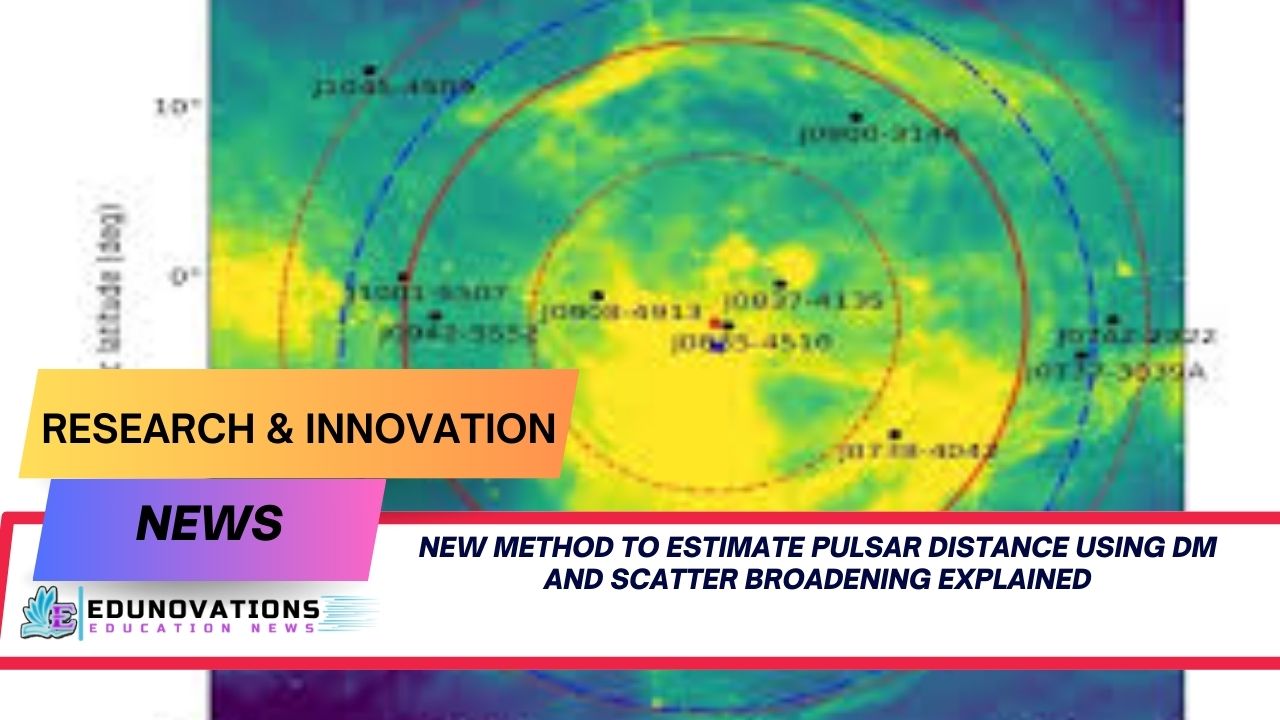
Discover how the new method to estimate pulsar distance using DM and scatter broadening is transforming pulsar astronomy, improving accuracy beyond parallax and neutral hydrogen techniques.
In a remarkable scientific advancement, researchers at the prestigious Indian Institute of Technology Kanpur (IIT Kanpur) have unveiled a groundbreaking technique that could significantly refine how astronomers calculate cosmic distances. The new method to estimate pulsar distance using DM and scatter broadening promises to address long-standing uncertainties in pulsar measurements and strengthen our understanding of the Milky Way’s structure.
Developed in collaboration with experts from the National Centre for Radio Astrophysics (NCRA), this research offers a robust alternative to traditional measurement approaches such as parallax and neutral hydrogen absorption. Scientists believe that this breakthrough could open fresh pathways in pulsar astronomy, interstellar medium studies, and gravitational wave research.
Understanding Pulsars and Why Distance Matters
Pulsars are rapidly rotating neutron stars that emit beams of electromagnetic radiation. First discovered in 1967, these celestial objects function like cosmic lighthouses. When their radiation beams sweep past Earth, astronomers detect periodic pulses.
However, accurately determining how far these pulsars are from Earth has always been a challenge. Traditional approaches include:
- Parallax measurement
- Neutral hydrogen absorption
- Model-based dispersion measure estimates
Each method has limitations, especially when dealing with distant pulsars buried deep within the interstellar medium.
This is where the new method to estimate pulsar distance using DM and scatter broadening makes a transformative difference.
The Science Behind the Breakthrough
The new method to estimate pulsar distance using DM and scatter broadening combines two key astrophysical parameters:
- Dispersion Measure (DM) – The integrated column density of free electrons between Earth and the pulsar.
- Scatter Broadening – The temporal spreading of pulsar signals due to irregularities in the interstellar medium.
By correlating these two phenomena, researchers have created a more accurate and independent way to determine distances without relying heavily on geometric parallax.
Why Is This Important?
- It reduces dependence on uncertain galactic electron density models.
- It improves measurement accuracy for distant pulsars.
- It enhances mapping of the Milky Way’s spiral arms.
Astrophysicists explain that dispersion measure reflects how much radio waves slow down while traveling through ionized space. Scatter broadening, on the other hand, shows how turbulent plasma affects signal clarity. The synergy between these two effects is the cornerstone of the new method to estimate pulsar distance using DM and scatter broadening.
Moving Beyond Traditional Techniques
Historically, astronomers have used parallax — observing slight positional shifts — to determine stellar distances. While reliable for nearby objects, parallax becomes ineffective for extremely distant pulsars.
Similarly, neutral hydrogen absorption techniques rely on detecting absorption lines from hydrogen clouds, but these measurements can be model-dependent and imprecise.
The new method to estimate pulsar distance using DM and scatter broadening bypasses these limitations by leveraging radio wave propagation physics instead of purely geometric estimation.
This advancement also supports the broader field of pulsar distance estimation technique for interstellar medium radio signals, providing fresh data for astrophysical modeling.
IIT Kanpur’s Role in Stellar Research
The Indian Institute of Technology Kanpur has consistently contributed to cutting-edge space research. This latest innovation reinforces the institute’s growing reputation in astrophysics and radio astronomy.
Experts at IIT Kanpur emphasized that the new method to estimate pulsar distance using DM and scatter broadening has undergone rigorous statistical validation. Early simulations demonstrate improved consistency compared to conventional dispersion-only estimates.
Collaborators from the National Centre for Radio Astrophysics added that the method is particularly effective for pulsars where parallax data is unavailable.
Global Relevance of This Discovery
International astrophysicists have welcomed the new method to estimate pulsar distance using DM and scatter broadening as a step forward in understanding galactic structure.
Accurate pulsar distances are crucial for:
- Testing theories of gravity
- Improving gravitational wave detection sensitivity
- Studying neutron star evolution
- Refining interstellar medium density models
The technique also strengthens the broader framework of pulsar distance estimation technique for interstellar medium radio signals, providing more reliable inputs for galactic cartography.
Educational and Competitive Exam Relevance
For students preparing for astronomy, physics, or competitive exams, understanding the new method to estimate pulsar distance using DM and scatter broadening is vital.
You can enhance your preparation through:
- 📘 NCERT Courses: https://courses.edunovations.com/
- 📰 Current Affairs Updates: https://edunovations.com/currentaffairs/
- 📝 Physics Notes: https://edunovations.com/notes/
- ❓ Practice MCQs: https://edunovations.com/mcq/
- 🎥 Educational Videos: https://edunovations.com/videos/
- 📚 Syllabus Guides: https://edunovations.com/syllabus/
- 📥 Free NCERT PDFs: https://courses.edunovations.com/shop-2/
- 🧠 NCERT Mind Maps: https://courses.edunovations.com/shop-2/
Schools looking to upgrade digital learning infrastructure may connect with Mart Ind Infotech for innovative solutions.
Expert Insights
Astrophysicists note that this advancement may redefine how scientists measure cosmic distances beyond parallax and neutral hydrogen methods.
One senior radio astronomer commented that the new method to estimate pulsar distance using DM and scatter broadening enhances confidence in pulsar timing arrays, which are critical for gravitational wave astronomy.
Globally, pulsar timing arrays contribute to the search for low-frequency gravitational waves. More accurate distance measurements improve timing precision and error margins.
Broader Impact on Astronomy
The implications of the new method to estimate pulsar distance using DM and scatter broadening extend beyond pulsar science:
- Better calibration of galactic electron density models
- Improved mapping of spiral arms
- Refined neutron star population estimates
- Enhanced understanding of cosmic plasma turbulence
Moreover, researchers suggest that this breakthrough complements existing frameworks in dispersion measure based pulsar distance calculation explained simply models, but with higher reliability.
Challenges and Future Research
While promising, the new method to estimate pulsar distance using DM and scatter broadening requires further observational validation across diverse galactic environments.
Future directions include:
- Applying the method to newly discovered pulsars
- Integrating results with international radio telescope arrays
- Cross-validating with parallax measurements
As astronomical instruments become more sensitive, the method’s precision will likely improve further.
Why This Matters for India’s Scientific Landscape
India’s growing prominence in space research receives a boost through innovations like the new method to estimate pulsar distance using DM and scatter broadening.
It highlights the collaborative excellence between IIT Kanpur and NCRA and reinforces India’s role in global astrophysical research.
Such achievements inspire young researchers and align with national scientific advancement goals.
Toppers Use Mind Maps to score more than 95%
NCERT Class 11th Commerce Mind Maps
Add to cartOriginal price was: ₹999.00.₹199.00Current price is: ₹199.00.NCERT Class 12th Chemistry Mind Maps
Add to cartOriginal price was: ₹199.00.₹75.00Current price is: ₹75.00.NCERT Class 12th Commerce Mind Maps
Add to cartOriginal price was: ₹999.00.₹199.00Current price is: ₹199.00.NCERT Class 12th Science Mind Maps
Add to cartOriginal price was: ₹999.00.₹199.00Current price is: ₹199.00.NCERT Mind Maps For Class 10th
Add to cartOriginal price was: ₹999.00.₹199.00Current price is: ₹199.00.





Purchase Today
Frequently Asked Questions (FAQs)
1. What is the new method to estimate pulsar distance using DM and scatter broadening?
It is a technique developed by IIT Kanpur researchers that combines dispersion measure and scatter broadening to calculate pulsar distances more accurately.
2. How is this different from parallax measurement?
Unlike parallax, this method does not rely on geometric positional shifts but instead uses radio wave propagation effects.
3. Why is pulsar distance estimation important?
It helps map the Milky Way, study neutron stars, and improve gravitational wave detection.
4. What role does dispersion measure play?
Dispersion measure quantifies the total free electrons between Earth and a pulsar.
5. What is scatter broadening?
Scatter broadening refers to the time delay in pulsar signals caused by irregularities in interstellar plasma.
6. Can this method replace traditional techniques?
It complements and improves upon traditional methods, especially for distant pulsars.
7. What institutions developed this breakthrough?
The Indian Institute of Technology Kanpur and the National Centre for Radio Astrophysics collaborated on the research.
8. How does this relate to pulsar distance estimation technique for interstellar medium radio signals?
It enhances the reliability of such estimation techniques by combining two measurable radio effects.
9. Is this useful for gravitational wave studies?
Yes, improved distance accuracy strengthens pulsar timing arrays used in gravitational wave research.
10. Where can students learn more about this topic?
Students can explore NCERT-based courses, current affairs, and physics notes through educational platforms mentioned above.