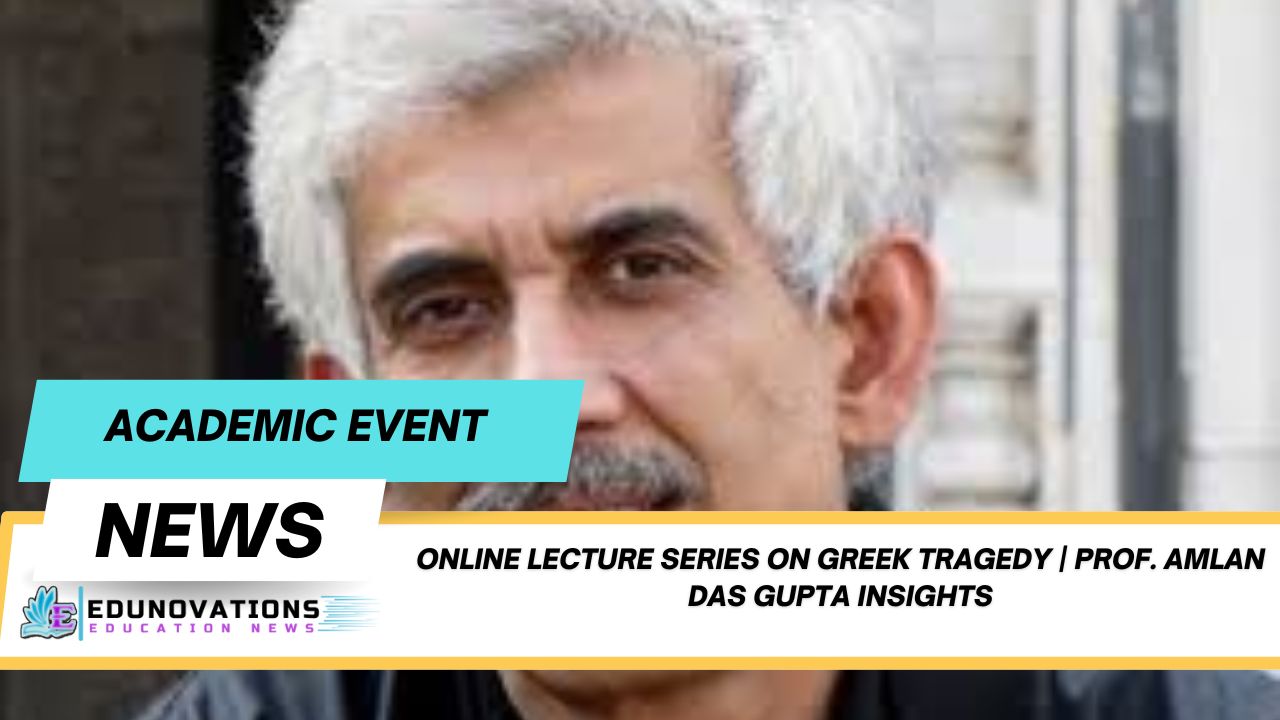
Join the Online Lecture Series on Greek Tragedy series with Prof. Amlan Das Gupta, exploring Antigone, Medea, and Aristotle’s Poetics. Delve into actions, disruptions, and consequences in classical drama.
The National Law School community is set to witness an intellectually stimulating Greek tragedy lecture series with Prof. Amlan Das Gupta, a renowned scholar of Classical Studies and English Renaissance literature. Titled “Sites of Disruption: Actions and Consequences in Greek Tragedy,” this exclusive online lecture series will provide participants with a deep understanding of Greek tragedy, focusing on key texts like Sophocles’ Antigone, Euripides’ Medea, and Aristotle’s Poetics.
Scheduled to take place on Saturdays – December 6, 13, 20, and 27, 2025, from 4:00 to 5:30 PM, the series promises to combine critical scholarship with engaging discussion for members of the NLS community.
Participants can register their interest via a dedicated Google Form, and registered attendees will receive lecture links and updates closer to the event.
About Prof. Amlan Das Gupta
Prof. Amlan Das Gupta is a retired Professor of English from Jadavpur University, where he taught for over two decades. He is celebrated for his contributions to Classical and Biblical Studies, Renaissance literature, and Miltonic scholarship. His expertise spans Greek tragedy, humanist traditions, and early modern intellectual history, making him one of the leading voices in classical studies in India.
During his tenure, Prof. Das Gupta played a pivotal role in advancing digital humanities and textual scholarship initiatives. He also founded the Archive of North Indian Classical Music and led the School of Cultural Texts and Records for nearly a decade, emphasizing the intersections of textual, aural, and digital scholarship.
His research and publications include extensive studies on Milton, Renaissance poetics, and Greek tragedy. This background makes him exceptionally qualified to lead a lecture series on the sites of disruption, actions, and consequences in Greek tragedy.
Lecture Schedule and Focus Areas
The online lecture series has been thoughtfully structured over four Saturdays, allowing participants to explore classical texts in depth. Each session will cover the following:
Session 1 – December 6, 2025
Text Focus: Sophocles’ Antigone
- Analysis of familial and civic disruption in the play
- Exploration of ethical dilemmas and moral consequences
- Examination of kinship, life, and death themes, referencing Judith Butler’s Antigone’s Claim
Session 2 – December 13, 2025
Text Focus: Euripides’ Medea
- Understanding irrationalist motives and emotional disruptions in Greek tragedy (E.R. Dodds’ studies)
- Study of revenge, passion, and ethical conflict
- Critical insights from contemporary scholarship on Euripides
Session 3 – December 20, 2025
Text Focus: Aristotle’s Poetics (Chapters 1–15)
- Analysis of literary criticism and structural frameworks of tragedy
- Exploration of catharsis, hamartia, and narrative consequences
- Discussion on philosophical dimensions of actions and disruption
Session 4 – December 27, 2025
Discussion Session: Comparative insights and applications
- Connections between the studied texts and contemporary thought
- Ethical and philosophical dimensions of Greek tragedy
- Integration of scholarly perspectives from Martha Nussbaum, Bruno Snell, and J-P Vernant
Recommended Reading List
To enhance comprehension, participants are encouraged to refer to the following texts:
Primary Texts:
- Sophocles, Antigone (translations by Richard Jebb, Richmond Lattimore, David Grene, Robert Fagles)
- Euripides, Medea (translations by Philip Vellacott, Lattimore and Grene)
- Aristotle, The Poetics, Ancient Literary Criticism, ed. D.A. Russell and M. Winterbottom
Secondary/Discussion Texts:
- Martha Nussbaum, The Fragility of Goodness: Luck and Ethics in Greek Tragedy, Cambridge University Press
- E.R. Dodds, Euripides the Irrationalist, The Classical Review
- The Cambridge Companion to Greek Tragedy, Edited by P. E. Easterling
- Bruno Snell, The Discovery of the Mind: The Greek Origins of European Thought
- J-P Vernant, The Origins of Greek Thought
- Judith Butler, Antigone’s Claim: Kinship Between Life and Death
These resources allow participants to explore not only the philosophy and literature of Greek tragedy but also the underlying ethical dilemmas, disruptions, and consequences that define classical drama.
Why Greek Tragedy Matters Today
Greek tragedy continues to resonate because it addresses timeless human concerns: ethical responsibility, moral conflict, family loyalty, and societal disruption. The Greek tragedy lecture series offers insights into how these ancient narratives reflect contemporary challenges in politics, law, and human relationships.
For students and scholars, attending this lecture series provides:
- In-depth analysis of classical texts with expert guidance
- Critical perspectives on ethics, disruption, and consequences
- Opportunities to engage with original scholarship and modern interpretations
This lecture series also bridges the gap between classical studies and modern humanities, fostering critical thinking skills that are relevant across disciplines.
Expert Insights
Prof. Das Gupta emphasizes that Greek tragedy is not merely a study of ancient texts but a window into human psychology and societal structure. According to him:
“Understanding the disruption and consequences in Greek tragedy allows us to interrogate the choices and moral dilemmas we face in contemporary life. These plays are not relics; they are mirrors reflecting human nature.”
His approach integrates textual scholarship with philosophical inquiry, ensuring participants gain both literary and analytical insights.
How to Participate
- Eligibility: Open to the NLS community
- Mode: Online lectures
- Registration: Fill in the Google Form to receive updates and lecture links
Attendees will also have the chance to participate in discussion sessions and Q&A, making the series highly interactive.
For those looking to supplement their learning, internal resources such as NCERT Courses, Current Affairs, Notes, MCQs, Videos, Syllabus, NCERT PDFs, and Mind Maps are available for reference to enhance comprehension and academic performance. These resources can be accessed through Edunovations and its subpages.
Broader Relevance for Scholars and Students
Engaging with Greek tragedy provides:
- Historical and literary context to classical works
- Analytical tools to examine societal and ethical conflicts
- Interdisciplinary learning, connecting philosophy, literature, and ethics
The lecture series also emphasizes disruption in tragic drama, examining how characters’ actions trigger consequences that extend beyond the narrative, a concept that remains highly relevant in legal, political, and literary studies today.
External Collaboration and Academic Tools
The lecture series aligns with global academic discourse. For tools, online collaboration, and further scholarly engagement, institutions like Mart India Infotech offer resources for educational software, digital archives, and learning management systems for schools and higher education institutions.
Toppers Use Mind Maps to score more than 95%
NCERT Class 11th Commerce Mind Maps
Add to cartOriginal price was: ₹999.00.₹199.00Current price is: ₹199.00.NCERT Class 12th Chemistry Mind Maps
Add to cartOriginal price was: ₹199.00.₹75.00Current price is: ₹75.00.NCERT Class 12th Commerce Mind Maps
Add to cartOriginal price was: ₹999.00.₹199.00Current price is: ₹199.00.NCERT Class 12th Science Mind Maps
Add to cartOriginal price was: ₹999.00.₹199.00Current price is: ₹199.00.NCERT Mind Maps For Class 10th
Add to cartOriginal price was: ₹999.00.₹199.00Current price is: ₹199.00.



Purchase Today
FAQs
- What is the Greek tragedy lecture series by Prof. Amlan Das Gupta?
It is an online series exploring Greek tragedy, focusing on Sophocles’ Antigone, Euripides’ Medea, and Aristotle’s Poetics. - When will the lecture series take place?
The sessions are scheduled for Saturdays: December 6, 13, 20, and 27, 2025, from 4:00 to 5:30 PM. - Who can attend the Greek tragedy lecture series?
The lectures are open exclusively to the NLS community. - What topics are covered in the lectures?
The series covers sites of disruption, ethical dilemmas, consequences in tragic drama, and critical perspectives on Greek tragedy. - Which texts are included in the reading list?
Antigone, Medea, Aristotle’s Poetics, and scholarly discussions by Nussbaum, Dodds, Butler, Snell, and Vernant. - How can I register for the lecture series?
Registration is via a Google Form, which provides updates and online lecture links. - What is the significance of Greek tragedy today?
It explores moral dilemmas, human ethics, disruption, and consequences, offering insights relevant to modern society. - Are there additional learning resources?
Yes, internal resources include NCERT courses, current affairs, notes, MCQs, videos, syllabus, PDFs, and mind maps. - Can external academic tools be used to support the series?
Yes, platforms like Mart India Infotech provide educational software and learning tools to enhance classical studies. - Who is Prof. Amlan Das Gupta?
A distinguished scholar of Classical Studies, English Renaissance literature, and Miltonic thought, he has led digital humanities and archival initiatives.