
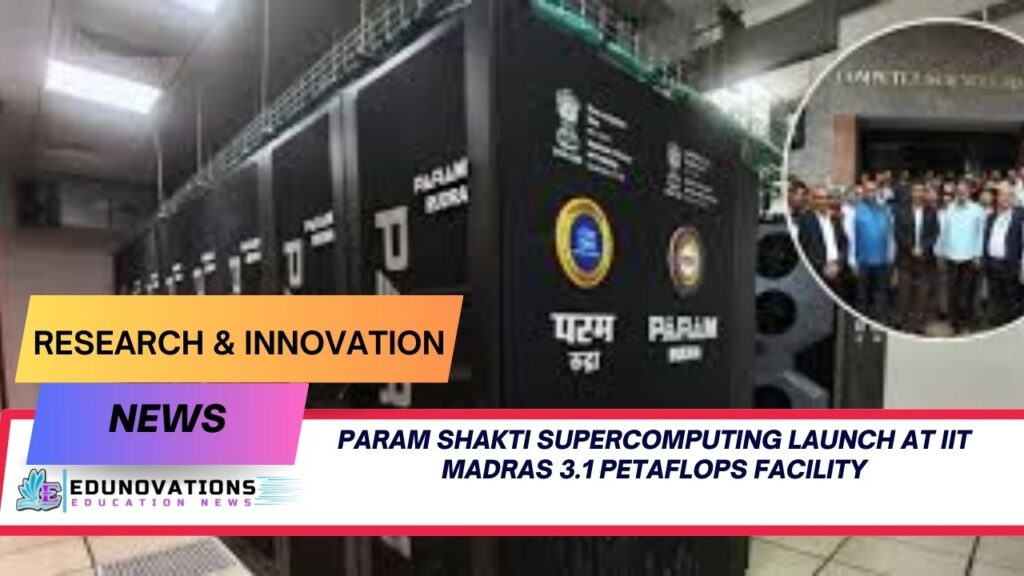
Discover how the Param Shakti supercomputing launch at IIT Madras 3.1 petaflops facility is transforming India’s high-performance computing ecosystem, advancing research, innovation, and national technological self-reliance.
Introduction: A Defining Leap in India’s Digital Infrastructure
India’s ambition to emerge as a global technology powerhouse received a monumental boost with the Param Shakti supercomputing launch at IIT Madras 3.1 petaflops facility. This landmark development marks a transformative chapter in the nation’s high-performance computing (HPC) journey, reinforcing its mission to achieve digital self-reliance and accelerate scientific breakthroughs across disciplines.
The newly inaugurated system stands among India’s most powerful academic supercomputing resources, designed to provide researchers, startups, and innovators with unprecedented computational strength. As global competition in artificial intelligence, climate modeling, aerospace engineering, and pharmaceutical research intensifies, such facilities are no longer optional — they are strategic necessities.
The inauguration ceremony was led by Shri S. Krishnan, Secretary of the Ministry of Electronics and Information Technology (MeitY), whose presence underscored the government’s commitment to strengthening India’s technological sovereignty. The event, hosted at the Indian Institute of Technology Madras, gathered leading scientists, academic heads, industry partners, and policymakers, all unified by a shared vision of empowering India’s research ecosystem.
At the heart of this milestone lies the Param Shakti supercomputing launch at IIT Madras 3.1 petaflops facility, developed under the National Supercomputing Mission (NSM), a flagship initiative of the Government of India. With its indigenous design and advanced processing capabilities, the facility is positioned to revolutionize research output, foster industry collaboration, and nurture next-generation scientific talent.
India’s Supercomputing Mission and the Road to Self-Reliance
India’s journey in high-performance computing has evolved rapidly over the past decade. The National Supercomputing Mission was introduced to establish a robust network of supercomputers across academic and research institutions. The objective is straightforward yet ambitious — enable world-class computational infrastructure within the country while reducing dependence on foreign technology.
The MeitY National Supercomputing Mission supercomputing infrastructure news has consistently highlighted India’s push to create a self-sustaining HPC ecosystem. Under this initiative, several PARAM series supercomputers have been installed nationwide, with each new deployment expanding computing accessibility for students, scientists, and startups.
The Param Shakti supercomputing launch at IIT Madras 3.1 petaflops facility represents one of the most advanced installations under this mission. Built with domestically developed technology, it reflects India’s growing capability to design, deploy, and maintain complex supercomputing architectures at global standards.
According to MeitY reports, India’s cumulative supercomputing capacity has grown from a few teraflops a decade ago to several petaflops today. This exponential rise signals not just infrastructure growth but also strategic foresight in nurturing scientific competitiveness.
A Technological Marvel at IIT Madras
The Indian Institute of Technology Madras has long been recognized as a center of engineering excellence. With the arrival of the new HPC system, the institute strengthens its role as a national innovation hub. The high performance computing facility at IIT Madras Param Shakti launch introduces a massive leap in processing speed, data handling, and energy efficiency.
The system delivers 3.1 petaflops of computing power — meaning it can perform over three quadrillion calculations per second. This capability opens new research frontiers in:
- Artificial Intelligence and Machine Learning
- Climate and weather prediction
- Aerospace and automotive design simulations
- Structural engineering and materials science
- Genomics and drug discovery
The Param Shakti supercomputing launch at IIT Madras 3.1 petaflops facility also integrates advanced cooling and power optimization features, ensuring sustainable operations despite intensive workloads. This energy-efficient design aligns with global efforts to make data centers greener and more cost-effective.
Experts from IIT Madras have emphasized that access to such computational strength will significantly reduce project timelines, enhance research accuracy, and enable Indian scientists to tackle problems that were previously computationally infeasible.
Shri S. Krishnan’s Vision for India’s Digital Future
The inauguration by Shri S. Krishnan, Secretary of MeitY, brought strong policy backing to the event. During his address, he highlighted how indigenous supercomputing infrastructure is central to India’s vision of becoming a knowledge-driven economy.
He emphasized that investments in advanced computing directly contribute to national security, scientific leadership, and economic resilience. His remarks reflected the government’s long-term strategy of ensuring that Indian researchers no longer depend on overseas computational facilities.
The presence of Shri S. Krishnan also reinforced the importance of inter-ministerial collaboration in developing large-scale digital infrastructure. Under his leadership, MeitY has accelerated programs supporting semiconductor research, AI development, and high-performance computing — making the Param Shakti supercomputing launch at IIT Madras 3.1 petaflops facility a symbolic yet practical achievement in India’s digital transformation roadmap.
Indigenous Innovation Behind PARAM Systems
A defining highlight of this achievement lies in the Indigenous PARAM RUDRA supercomputer research applications in India. PARAM systems, developed by India’s Centre for Development of Advanced Computing (C-DAC), are designed to meet global benchmarks while remaining cost-effective and locally supported.
The PARAM Shakti system builds upon the RUDRA architecture, optimized for research-intensive tasks. This indigenous development ensures:
- Reduced dependency on foreign hardware
- Enhanced cybersecurity through domestic control
- Easier customization for Indian research needs
- Long-term sustainability of maintenance and upgrades
The Param Shakti supercomputing launch at IIT Madras 3.1 petaflops facility thus serves as proof of India’s maturity in designing complex digital infrastructure. It also sets a precedent for future installations across universities, research labs, and strategic institutions.
Transforming Research Across Critical Sectors
One of the greatest promises of the new HPC system is its multi-disciplinary impact. The Param Shakti supercomputer boost for aerospace climate and drug research is expected to accelerate breakthroughs in some of the most computationally demanding fields.
Aerospace Engineering
High-resolution aerodynamic simulations require massive computing power. The new facility allows Indian aerospace researchers to design and test aircraft models digitally, reducing dependency on expensive physical prototypes.
Climate Modeling
Accurate climate prediction is vital for disaster management and agricultural planning. With the Param Shakti supercomputing launch at IIT Madras 3.1 petaflops facility, scientists can run long-term, high-precision simulations to better understand monsoon behavior and extreme weather patterns.
Pharmaceutical Research
Drug discovery involves analyzing millions of molecular combinations. Supercomputing power dramatically speeds up this process, enabling faster identification of potential compounds — a crucial advantage in healthcare innovation.
Artificial Intelligence
Training large AI models requires enormous data processing capabilities. The facility equips Indian AI researchers to develop competitive models locally, supporting national initiatives in automation, smart cities, and digital governance.
The MeitY National Supercomputing Mission supercomputing infrastructure news regularly highlights how such facilities are becoming central to India’s scientific competitiveness in the global arena.
Empowering Students and Startups
Beyond research institutions, the impact extends to India’s innovation ecosystem. Students, doctoral scholars, and startups affiliated with IIT Madras will gain access to world-class computing resources, lowering entry barriers to advanced research.
This democratization of HPC access nurtures:
- Early exposure to large-scale computing environments
- Faster prototyping for tech startups
- Collaboration between academia and industry
- Development of skilled HPC professionals
The Param Shakti supercomputing launch at IIT Madras 3.1 petaflops facility thus becomes not only a research enabler but also a talent incubator for the next generation of Indian technologists.
Global Positioning and Strategic Importance
Globally, supercomputing capability is increasingly linked to geopolitical strength. Nations with advanced HPC infrastructure dominate innovations in defense simulations, climate intelligence, and biomedical research.
By investing in indigenous systems, India signals its readiness to compete at the highest technological levels. The high performance computing facility at IIT Madras Param Shakti launch strengthens India’s position among emerging digital superpowers.
International collaborations are also expected to increase, as global research institutions seek partnerships with Indian universities equipped with advanced HPC infrastructure. This opens new opportunities for knowledge exchange, funding partnerships, and cross-border innovation.
Digital Infrastructure Meets Education Outreach
To ensure broader academic engagement, educational platforms are actively aligning learning resources with emerging technological advancements. Students preparing for science and technology careers can explore foundational concepts through NCERT Courses, while Current Affairs portals provide updates on national tech missions.
Those seeking deeper understanding can refer to Notes and MCQ learning sections, video explainers in the Videos section, structured exam guidance in the Syllabus resources, and concept visualizations through NCERT Mind Maps. These integrated educational pathways ensure that the knowledge generated through facilities like the Param Shakti supercomputing launch at IIT Madras 3.1 petaflops facility reaches learners across the country.
Industry Collaboration and Private Sector Engagement
The private technology sector stands to benefit significantly from India’s expanding HPC infrastructure. Startups specializing in AI, biotechnology, and computational engineering can partner with IIT Madras to access computing power previously unavailable within domestic budgets.
Additionally, technology solution providers supporting institutional digital infrastructure — such as Mart Ind Infotech — play a key role in bridging implementation and maintenance of large-scale IT environments for educational institutions. Such collaborations ensure seamless integration between hardware, software, and institutional research goals.
Expert Insights: Why This Matters Now
Technology analysts note that global investment in supercomputing exceeded $10 billion annually, with rapid growth expected over the next decade. India’s accelerated deployment of PARAM systems places it on a strategic growth trajectory.
Academic experts at IIT Madras have stated that the Param Shakti supercomputing launch at IIT Madras 3.1 petaflops facility will reduce research timeframes by nearly 60% for data-intensive projects. This efficiency gain translates directly into faster innovation cycles and improved global research competitiveness.
Meanwhile, policy observers credit MeitY’s leadership under Shri S. Krishnan for aligning infrastructure development with national digital priorities, ensuring consistent policy support for HPC expansion.
Future Roadmap of India’s HPC Expansion
The National Supercomputing Mission envisions a nationwide grid of interconnected supercomputers, enabling shared computational access among institutions. Future installations are expected to surpass current petaflop capacities, entering the exascale computing era.
With each milestone, India strengthens its preparedness for next-generation technological challenges — from quantum simulations to autonomous systems and space exploration.
The Param Shakti supercomputing launch at IIT Madras 3.1 petaflops facility thus becomes a stepping stone toward a larger national ambition: creating a resilient, innovation-driven, and technologically sovereign India.
Conclusion: A Catalyst for India’s Knowledge Economy
The launch of India’s latest supercomputing powerhouse at IIT Madras is more than a ceremonial achievement — it is a strategic leap forward in building an innovation-driven knowledge economy.
Backed by government vision, indigenous engineering, academic excellence, and industry collaboration, the Param Shakti supercomputing launch at IIT Madras 3.1 petaflops facility sets a new benchmark for research infrastructure in India.
As students, scientists, startups, and policymakers align their efforts around this digital asset, India moves closer to its goal of global leadership in science, technology, and innovation.
Toppers Use Mind Maps to score more than 95%
-
NCERT Class 11th Commerce Mind Maps
Add to cartOriginal price was: ₹999.00.₹199.00Current price is: ₹199.00. -
NCERT Class 12th Chemistry Mind Maps
Add to cartOriginal price was: ₹199.00.₹75.00Current price is: ₹75.00. -
NCERT Class 12th Commerce Mind Maps
Add to cartOriginal price was: ₹999.00.₹199.00Current price is: ₹199.00. -
NCERT Class 12th Science Mind Maps
Add to cartOriginal price was: ₹999.00.₹199.00Current price is: ₹199.00. -
NCERT Mind Maps For Class 10th
Add to cartOriginal price was: ₹999.00.₹199.00Current price is: ₹199.00.





Purchase Today
🔎 Frequently Asked Questions (FAQs)
1. What is the Param Shakti supercomputing launch at IIT Madras 3.1 petaflops facility?
It is the inauguration of a high-performance supercomputer at IIT Madras delivering 3.1 petaflops computing power under India’s National Supercomputing Mission.
2. Who inaugurated the Param Shakti supercomputing facility?
The facility was inaugurated by Shri S. Krishnan, Secretary of the Ministry of Electronics and Information Technology (MeitY).
3. What is the purpose of the high performance computing facility at IIT Madras Param Shakti launch?
It aims to provide advanced computing infrastructure for academic research, innovation, and industry collaboration.
4. How does the MeitY National Supercomputing Mission supercomputing infrastructure news impact India?
It reflects India’s commitment to building indigenous computing capacity and reducing dependence on foreign technology.
5. What are Indigenous PARAM RUDRA supercomputer research applications in India?
They include AI modeling, climate simulations, aerospace design, and pharmaceutical research.
6. How will the Param Shakti supercomputer boost aerospace climate and drug research?
By enabling faster, high-precision simulations and data processing required in these complex research fields.
7. Why is the Param Shakti supercomputing launch at IIT Madras important for students?
It provides access to world-class computing resources, enhancing education, innovation, and technical skill development.
8. How does India benefit globally from this supercomputing facility?
It strengthens India’s global research standing and attracts international academic and industrial partnerships.
9. Is the PARAM Shakti system developed indigenously?
Yes, it is built using Indian technology developed under the National Supercomputing Mission.
10. What future developments are expected after this supercomputing launch?
India plans further expansion of supercomputing networks and next-generation exascale systems nationwide.