
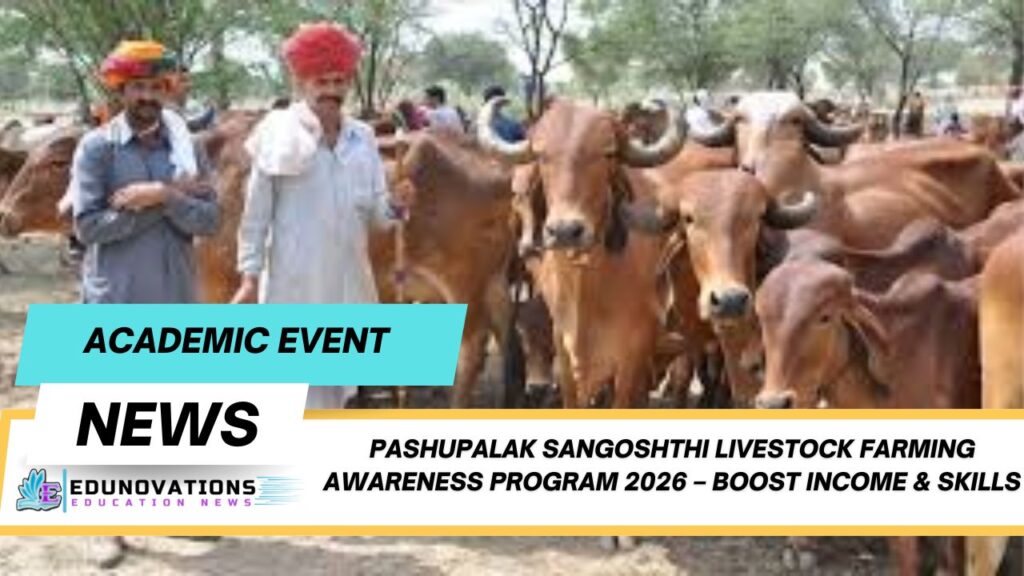
Discover how the Pashupalak Sangoshthi livestock farming awareness program 2026 empowers tribal farmers with scientific animal husbandry skills, vaccination tips, and income-enhancing strategies.
Introduction
The Pashupalak Sangoshthi livestock farming awareness program 2026 emerged as a landmark initiative to empower tribal and rural farmers in West Bengal. Organized by the Indian Veterinary Research Institute – Eastern Regional Station (IVRI-ERS), Kolkata, at the Kalyani Animal Farm on January 30, 2026, the program aimed to enhance farmers’ understanding of scientific animal farming, promote livestock vaccination schedules, and improve farm management practices. By connecting farmers directly with experts, this initiative sought to bridge the gap between traditional livestock practices and modern scientific approaches.
A Focus on Tribal Farmers and Women Participation
The event witnessed enthusiastic participation from 120 farmers, including 100 women and 20 men, representing villages such as Gayeshpur, Birsidhunagar, Pangashkhali, Gopalpur, Dumki, and Paranikheko. Among them, 107 farmers were from the scheduled tribe community, benefiting from the DAPST program organized by ERS-IVRI. This focus on tribal farmers ensured that knowledge transfer reached communities that traditionally lacked access to scientific animal husbandry training.
Women farmers actively shared their success stories, showcasing how the program helped them achieve higher productivity and income. Their engagement highlighted the transformative role of empowering women in animal farming awareness programs.
Key Highlights of the Program
The Pashupalak Sangoshthi livestock farming awareness program 2026 covered multiple aspects of livestock management, disease prevention, and income generation:
1. Scientific Animal Husbandry and Breeding
Dr. T. K. Biswas inaugurated the event, emphasizing the importance of linking farmers with scientific institutions. He provided simple techniques for proper breeding to produce high-quality livestock, ensuring improved yield and income.
2. Disease Management and Vaccination
Dr. Dayamoy Mondal refreshed farmers’ knowledge about common animal and poultry diseases, while Dr. B. Mondal detailed livestock vaccination schedules, underlining the economic and health benefits of regular vaccination.
3. Livestock Farm Management
Dr. S. Naskar offered insights on housing, feeding, sanitation, and daily management practices. He also presented various income-generating opportunities and schemes, enabling farmers to optimize their resources.
4. Reproductive Health and Record-Keeping
Dr. G. K. Das discussed reproductive issues, proper breeding timing, and the importance of accurate record-keeping, including animal sales and income tracking. He also raised awareness about the model medicine bank, ensuring veterinary access in remote areas.
5. Stress Management and Value Addition
Dr. S. Bag addressed animal stress and management strategies, while Dr. A. K. Das guided farmers on value-added products to maximize profits. Farmers were encouraged to sell livestock based on actual weight rather than estimations, improving economic outcomes.
Distribution of Essential Supplies
Each participant received a kit comprising:
- Mosquito net
- High-quality raincoat
- Feed and health supplements
- Anthelmintics
- Informative literature on scientific animal farming, disease management, and livestock vaccination schedules
This distribution reinforced practical learning and ensured that farmers could immediately apply the knowledge gained.
Outcomes and Expert Insights
Feedback from the Pashupalak Sangoshthi livestock farming awareness program 2026 highlighted the effectiveness of direct interaction with experts. Farmers reported:
- Improved knowledge of scientific animal farming techniques
- Better understanding of livestock vaccination schedules and disease prevention
- Adoption of best practices in livestock farm management
- Increased income and productivity from animal husbandry
Experts assert that combining training with input distribution and awareness campaigns leads to sustainable improvement in rural livelihoods. According to Dr. T. K. Biswas, “Empowering farmers with scientific knowledge and practical tools directly impacts their income and strengthens rural economies.”
Connecting Knowledge with Resources
To further support learning, farmers and readers can access a range of educational resources:
- NCERT Courses: Link
- Current Affairs: Link
- Notes & Study Material: Link
- MCQs: Link
- Videos: Link
- Syllabus Details: Link
- Free NCERT PDFs & Mind Maps: Link
External collaboration with authoritative educational and technical organizations, such as Mart India Infotech, ensures the credibility and reliability of shared resources.
Why This Program Matters
The Pashupalak Sangoshthi livestock farming awareness program 2026 is more than just a training event—it represents a strategic effort to modernize rural livelihoods through scientific animal husbandry practices. Key benefits include:
- Bridging the knowledge gap between scientists and farmers
- Promoting tribal farmers’ access to modern animal husbandry techniques
- Increasing productivity and sustainable income
- Encouraging adoption of vaccination schedules and farm hygiene practices
- Providing hands-on exposure to value-added products and market-oriented strategies
This initiative underscores the critical role of awareness programs in rural development and the potential of livestock farming as a sustainable livelihood source.
Conclusion
The 2026 Pashupalak Sangoshthi has successfully demonstrated how targeted training, expert guidance, and resource provision can empower rural and tribal farmers. By integrating scientific animal farming, vaccination awareness, and farm management best practices, this initiative has tangibly improved both knowledge and income. It serves as a model for similar programs nationwide, emphasizing that informed and well-supported farmers are the backbone of a resilient rural economy.
Toppers Use Mind Maps to score more than 95%
-
NCERT Class 11th Commerce Mind Maps
Add to cartOriginal price was: ₹999.00.₹199.00Current price is: ₹199.00. -
NCERT Class 12th Chemistry Mind Maps
Add to cartOriginal price was: ₹199.00.₹75.00Current price is: ₹75.00. -
NCERT Class 12th Commerce Mind Maps
Add to cartOriginal price was: ₹999.00.₹199.00Current price is: ₹199.00. -
NCERT Class 12th Science Mind Maps
Add to cartOriginal price was: ₹999.00.₹199.00Current price is: ₹199.00. -
NCERT Mind Maps For Class 10th
Add to cartOriginal price was: ₹999.00.₹199.00Current price is: ₹199.00.





Purchase Today
10 FAQs: Pashupalak Sangoshthi Livestock Farming Awareness Program 2026
- What is the Pashupalak Sangoshthi livestock farming awareness program 2026?
A training initiative to educate tribal farmers on scientific animal husbandry and income improvement. - Who organizes the Pashupalak Sangoshthi program?
The program is conducted by IVRI-ERS, Kolkata, focusing on rural livestock development. - What are the key benefits of attending this program?
Participants gain knowledge on livestock vaccination schedules, farm management, and income-enhancing techniques. - Which farmers benefit most from the program?
Primarily tribal farmers and women, providing tools and knowledge to improve animal husbandry practices. - Does the program provide practical resources?
Yes, including kits with feed supplements, anthelmintics, raincoats, mosquito nets, and informative literature. - How does the program improve livestock health?
By teaching vaccination schedules, disease management, and stress reduction methods. - Are income-generating techniques covered?
Yes, farmers learn value-added product strategies, direct sales methods, and proper record-keeping. - Can women farmers participate in Pashupalak Sangoshthi?
Absolutely, women farmers play a significant role, sharing success stories and applying scientific methods. - Where can I access additional learning resources?
Through NCERT courses, notes, MCQs, videos, syllabus, PDFs, and mind maps linked online. - Why is linking farmers with scientists important?
It ensures adoption of scientific animal farming techniques, increasing productivity and rural income sustainably.